Notes
Source: Board of Governors of the Federal Reserve System (US)
Release: FOMC Press Release
Units:
Frequency:
Notes:
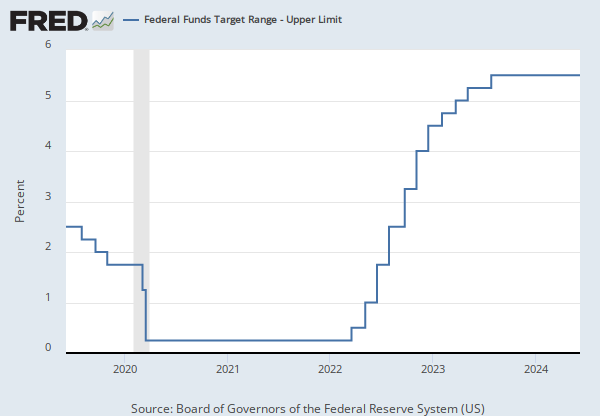
This series represents upper limit of the federal funds target range established by the Federal Open Market Committee. The data updated each day is the data effective as of that day.
Suggested Citation:
Board of Governors of the Federal Reserve System (US), Federal Funds Target Range - Upper Limit [DFEDTARU], retrieved from FRED, Federal Reserve Bank of St. Louis; https://fred.stlouisfed.org/series/DFEDTARU, .
Source: Federal Reserve Bank of New York
Release: Temporary Open Market Operations
Units:
Frequency:
Notes:
The rate set by the FOMC for Standing Repo (SRP) operations transactions reported by the New York Fed as part of the Temporary Open Market Operations.
Temporary open market operations involve short-term repurchase and reverse repurchase agreements that are designed to temporarily add or drain reserves available to the banking system and influence day-to-day trading in the federal funds market.
A repurchase agreement (known as repo) is a transaction in which the New York Fed under the authorization and direction of the Federal Open Market Committee buys a security to an eligible counterparty with an agreement to resell that same security at a specified price at a specific time in the future. For these transactions, eligible securities include U.S. Treasury securities, agency debt securities, and agency mortgage-backed securities.
See FAQs for more information.
Suggested Citation:
Federal Reserve Bank of New York, Standing Repo (SRP) Operations Rate [SRFTSYD], retrieved from FRED, Federal Reserve Bank of St. Louis; https://fred.stlouisfed.org/series/SRFTSYD, .
Source: Board of Governors of the Federal Reserve System (US)
Release: Interest Rate on Reserve Balances
Units:
Frequency:
Notes:
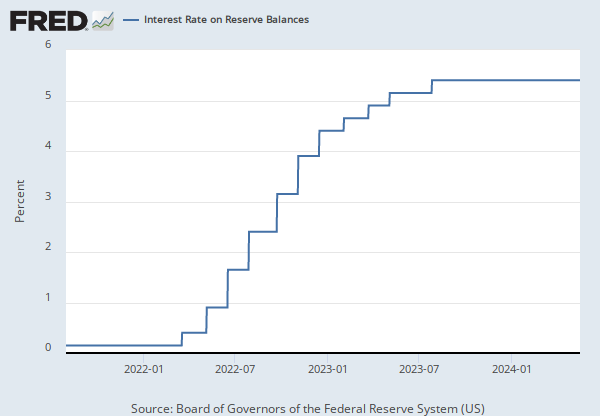
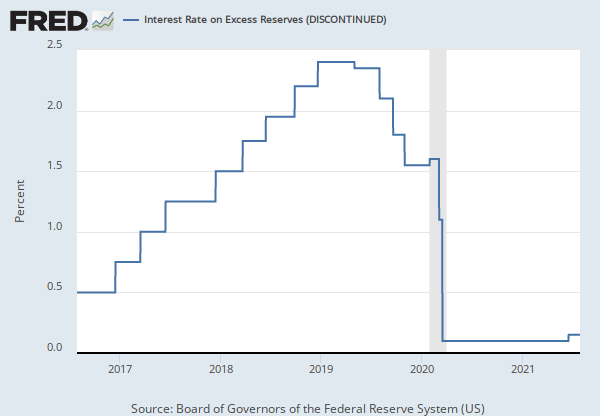
Starting July 29, 2021, the interest rate on excess reserves (IOER) and the interest rate on required reserves (IORR) were replaced with a single rate, the interest rate on reserve balances (IORB). See the source's announcement for more details.
The interest rate on reserve balances (IORB rate) is the rate of interest that the Federal Reserve pays on balances maintained by or on behalf of eligible institutions in master accounts at Federal Reserve Banks. The interest rate is set by the Board of Governors, and it is an important tool of monetary policy.
See Policy Tools and the IORB FAQs for more information.
For questions on FRED functionality, please contact us here.
Suggested Citation:
Board of Governors of the Federal Reserve System (US), Interest Rate on Reserve Balances (IORB Rate) [IORB], retrieved from FRED, Federal Reserve Bank of St. Louis; https://fred.stlouisfed.org/series/IORB, .
Source: Federal Reserve Bank of New York
Release: Secured Overnight Financing Rate Data
Units:
Frequency:
Suggested Citation:
Federal Reserve Bank of New York, Secured Overnight Financing Rate [SOFR], retrieved from FRED, Federal Reserve Bank of St. Louis; https://fred.stlouisfed.org/series/SOFR, .
Source: Board of Governors of the Federal Reserve System (US)
Release: H.15 Selected Interest Rates
Units:
Frequency:
Notes:
For additional historical federal funds rate data, please see Daily Federal Funds Rate from 1928-1954.
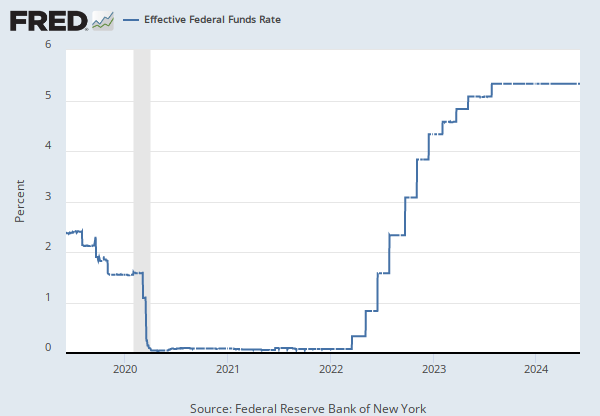
The federal funds rate is the interest rate at which depository institutions trade federal funds (balances held at Federal Reserve Banks) with each other overnight. When a depository institution has surplus balances in its reserve account, it lends to other banks in need of larger balances. In simpler terms, a bank with excess cash, which is often referred to as liquidity, will lend to another bank that needs to quickly raise liquidity. (1) The rate that the borrowing institution pays to the lending institution is determined between the two banks; the weighted average rate for all of these types of negotiations is called the effective federal funds rate.(2) The effective federal funds rate is essentially determined by the market but is influenced by the Federal Reserve as it uses the Interest on Reserve Balances rate to steer the federal funds rate toward the target range.(2)
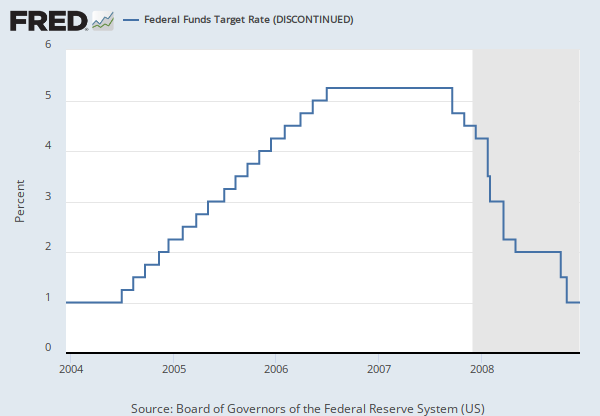
The Federal Open Market Committee (FOMC) meets eight times a year to determine the federal funds target range. The Fed's primary tool for influencing the federal funds rate is the interest the Fed pays on the funds that banks hold as reserve balances at their Federal Reserve Bank, which is the Interest on Reserves Balances (IORB) rate. Because banks are unlikely to lend funds in the federal funds market for less than they get paid in their reserve balance account at the Federal Reserve, the Interest on Reserve Balances (IORB) is an effective tool for guiding the federal funds rate. (3) Whether the Federal Reserve raises or lowers the target range for the federal funds rate depends on the state of the economy. If the FOMC believes the economy is growing too fast and inflation pressures are inconsistent with the dual mandate of the Federal Reserve, the Committee may temper economic activity by raising the target range for federal funds rate, and increasing the IORB rate to steer the federal funds rate into the target range. In the opposing scenario, the FOMC may spur greater economic activity by lowering the target range for federal funds rate, and decreasing the IORB rate to steer the federal funds rate into the target range. (3) Therefore, the FOMC must observe the current state of the economy to determine the best course of monetary policy that will maximize economic growth while adhering to the dual mandate set forth by Congress. In making its monetary policy decisions, the FOMC considers a wealth of economic data, such as: trends in prices and wages, employment, consumer spending and income, business investments, and foreign exchange markets.
The federal funds rate is the central interest rate in the U.S. financial market. It influences other interest rates such as the prime rate, which is the rate banks charge their customers with higher credit ratings. Additionally, the federal funds rate indirectly influences longer- term interest rates such as mortgages, loans, and savings, all of which are very important to consumer wealth and confidence.(2)
References
(1) Federal Reserve Bank of New York. "Federal funds." Fedpoints, August 2007.
(2) Monetary Policy, Board of Governors of the Federal Reserve System.
(3) The Fed Explained, Board of Governors of the Federal Reserve System
For further information, see The Fed's New Monetary Policy Tools, Page One Economics, Federal Reserve Bank of St. Louis.
For questions on the data, please contact the data source. For questions on FRED functionality, please contact us here.
Suggested Citation:
Board of Governors of the Federal Reserve System (US), Federal Funds Effective Rate [DFF], retrieved from FRED, Federal Reserve Bank of St. Louis; https://fred.stlouisfed.org/series/DFF, .
Source: Federal Reserve Bank of New York
Release: Tri-Party General Collateral Rate Data
Units:
Frequency:
Notes:
The tri-party general collateral rate (TGCR) is a measure of rates on overnight, specific-counterparty tri-party general collateral repurchase agreement (repo) transactions secured by Treasury securities. General collateral repo transactions are those for which the specific securities provided as collateral are not identified until after other terms of the trade are agreed.
The TGCR is reported by the New York Fed. It is calculated as a volume-weighted median of transaction-level tri-party repo data collected from the Bank of New York Mellon only. This rate excludes general collateral finance repo transactions and transactions to which the Federal Reserve is a counterparty.
For more information on the TGCR's methodology and publication schedule, see the Additional Information about Reference Rates Administered by the New York Fed.
Suggested Citation:
Federal Reserve Bank of New York, Tri-Party General Collateral Rate [TGCRRATE], retrieved from FRED, Federal Reserve Bank of St. Louis; https://fred.stlouisfed.org/series/TGCRRATE, .
Source: Federal Reserve Bank of New York
Release: Temporary Open Market Operations
Units:
Frequency:
Notes:
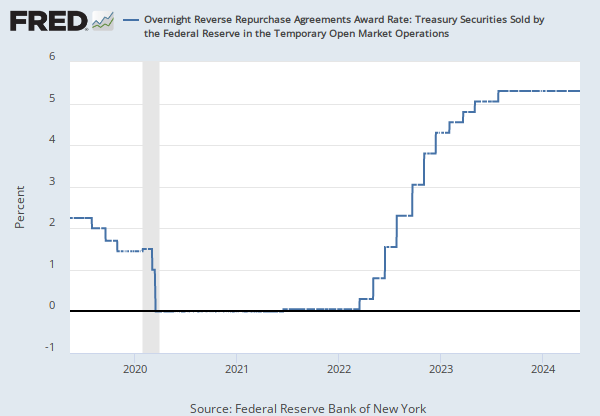
The award rate is the rate given to all accepted propositions for the collateral type reported by the New York Fed as part of the Temporary Open Market Operations.
Temporary open market operations involve short-term repurchase and reverse repurchase agreements that are designed to temporarily add or drain reserves available to the banking system and influence day-to-day trading in the federal funds market.
A reverse repurchase agreement (known as reverse repo or RRP) is a transaction in which the New York Fed under the authorization and direction of the Federal Open Market Committee sells a security to an eligible counterparty with an agreement to repurchase that same security at a specified price at a specific time in the future. For these transactions, eligible securities are U.S. Treasury instruments.
See FAQs for more information.
Suggested Citation:
Federal Reserve Bank of New York, Overnight Reverse Repurchase Agreements Award Rate [RRPONTSYAWARD], retrieved from FRED, Federal Reserve Bank of St. Louis; https://fred.stlouisfed.org/series/RRPONTSYAWARD, .
Source: Board of Governors of the Federal Reserve System (US)
Release: FOMC Press Release
Units:
Frequency:
Notes:
This series represents lower limit of the federal funds target range established by the Federal Open Market Committee. The data updated each day is the data effective as of that day.
Suggested Citation:
Board of Governors of the Federal Reserve System (US), Federal Funds Target Range - Lower Limit [DFEDTARL], retrieved from FRED, Federal Reserve Bank of St. Louis; https://fred.stlouisfed.org/series/DFEDTARL, .
Release Tables
H.15 Selected Interest Rates
Secured Overnight Financing Rate Data
Temporary Open Market Operations
Related Data and Content
Data Suggestions Based On Your Search

















Content Suggestions



Other Formats
Annual, Not Seasonally Adjusted
Biweekly, Not Seasonally Adjusted
Daily, Not Seasonally Adjusted
Monthly, Not Seasonally Adjusted
Weekly, Not Seasonally Adjusted
Related Categories
FRB Rates - discount, fed funds, primary credit
Interest Rates
Money, Banking, & Finance
Factors Affecting Reserve Balances
Monetary Data
Releases
More
Series from FOMC Press Release
More
Series from Temporary Open Market Operations
More
Series from Interest Rate on Reserve Balances
More
Series from Secured Overnight Financing Rate Data
More
Series from H.15 Selected Interest Rates
More
Series from Tri-Party General Collateral Rate Data
Tags
Federal Open Markets Committee
Federal
Interest Rate
Interest
Daily
Board of Governors
Rate
Nation
Public Domain: Citation Requested
United States of America
Not Seasonally Adjusted
Marketable
Repurchase Agreements
New York Fed
Trade
Securities
Copyrighted: Citation Required
Reserves
Financing
Overnight
H.15 Selected Interest Rates
Collateral
General
Percentile
Treasury
Reverse Repos
Sales