Notes
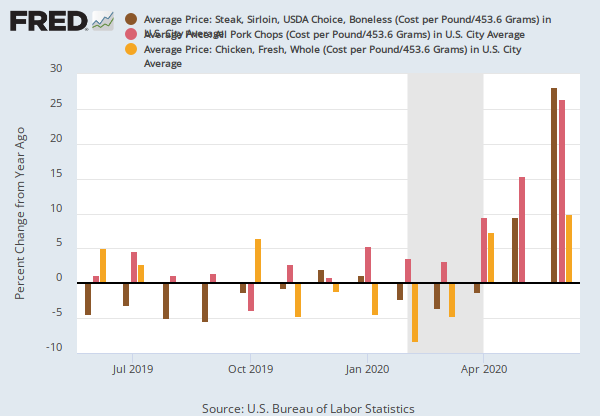
Source: U.S. Bureau of Labor Statistics
Release: Average Price Data
Units:
Frequency:
Notes:
Steaks other than round or sirloin, regardless of cut or grade. Includes bone-in, boneless, organic, non-organic, fresh, and frozen.
Average consumer prices are calculated for household fuel, motor fuel, and food items from prices collected for the Consumer Price Index (CPI). Average prices are best used to measure the price level in a particular month, not to measure price change over time. It is more appropriate to use CPI index values for the particular item categories to measure price change.
Prices, except for electricity, are collected monthly by BLS representatives in the 75 urban areas priced for the CPI. Electricity prices are collected for the BLS for the same 75 areas on a monthly basis by the Department of Energy using mail questionnaires. All fuel prices include applicable Federal, State, and local taxes; prices for natural gas and electricity also include fuel and purchased gas adjustments.
For more information, please visit the Bureau of Labor Statistics.
Suggested Citation:
U.S. Bureau of Labor Statistics, Average Price: All Uncooked Beef Steaks (Cost per Pound/453.6 Grams) in U.S. City Average [APU0000FC3101], retrieved from FRED, Federal Reserve Bank of St. Louis; https://fred.stlouisfed.org/series/APU0000FC3101, .
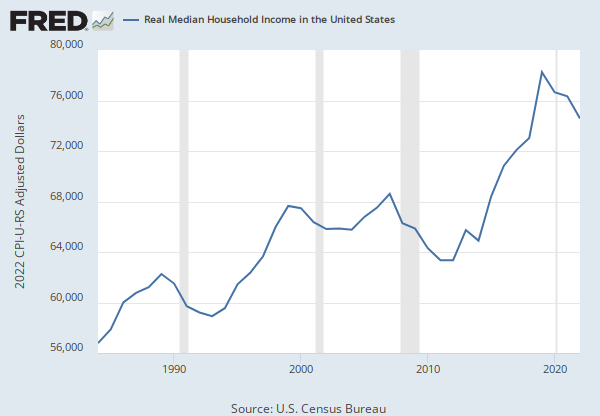
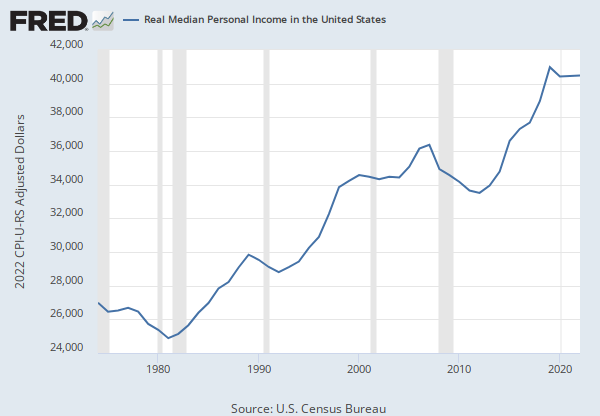
Source: U.S. Census Bureau
Release: Income and Poverty in the United States
Units:
Frequency:
Notes:
Household data are collected as of March.
As stated in the Census's "Source and Accuracy of Estimates for Income, Poverty, and Health Insurance Coverage in the United States: 2011" (http://www.census.gov/hhes/www/p60_243sa.pdf):
Estimation of Median Incomes. The Census Bureau has changed the methodology for computing median income over time. The Census Bureau has computed medians using either Pareto interpolation or linear interpolation. Currently, we are using linear interpolation to estimate all medians. Pareto interpolation assumes a decreasing density of population within an income interval, whereas linear interpolation assumes a constant density of population within an income interval. The Census Bureau calculated estimates of median income and associated standard errors for 1979 through 1987 using Pareto interpolation if the estimate was larger than $20,000 for people or $40,000 for families and households. This is because the width of the income interval containing the estimate is greater than $2,500.
We calculated estimates of median income and associated standard errors for 1976, 1977, and 1978 using Pareto interpolation if the estimate was larger than $12,000 for people or $18,000 for families and households. This is because the width of the income interval containing the estimate is greater than $1,000. All other estimates of median income and associated standard errors for 1976 through 2011 (2012 ASEC) and almost all of the estimates of median income and associated standard errors for 1975 and earlier were calculated using linear interpolation.
Thus, use caution when comparing median incomes above $12,000 for people or $18,000 for families and households for different years. Median incomes below those levels are more comparable from year to year since they have always been calculated using linear interpolation. For an indication of the comparability of medians calculated using Pareto interpolation with medians calculated using linear interpolation, see Series P-60, Number 114, Money Income in 1976 of Families and Persons in the United States (www2.census.gov/prod2/popscan/p60-114.pdf).
Suggested Citation:
U.S. Census Bureau, Median Household Income in the United States [MEHOINUSA646N], retrieved from FRED, Federal Reserve Bank of St. Louis; https://fred.stlouisfed.org/series/MEHOINUSA646N, .
Source: U.S. Bureau of Labor Statistics
Release: Average Price Data
Units:
Frequency:
Notes:
Bone-in, boneless, and semi-boneless pork chops, regardless of type, loin source, or processing state.
Average consumer prices are calculated for household fuel, motor fuel, and food items from prices collected for the Consumer Price Index (CPI). Average prices are best used to measure the price level in a particular month, not to measure price change over time. It is more appropriate to use CPI index values for the particular item categories to measure price change.
Prices, except for electricity, are collected monthly by BLS representatives in the 75 urban areas priced for the CPI. Electricity prices are collected for the BLS for the same 75 areas on a monthly basis by the Department of Energy using mail questionnaires. All fuel prices include applicable Federal, State, and local taxes; prices for natural gas and electricity also include fuel and purchased gas adjustments.
For more information, please visit the Bureau of Labor Statistics.
Suggested Citation:
U.S. Bureau of Labor Statistics, Average Price: All Pork Chops (Cost per Pound/453.6 Grams) in U.S. City Average [APU0000FD3101], retrieved from FRED, Federal Reserve Bank of St. Louis; https://fred.stlouisfed.org/series/APU0000FD3101, .
Release Tables
Average Price Data
Income and Poverty in the United States