Notes
Source: U.S. Bureau of Labor Statistics
Release: Employment Situation
Units:
Frequency:
Notes:
The series comes from the 'Current Population Survey (Household Survey)'
The source code is: LNS11300000
The Labor Force Participation Rate is defined by the Current Population Survey (CPS) as “the number of people in the labor force as a percentage of the civilian noninstitutional population […] the participation rate is the percentage of the population that is either working or actively looking for work.”
The Labor Force Participation Rate is collected in the CPS and published by the BLS. It is provided on a monthly basis, so this data is used in part by macroeconomists as an initial economic indicator of current labor market trends. The labor force participation rate helps government agencies, financial markets, and researchers gauge the overall health of the economy.
Note that long-run changes in labor force participation may reflect secular economic trends that are unrelated to the overall health of the economy. For instance, demographic changes such as the aging of population can lead to a secular increase of exits from the labor force, shrinking the labor force and decreasing the labor force participation rate.
For more information, see:
U.S. Bureau of Labor Statistics, CES Overview
U.S. Bureau of Labor Statistics, Concepts and Definitions (CPS)
Suggested Citation:
U.S. Bureau of Labor Statistics, Labor Force Participation Rate [CIVPART], retrieved from FRED, Federal Reserve Bank of St. Louis; https://fred.stlouisfed.org/series/CIVPART, .
Source: Board of Governors of the Federal Reserve System (US)
Release: H.6 Money Stock Measures
Units:
Frequency:
Notes:
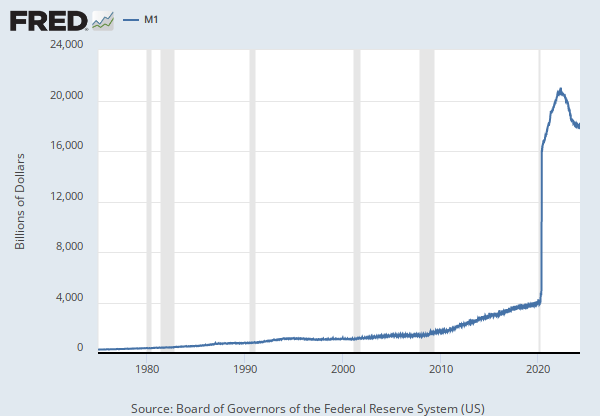
Seasonally adjusted M1 is constructed by summing currency, demand deposits, and OCDs (before May 2020) or other liquid deposits (beginning May 2020), each seasonally adjusted separately.
For more information on the H.6 release changes and the regulatory amendment that led to the creation of the other liquid deposits component and its inclusion in the M1 monetary aggregate, see the H.6 announcements and Technical Q&As posted on December 17, 2020.
For questions on the data, please contact the data source. For questions on FRED functionality, please contact us here.
Suggested Citation:
Board of Governors of the Federal Reserve System (US), M1 [M1SL], retrieved from FRED, Federal Reserve Bank of St. Louis; https://fred.stlouisfed.org/series/M1SL, .
Release Tables
Related Data and Content
Data Suggestions Based On Your Search









Content Suggestions






Other Formats
Labor Force Participation Rate
Monthly, Not Seasonally AdjustedM1
Monthly, Not Seasonally Adjusted Weekly, Not Seasonally AdjustedRelated Categories
Civilian Labor Force Participation Rate
Current Population Survey (Household Survey)
Population, Employment, & Labor Markets
M1 and Components
Monetary Data
Money, Banking, & Finance
Releases
Tags
Participation
Civilian
16 Years +
Labor Force
Labor
Current Population Survey (Household Survey)
Rate
Seasonally Adjusted
Bureau of Labor Statistics
Monthly
Nation
Public Domain: Citation Requested
United States of America
M1 Money Stock
H.6 Money Stock Measures
Monetary Aggregates
Board of Governors