Notes
Source: U.S. Census Bureau
Release: Income and Poverty in the United States
Units:
Frequency:
Notes:
Household data are collected as of March.
As stated in the Census's "Source and Accuracy of Estimates for Income, Poverty, and Health Insurance Coverage in the United States: 2011" (http://www.census.gov/hhes/www/p60_243sa.pdf):
Estimation of Median Incomes. The Census Bureau has changed the methodology for computing median income over time. The Census Bureau has computed medians using either Pareto interpolation or linear interpolation. Currently, we are using linear interpolation to estimate all medians. Pareto interpolation assumes a decreasing density of population within an income interval, whereas linear interpolation assumes a constant density of population within an income interval. The Census Bureau calculated estimates of median income and associated standard errors for 1979 through 1987 using Pareto interpolation if the estimate was larger than $20,000 for people or $40,000 for families and households. This is because the width of the income interval containing the estimate is greater than $2,500.
We calculated estimates of median income and associated standard errors for 1976, 1977, and 1978 using Pareto interpolation if the estimate was larger than $12,000 for people or $18,000 for families and households. This is because the width of the income interval containing the estimate is greater than $1,000. All other estimates of median income and associated standard errors for 1976 through 2011 (2012 ASEC) and almost all of the estimates of median income and associated standard errors for 1975 and earlier were calculated using linear interpolation.
Thus, use caution when comparing median incomes above $12,000 for people or $18,000 for families and households for different years. Median incomes below those levels are more comparable from year to year since they have always been calculated using linear interpolation. For an indication of the comparability of medians calculated using Pareto interpolation with medians calculated using linear interpolation, see Series P-60, Number 114, Money Income in 1976 of Families and Persons in the United States (www2.census.gov/prod2/popscan/p60-114.pdf).
Suggested Citation:
U.S. Census Bureau, Median Household Income in the United States [MEHOINUSA646N], retrieved from FRED, Federal Reserve Bank of St. Louis; https://fred.stlouisfed.org/series/MEHOINUSA646N, .
Source: Freddie Mac
Release: Primary Mortgage Market Survey
Units:
Frequency:
Notes:
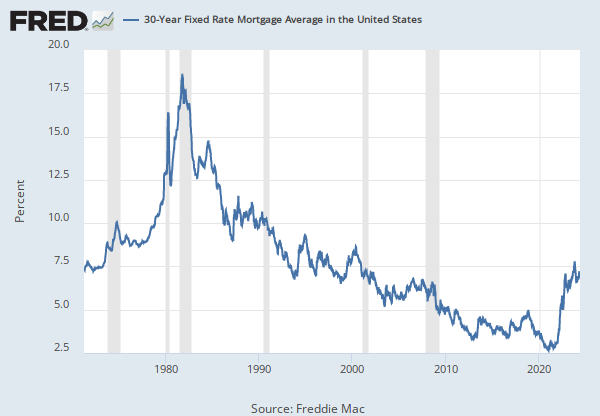
On November 17, 2022, Freddie Mac changed the methodology of the Primary Mortgage Market Survey® (PMMS®). The weekly mortgage rate is now based on applications submitted to Freddie Mac from lenders across the country. For more information regarding Freddie Mac’s enhancement, see their research note.
Data are provided “as is” by Freddie Mac®, with no warranties of any kind, express or implied, including but not limited to warranties of accuracy or implied warranties of merchantability or fitness for a particular purpose. Use of the data is at the user’s sole risk. In no event will Freddie Mac be liable for any damages arising out of or related to the data, including but not limited to direct, indirect, incidental, special, consequential, or punitive damages, whether under a contract, tort, or any other theory of liability, even if Freddie Mac is aware of the possibility of such damages.
Copyright, 2016, Freddie Mac. Reprinted with permission.
Suggested Citation:
Freddie Mac, 30-Year Fixed Rate Mortgage Average in the United States [MORTGAGE30US], retrieved from FRED, Federal Reserve Bank of St. Louis; https://fred.stlouisfed.org/series/MORTGAGE30US, .
Source: U.S. Census Bureau
Source: U.S. Department of Housing and Urban Development
Release: New Residential Sales
Units:
Frequency:
Suggested Citation:
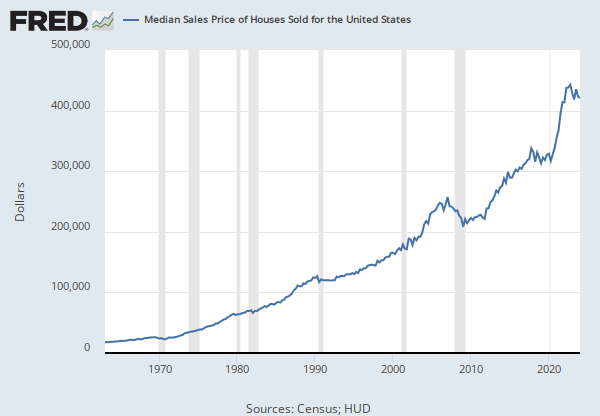
U.S. Census Bureau and U.S. Department of Housing and Urban Development, Median Sales Price of Houses Sold for the United States [MSPUS], retrieved from FRED, Federal Reserve Bank of St. Louis; https://fred.stlouisfed.org/series/MSPUS, .
Source: U.S. Census Bureau
Release: Small Area Income and Poverty Estimates
Units:
Frequency:
Notes:
The U.S. Census Bureau provides annual estimates of income and poverty statistics for all school districts, counties, and states through the Small Area Income and Poverty Estimates (SAIPE) program. The bureau's main objective with this program is to provide estimates of income and poverty for the administration of federal programs and the allocation of federal funds to local jurisdictions. In addition to these federal programs, state and local programs use the income and poverty estimates for distributing funds and managing programs.
Household income includes income of the householder and all other people 15 years and older in the household, whether or not they are related to the householder. Median is the point that divides the household income distributions into two halves: one-half with income above the median and the other with income below the median. The median is based on the income distribution of all households, including those with no income.
Suggested Citation:
U.S. Census Bureau, Estimate of Median Household Income for King County, WA [MHIWA53033A052NCEN], retrieved from FRED, Federal Reserve Bank of St. Louis; https://fred.stlouisfed.org/series/MHIWA53033A052NCEN, .
Source: Realtor.com
Release: Housing Inventory Core Metrics
Units:
Frequency:
Notes:
The median listing price in a given market during the specified month.
With the release of its September 2022 housing trends report, Realtor.com® incorporated a new and improved methodology for capturing and reporting housing inventory trends and metrics. The new methodology updates and improves the calculation of time on market and improves handling of duplicate listings. Most areas across the country will see minor changes with a smaller handful of areas seeing larger updates. As a result of these changes, the data released since October 2022 will not be directly comparable with previous data releases (files downloaded before October 2022) and Realtor.com® economics blog posts. However, future data releases, including historical data, will consistently apply the new methodology. More details are available at the source's Real Estate Data Library.
With the release of its November 2021 housing trends report, Realtor.com® incorporated a new and improved methodology for capturing and reporting housing inventory trends and metrics. The new methodology uses the latest and most accurate data mapping of listing statuses to yield a cleaner and more consistent measurement of active listings at both the national and local level. The methodology has also been adjusted to better account for missing data in some fields including square footage. Most areas across the country will see minor changes with a smaller handful of areas seeing larger updates. As a result of these changes, the data released since December 2021 will not be directly comparable with previous data releases (files downloaded before December 2021) and Realtor.com® economics blog posts. However, future data releases, including historical data, will consistently apply the new methodology. More details are available at the source's Real Estate Data Library.
Suggested Citation:
Realtor.com, Housing Inventory: Median Listing Price in King County, WA [MEDLISPRI53033], retrieved from FRED, Federal Reserve Bank of St. Louis; https://fred.stlouisfed.org/series/MEDLISPRI53033, .
Release Tables
Housing Inventory Core Metrics
Income and Poverty in the United States
New Residential Sales
- Median and Average Sales Price of Houses Sold by Region
- Median and Average Sales Price of Houses Sold by Type of Financing
Primary Mortgage Market Survey
Related Data and Content
Data Suggestions Based On Your Search















Content Suggestions






Related Categories
Income Distribution
Population, Employment, & Labor Markets
Mortgage Rates
Interest Rates
Money, Banking, & Finance
New Residential Sales
Housing
Production & Business Activity
King County, WA
Counties
Washington
States
U.S. Regional Data
Releases
More
Series from Income and Poverty in the United States
More
Series from Primary Mortgage Market Survey
More
Series from New Residential Sales
More
Series from Small Area Income and Poverty Estimates
More
Series from Housing Inventory Core Metrics
Tags
Households
Income
Median
Census
Annual
Nation
Public Domain: Citation Requested
United States of America
Not Seasonally Adjusted
Freddie Mac
30-Year
Mortgage
Fixed
Weekly
Interest Rate
Interest
Rate
Copyrighted: Citation Required
New Residential Sales
Housing and Urban Development
Sales
Housing
Quarterly
King County, WA
Seattle
Washington (state)
Small Area Income & Poverty Estimates
County or County Equivalent
Listing
Realtor.com
Price
Monthly