Notes
Source: U.S. Bureau of Economic Analysis
Release: Health Care Satellite Account
Units:
Frequency:
Notes:
As stated by the source, the Health Care Satellite Account presents two versions of the accounts. One version uses data from the Medical Expenditure Panel Survey (MEPS) - referred to as the "MEPS Account" - which is the only nationally representative survey that contains detailed expenditure information by disease. Due to the relatively small sample size the MEPS Account produces more volatile estimates across years. To address this issue, BEA presents a second version of the satellite account - referred to as the "Blended Account" - which blends together data from multiple sources, including large claims databases that cover millions of enrollees and billions of claims. The key difference is that the MEPS Account and Blended Account use different methodologies and data sources to allocate expenditures across different diseases within the medical services by disease category.
For more information see http://www.bea.gov/national/health_care_satellite_account.htm
Suggested Citation:
U.S. Bureau of Economic Analysis, Health Expenditures Price Index, Blended Account Basis [HLTHSCPIBLEND], retrieved from FRED, Federal Reserve Bank of St. Louis; https://fred.stlouisfed.org/series/HLTHSCPIBLEND, .
Source: U.S. Bureau of Labor Statistics
Release: Consumer Price Index
Units:
Frequency:
Notes:
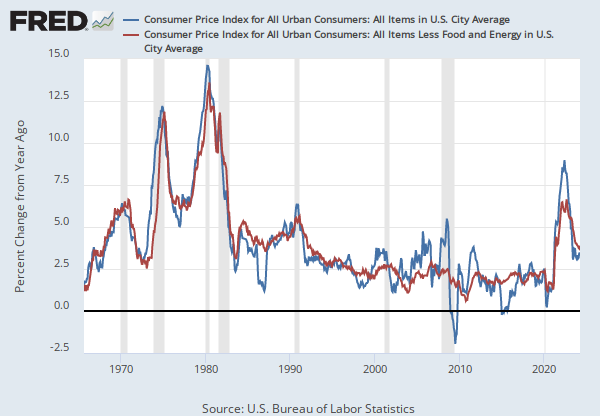
The Consumer Price Index for All Urban Consumers: All Items (CPIAUCSL) is a price index of a basket of goods and services paid by urban consumers. Percent changes in the price index measure the inflation rate between any two time periods. The most common inflation metric is the percent change from one year ago. It can also represent the buying habits of urban consumers. This particular index includes roughly 88 percent of the total population, accounting for wage earners, clerical workers, technical workers, self-employed, short-term workers, unemployed, retirees, and those not in the labor force.
The CPIs are based on prices for food, clothing, shelter, and fuels; transportation fares; service fees (e.g., water and sewer service); and sales taxes. Prices are collected monthly from about 4,000 housing units and approximately 26,000 retail establishments across 87 urban areas. To calculate the index, price changes are averaged with weights representing their importance in the spending of the particular group. The index measures price changes (as a percent change) from a predetermined reference date. In addition to the original unadjusted index distributed, the Bureau of Labor Statistics also releases a seasonally adjusted index. The unadjusted series reflects all factors that may influence a change in prices. However, it can be very useful to look at the seasonally adjusted CPI, which removes the effects of seasonal changes, such as weather, school year, production cycles, and holidays.
The CPI can be used to recognize periods of inflation and deflation. Significant increases in the CPI within a short time frame might indicate a period of inflation, and significant decreases in CPI within a short time frame might indicate a period of deflation. However, because the CPI includes volatile food and oil prices, it might not be a reliable measure of inflationary and deflationary periods. For a more accurate detection, the core CPI (CPILFESL) is often used. When using the CPI, please note that it is not applicable to all consumers and should not be used to determine relative living costs. Additionally, the CPI is a statistical measure vulnerable to sampling error since it is based on a sample of prices and not the complete average.
For more information on the CPI, see the Handbook of Methods, the release notes and announcements, and the Frequently Asked Questions (FAQs).
Suggested Citation:
U.S. Bureau of Labor Statistics, Consumer Price Index for All Urban Consumers: All Items in U.S. City Average [CPIAUCSL], retrieved from FRED, Federal Reserve Bank of St. Louis; https://fred.stlouisfed.org/series/CPIAUCSL, .
Source: U.S. Bureau of Labor Statistics
Release: Consumer Price Index
Units:
Frequency:
Suggested Citation:
U.S. Bureau of Labor Statistics, Consumer Price Index for All Urban Consumers: Medical Care in U.S. City Average [CPIMEDSL], retrieved from FRED, Federal Reserve Bank of St. Louis; https://fred.stlouisfed.org/series/CPIMEDSL, .
Release Tables
Consumer Price Index
Health Care Satellite Account
Related Data and Content
Data Suggestions Based On Your Search











Content Suggestions







Other Formats
Consumer Price Index for All Urban Consumers: All Items in U.S. City Average
Monthly, Not Seasonally Adjusted Semiannual, Not Seasonally AdjustedConsumer Price Index for All Urban Consumers: Medical Care in U.S. City Average
Monthly, Not Seasonally Adjusted Semiannual, Not Seasonally AdjustedRelated Categories
Releases
Tags
Healthcare
Health
Expenditures
Bureau of Economic Analysis
Price Index
Indexes
Price
Annual
Nation
Public Domain: Citation Requested
United States of America
Not Seasonally Adjusted
Headline Figure
Average
All Items
Urban
Consumer
Consumer Price Index
Inflation
Seasonally Adjusted
Bureau of Labor Statistics
Monthly
Medical