Federal Reserve Economic Data
Notes
Source: U.S. Federal Housing Finance Agency
Release: House Price Index
Units:
Frequency:
Notes:
As stated by the source, these annual county indexes should be considered developmental. As with the standard FHFA HPIs, revisions to these indexes may reflect the impact of new data or technical adjustments. Indexes are calibrated using appraisal values and sales prices for mortgages bought or guaranteed by Fannie Mae and Freddie Mac. As discussed in the Working Paper 16-01, in cases where sample sizes are small for the county area, an index is either not reported if recording has not started or a missing value is reported with a period (.). Index values always reflect the native county index, i.e. they are not made with data from another area or year.
For tracking and feedback purposes, please cite Working Paper 16-01 when using these data. A suggested form is: Bogin, A., Doerner, W. and Larson, W. (2016). Local House Price Dynamics: New Indices and Stylized Facts. Federal Housing Finance Agency, Working Paper 16-01. The working paper is accessible at http://www.fhfa.gov/papers/wp1601.aspx.
Suggested Citation:
U.S. Federal Housing Finance Agency, All-Transactions House Price Index for Kent County, MI [ATNHPIUS26081A], retrieved from FRED, Federal Reserve Bank of St. Louis; https://fred.stlouisfed.org/series/ATNHPIUS26081A, .
Source: U.S. Bureau of Labor Statistics
Release: Consumer Price Index
Units:
Frequency:
Notes:
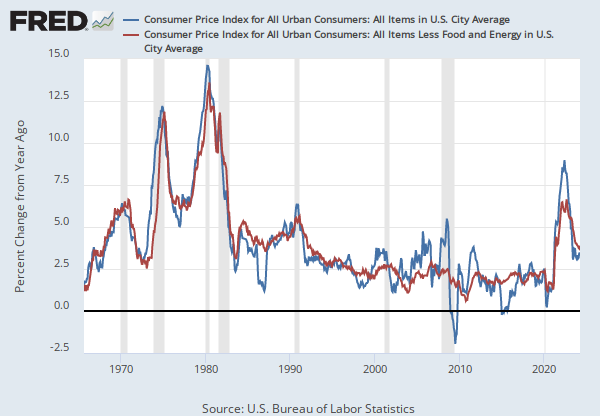
The Consumer Price Index for All Urban Consumers: All Items (CPIAUCSL) is a price index of a basket of goods and services paid by urban consumers. Percent changes in the price index measure the inflation rate between any two time periods. The most common inflation metric is the percent change from one year ago. It can also represent the buying habits of urban consumers. This particular index includes roughly 88 percent of the total population, accounting for wage earners, clerical workers, technical workers, self-employed, short-term workers, unemployed, retirees, and those not in the labor force.
The CPIs are based on prices for food, clothing, shelter, and fuels; transportation fares; service fees (e.g., water and sewer service); and sales taxes. Prices are collected monthly from about 4,000 housing units and approximately 26,000 retail establishments across 87 urban areas. To calculate the index, price changes are averaged with weights representing their importance in the spending of the particular group. The index measures price changes (as a percent change) from a predetermined reference date. In addition to the original unadjusted index distributed, the Bureau of Labor Statistics also releases a seasonally adjusted index. The unadjusted series reflects all factors that may influence a change in prices. However, it can be very useful to look at the seasonally adjusted CPI, which removes the effects of seasonal changes, such as weather, school year, production cycles, and holidays.
The CPI can be used to recognize periods of inflation and deflation. Significant increases in the CPI within a short time frame might indicate a period of inflation, and significant decreases in CPI within a short time frame might indicate a period of deflation. However, because the CPI includes volatile food and oil prices, it might not be a reliable measure of inflationary and deflationary periods. For a more accurate detection, the core CPI (CPILFESL) is often used. When using the CPI, please note that it is not applicable to all consumers and should not be used to determine relative living costs. Additionally, the CPI is a statistical measure vulnerable to sampling error since it is based on a sample of prices and not the complete average.
For more information on the CPI, see the Handbook of Methods, the release notes and announcements, and the Frequently Asked Questions (FAQs).
Suggested Citation:
U.S. Bureau of Labor Statistics, Consumer Price Index for All Urban Consumers: All Items in U.S. City Average [CPIAUCSL], retrieved from FRED, Federal Reserve Bank of St. Louis; https://fred.stlouisfed.org/series/CPIAUCSL, .
Source: U.S. Federal Housing Finance Agency
Release: House Price Index
Units:
Frequency:
Notes:
Estimated using sales prices and appraisal data.
Suggested Citation:
U.S. Federal Housing Finance Agency, All-Transactions House Price Index for California [CASTHPI], retrieved from FRED, Federal Reserve Bank of St. Louis; https://fred.stlouisfed.org/series/CASTHPI, .
Release Tables
Consumer Price Index
Related Data and Content
Data Suggestions Based On Your Search










Content Suggestions








Other Formats
Related Categories
Kent County, MI
Counties
Michigan
States
U.S. Regional Data
Consumer Price Indexes (CPI and PCE)
Prices
California
House Price Indexes
Releases
Tags
Kent County, MI
Grand Rapids
Michigan
Federal Housing Finance Agency
House Price Index
Housing
Price Index
Indexes
Price
County or County Equivalent
Annual
Public Domain: Citation Requested
United States of America
Not Seasonally Adjusted
Headline Figure
All Items
Average
Urban
Consumer
Consumer Price Index
Inflation
Seasonally Adjusted
Bureau of Labor Statistics
Monthly
Nation
Appraisers
California
State
Quarterly