Notes
Source: U.S. Bureau of Labor Statistics
Release: Job Openings and Labor Turnover Survey
Units:
Frequency:
Notes:
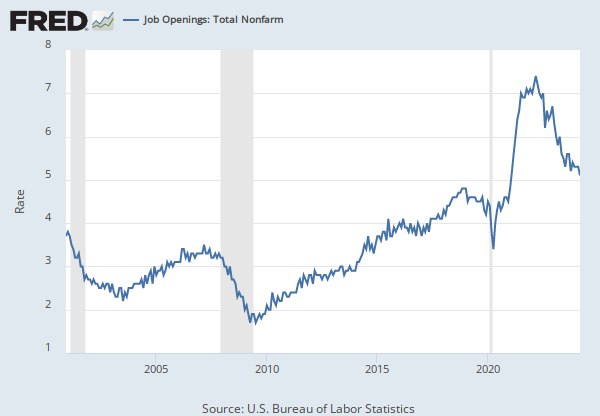
Total Nonfarm Job Openings are a measure of all jobs that are not filled on the last business day of the month. A job is considered open if a specific position exists and there is work available for it, the job can be started within 30 days, and there is active recruiting for the position.
Total Nonfarm Job Openings are measured by the Job Openings and Labor Turnover Survey (JOLTS) and published by the Bureau of Labor Statistics (BLS). These data are a unique economic indicator of unmet demand for labor and labor shortages. Economists, government officials, and researchers use Job Openings as a measure of tightness within job markets.
Note that the set of available job openings may decline because openings become filled, or because previous openings are removed without filling positions.
For more information, see:
U.S. Bureau of Labor Statistics, Job Openings and Labor Turnover Survey Overview Page
U.S. Bureau of Labor Statistics, Data Definitions
Suggested Citation:
U.S. Bureau of Labor Statistics, Job Openings: Total Nonfarm [JTSJOL], retrieved from FRED, Federal Reserve Bank of St. Louis; https://fred.stlouisfed.org/series/JTSJOL, .
Source: U.S. Census Bureau
Release: National Population Estimates
Units:
Frequency:
Notes:
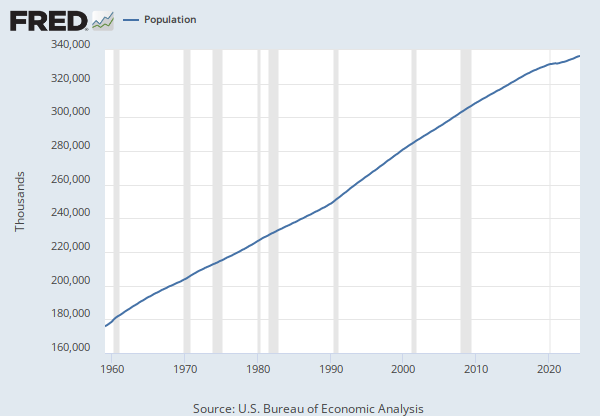
The intercensal estimates for 1990-2000 for the United States population are produced by converting the 1990-2000 postcensal estimates prepared previously for the U. S. to account for differences between the postcensal estimates in 2000 and census counts (error of closure). The postcensal estimates for 1990 to 2000 were produced by updating the resident population enumerated in the 1990 census by estimates of the components of population change between April 1, 1990 and April 1, 2000-- births to U.S. resident women, deaths to U.S. residents, net international migration (incl legal & residual foreign born), and net movement of the U.S. armed forces and civilian citizens to the United States. Intercensal population estimates for 1990 to 2000 are derived from the postcensal estimates by distributing the error of closure over the decade by month. The method used for the 1990s for distributing the error of closure is the same that was used for the 1980s. This method produces an intercensal estimate as a function of time and the postcensal estimates,using the following formula: the population at time t is equal to the postcensal estimate at time t multiplied by a function. The function is the April 1, 2000 census count divided by the April 1, 2000 postcensal estimate raised to the power of t divided by 3653.
Suggested Citation:
U.S. Census Bureau, Total Population: All Ages including Armed Forces Overseas [POP], retrieved from FRED, Federal Reserve Bank of St. Louis; https://fred.stlouisfed.org/series/POP, .
Release Tables
Job Openings and Labor Turnover Survey
Related Data and Content
Data Suggestions Based On Your Search




Content Suggestions


Other Formats
Monthly, Not Seasonally Adjusted
Rate, Monthly, Not Seasonally Adjusted
Rate, Monthly, Seasonally Adjusted
Related Categories
Job Openings (Levels and Rates)
Job Openings and Labor Turnover (JOLTS)
Population, Employment, & Labor Markets
Population
Releases
More
Series from Job Openings and Labor Turnover Survey
More
Series from National Population Estimates