Federal Reserve Economic Data
Notes
Source: Organization for Economic Co-operation and Development
Release: Main Economic Indicators
Units:
Frequency:
Notes:
OECD Data Filters:
REF_AREA: USA
MEASURE: CCICP
UNIT_MEASURE: IX
ACTIVITY: _Z
ADJUSTMENT: AA
TRANSFORMATION: IX
TIME_HORIZ: _Z
METHODOLOGY: H
FREQ: M
All OECD data should be cited as follows: OECD (year), (dataset name), (data source) DOI or https://data-explorer.oecd.org/. (accessed on (date)).
Suggested Citation:
Organization for Economic Co-operation and Development, Composite Leading Indicators: Composite Consumer Confidence Amplitude Adjusted for United States [CSCICP03USM665S], retrieved from FRED, Federal Reserve Bank of St. Louis; https://fred.stlouisfed.org/series/CSCICP03USM665S, .
Source: U.S. Bureau of Labor Statistics
Release: Employment Situation
Units:
Frequency:
Notes:
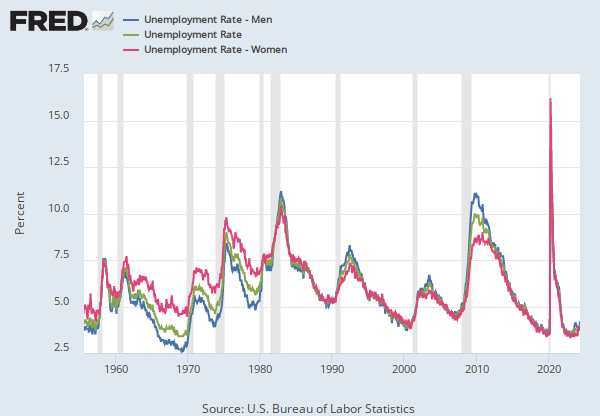
The unemployment rate represents the number of unemployed as a percentage of the labor force. Labor force data are restricted to people 16 years of age and older, who currently reside in 1 of the 50 states or the District of Columbia, who do not reside in institutions (e.g., penal and mental facilities, homes for the aged), and who are not on active duty in the Armed Forces.
This rate is also defined as the U-3 measure of labor underutilization.
The series comes from the 'Current Population Survey (Household Survey)'
The source code is: LNS14000000
Suggested Citation:
U.S. Bureau of Labor Statistics, Unemployment Rate [UNRATE], retrieved from FRED, Federal Reserve Bank of St. Louis; https://fred.stlouisfed.org/series/UNRATE, .
Release Tables
Employment Situation
- Monthly, Seasonally Adjusted (population data is not adjusted for seasonal variation; not seasonally adjusted version used)
- Table A-10. Selected unemployment indicators, Seasonally adjusted: Monthly, Unemployment Rates
- Table A-15. Alternative measures of labor underutilization: Monthly, Seasonally Adjusted
Related Data and Content
Data Suggestions Based On Your Search






Content Suggestions











Other Formats
Related Categories
Financial Activity Measures
Financial Indicators
Money, Banking, & Finance
Indicators
United States
Countries
International Data
Unemployment Rate
Current Population Survey (Household Survey)
Population, Employment, & Labor Markets
Releases
Tags
Consumer Sentiment
Composite
Consumer
Main Economic Indicators
Org. for Economic Co-operation and Development
Seasonally Adjusted
Copyrighted: Citation Required
Monthly
Nation
United States of America
Labor Underutilization
Headline Figure
Civilian
16 Years +
Current Population Survey (Household Survey)
Labor
Unemployment
Rate
Bureau of Labor Statistics
Public Domain: Citation Requested