Federal Reserve Economic Data
Notes
Source: U.S. Bureau of Labor Statistics
Release: Employment Situation
Units:
Frequency:
Notes:
The series comes from the 'Current Employment Statistics (Establishment Survey).'
The source code is: CES0500000001
Suggested Citation:
U.S. Bureau of Labor Statistics, All Employees, Total Private [USPRIV], retrieved from FRED, Federal Reserve Bank of St. Louis; https://fred.stlouisfed.org/series/USPRIV, .
Source: U.S. Bureau of Economic Analysis
Release: Personal Income and Outlays
Units:
Frequency:
Notes:
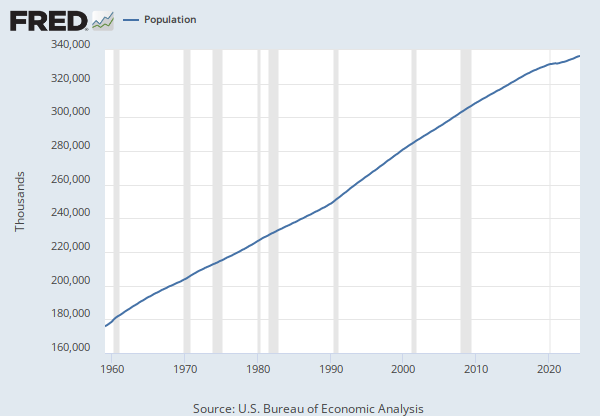
Population includes resident population plus armed forces overseas. The monthly estimate is the average of estimates for the first of the month and the first of the following month.
BEA Account Code: B230RC
A Guide to the National Income and Product Accounts of the United States (NIPA) - (http://www.bea.gov/national/pdf/nipaguid.pdf)
Suggested Citation:
U.S. Bureau of Economic Analysis, Population [POPTHM], retrieved from FRED, Federal Reserve Bank of St. Louis; https://fred.stlouisfed.org/series/POPTHM, .
Source: Organization for Economic Co-operation and Development
Release: Main Economic Indicators
Units:
Frequency:
Notes:
OECD Data Filters:
REF_AREA: USA
MEASURE: WAP
UNIT_MEASURE: PS
TRANSFORMATION: _Z
ADJUSTMENT: N
SEX: _T
AGE: Y25T54
ACTIVITY: _Z
FREQ: M
All OECD data should be cited as follows: OECD (year), (dataset name), (data source) DOI or https://data-explorer.oecd.org/. (accessed on (date)).
Suggested Citation:
Organization for Economic Co-operation and Development, Infra-Annual Labor Statistics: Working-Age Population Total: From 25 to 54 Years for United States [LFWA25TTUSM647N], retrieved from FRED, Federal Reserve Bank of St. Louis; https://fred.stlouisfed.org/series/LFWA25TTUSM647N, .
Source: U.S. Bureau of Labor Statistics
Release: Employment Situation
Units:
Frequency:
Notes:
The series comes from the 'Current Employment Statistics (Establishment Survey).'
The source code is: CES8081100001
Suggested Citation:
U.S. Bureau of Labor Statistics, All Employees, Repair and Maintenance [CES8081100001], retrieved from FRED, Federal Reserve Bank of St. Louis; https://fred.stlouisfed.org/series/CES8081100001, .
Source: U.S. Bureau of Labor Statistics
Release: Employment Situation
Units:
Frequency:
Notes:
Construction employees in the construction sector include: Working supervisors, qualified craft workers, mechanics, apprentices, helpers, laborers, and so forth, engaged in new work, alterations, demolition, repair, maintenance, and the like, whether working at the site of construction or in shops or yards at jobs (such as precutting and preassembling) ordinarily performed by members of the construction trades.
The series comes from the 'Current Employment Statistics (Establishment Survey).'
The source code is: CES2000000001
Suggested Citation:
U.S. Bureau of Labor Statistics, All Employees, Construction [USCONS], retrieved from FRED, Federal Reserve Bank of St. Louis; https://fred.stlouisfed.org/series/USCONS, .
Source: U.S. Bureau of Labor Statistics
Release: Employment Situation
Units:
Frequency:
Notes:
Government employment covers only civilian employees; military personnel are excluded. Employees of the Central Intelligence Agency, the National Security Agency, the National Imagery and Mapping Agency, and the Defense Intelligence Agency also are excluded. Postal Services are included.
Handbook of Methods Establishment Survey - (http://www.bls.gov/opub/hom/pdf/homch2.pdf)
Frequently Asked Questions - (http://stats.bls.gov:80/cps/cps_faq.htm)
The series comes from the 'Current Employment Statistics (Establishment Survey).'
The source code is: CES9000000001
Suggested Citation:
U.S. Bureau of Labor Statistics, All Employees, Government [USGOVT], retrieved from FRED, Federal Reserve Bank of St. Louis; https://fred.stlouisfed.org/series/USGOVT, .
Source: U.S. Census Bureau
Release: National Population Estimates
Units:
Frequency:
Notes:
The intercensal estimates for 1990-2000 for the United States population are produced by converting the 1990-2000 postcensal estimates prepared previously for the U. S. to account for differences between the postcensal estimates in 2000 and census counts (error of closure). The postcensal estimates for 1990 to 2000 were produced by updating the resident population enumerated in the 1990 census by estimates of the components of population change between April 1, 1990 and April 1, 2000-- births to U.S. resident women, deaths to U.S. residents, net international migration (incl legal & residual foreign born), and net movement of the U.S. armed forces and civilian citizens to the United States. Intercensal population estimates for 1990 to 2000 are derived from the postcensal estimates by distributing the error of closure over the decade by month. The method used for the 1990s for distributing the error of closure is the same that was used for the 1980s. This method produces an intercensal estimate as a function of time and the postcensal estimates,using the following formula: the population at time t is equal to the postcensal estimate at time t multiplied by a function. The function is the April 1, 2000 census count divided by the April 1, 2000 postcensal estimate raised to the power of t divided by 3653.
Suggested Citation:
U.S. Census Bureau, Total Population: All Ages including Armed Forces Overseas [POP], retrieved from FRED, Federal Reserve Bank of St. Louis; https://fred.stlouisfed.org/series/POP, .
Source: U.S. Bureau of Labor Statistics
Release: Employment Situation
Units:
Frequency:
Notes:
The series comes from the 'Current Employment Statistics (Establishment Survey).'
The source code is: CES5500000001
Suggested Citation:
U.S. Bureau of Labor Statistics, All Employees, Financial Activities [USFIRE], retrieved from FRED, Federal Reserve Bank of St. Louis; https://fred.stlouisfed.org/series/USFIRE, .
Release Tables
Employment Situation
Main Economic Indicators
Personal Income and Outlays
Related Data and Content
Data Suggestions Based On Your Search




Content Suggestions


Other Formats
All Employees, Total Private
Monthly, Not Seasonally AdjustedPopulation
Annual, Not Seasonally Adjusted Quarterly, Not Seasonally AdjustedInfra-Annual Labor Statistics: Working-Age Population Total: From 25 to 54 Years for United States
Annual, Not Seasonally Adjusted Annual, Seasonally Adjusted Monthly, Seasonally Adjusted Quarterly, Not Seasonally Adjusted Quarterly, Seasonally AdjustedAll Employees, Repair and Maintenance
Monthly, Not Seasonally AdjustedAll Employees, Construction
Monthly, Not Seasonally AdjustedAll Employees, Government
Monthly, Not Seasonally AdjustedAll Employees, Financial Activities
Monthly, Not Seasonally AdjustedRelated Categories
Total Private
Current Employment Statistics (Establishment Survey)
Population, Employment, & Labor Markets
Population
Labor Force
Population, Employment, & Labor Markets
Indicators
United States
Countries
International Data
Other Services
Construction
Government
Financial Activities
Releases
More
Series from Employment Situation
More
Series from Personal Income and Outlays
More
Series from Main Economic Indicators
More
Series from National Population Estimates
Tags
Headline Figure
Current Employment Statistics Survey (Establishment Survey)
Private Industries
Private
Employment
Industry
Seasonally Adjusted
Bureau of Labor Statistics
Monthly
Nation
Public Domain: Citation Requested
United States of America
National Income and Product Accounts
Population
Bureau of Economic Analysis
Not Seasonally Adjusted
Working-Age
25 to 54 Years
Main Economic Indicators
Org. for Economic Co-operation and Development
Copyrighted: Citation Required
Services
Construction
Government
Census
Financial