Notes
Source: Federal Reserve Bank of St. Louis
Release: St. Louis Fed Financial Stress Index
Units:
Frequency:
Notes:
The methodology for the St. Louis Fed's Financial Stress Index was revised and this series is discontinued. The new version, STLFSI3, can be found here.
The STLFSI2 measures the degree of financial stress in the markets and is constructed from 18 weekly data series, all of which are weekly averages of daily data series: seven interest rates, six yield spreads, and five other indicators. Each of these variables captures some aspect of financial stress. Accordingly, as the level of financial stress in the economy changes, the data series are likely to move together.
How to Interpret the Index:
The average value of the index, which begins in late 1993, is designed to be zero. Thus, zero is viewed as representing normal financial market conditions. Values below zero suggest below-average financial market stress, while values above zero suggest above-average financial market stress.
More information:
The STLFSI2 is a revision of the original STLFSI. For additional information on the STLFSI2 and its construction, see “The St. Louis Fed’s Financial Stress Index, Version 2.0”.
Suggested Citation:
Federal Reserve Bank of St. Louis, St. Louis Fed Financial Stress Index (DISCONTINUED) [STLFSI2], retrieved from FRED, Federal Reserve Bank of St. Louis; https://fred.stlouisfed.org/series/STLFSI2, .
Source: Board of Governors of the Federal Reserve System (US)
Release: Senior Loan Officer Opinion Survey on Bank Lending Practices
Units:
Frequency:
Notes:
This data series is part of the Board of Governors of the Federal Reserve System's Senior Loan Officer Opinion Survey on Bank Lending Practices (SLOOS). The purpose of the survey is to provide qualitative and limited quantitative information on bank credit availability and loan demand, as well as on evolving developments and lending practices in the U.S. loan markets. A portion of each survey typically covers special topics of timely interest.
For questions on the data, please contact the data source. For questions on FRED functionality, please contact us here.
Suggested Citation:
Board of Governors of the Federal Reserve System (US), Net Percentage of Domestic Banks Tightening Standards for Commercial and Industrial Loans to Large and Middle-Market Firms [DRTSCILM], retrieved from FRED, Federal Reserve Bank of St. Louis; https://fred.stlouisfed.org/series/DRTSCILM, .
Source: Board of Governors of the Federal Reserve System (US)
Release: Charge-Off and Delinquency Rates on Loans and Leases at Commercial Banks
Units:
Frequency:
Notes:
For questions on the data, please contact the data source. For questions on FRED functionality, please contact us here.
Suggested Citation:
Board of Governors of the Federal Reserve System (US), Delinquency Rate on Business Loans, All Commercial Banks [DRBLACBN], retrieved from FRED, Federal Reserve Bank of St. Louis; https://fred.stlouisfed.org/series/DRBLACBN, .
Source: Board of Governors of the Federal Reserve System (US)
Release: Charge-Off and Delinquency Rates on Loans and Leases at Commercial Banks
Units:
Frequency:
Notes:
For questions on the data, please contact the data source. For questions on FRED functionality, please contact us here.
Suggested Citation:
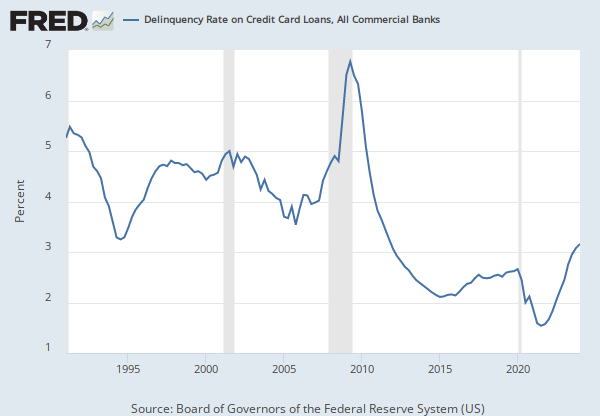
Board of Governors of the Federal Reserve System (US), Delinquency Rate on Credit Card Loans, All Commercial Banks [DRCCLACBS], retrieved from FRED, Federal Reserve Bank of St. Louis; https://fred.stlouisfed.org/series/DRCCLACBS, .
Release Tables
Charge-Off and Delinquency Rates on Loans and Leases at Commercial Banks
Related Data and Content
Data Suggestions Based On Your Search










Content Suggestions


Other Formats
St. Louis Fed Financial Stress Index (DISCONTINUED)
Weekly, Not Seasonally Adjusted Weekly, Not Seasonally AdjustedDelinquency Rate on Business Loans, All Commercial Banks
Quarterly, Seasonally AdjustedDelinquency Rate on Credit Card Loans, All Commercial Banks
Quarterly, Not Seasonally AdjustedRelated Categories
Financial Activity Measures
Financial Indicators
Money, Banking, & Finance
Senior Loan Officer Survey
Banking
Delinquencies and Delinquency Rates
Releases
More
Series from St. Louis Fed Financial Stress Index
More
Series from Senior Loan Officer Opinion Survey on Bank Lending Practices
More
Series from Charge-Off and Delinquency Rates on Loans and Leases at Commercial Banks
Tags
St. Louis Financial Stress Index
Financial Stress Index
Financial
Weekly
Discontinued
St. Louis Fed
Indexes
Copyrighted: Citation Required
Nation
United States of America
Not Seasonally Adjusted
Tightening Standards
Senior Loan Officer Surv. on Bank Lending
Commercial
Domestic
Net
Loans
Percent
Board of Governors
Industry
Quarterly
Public Domain: Citation Requested
Delinquencies
Business
Banks
Depository Institutions
Rate
Credit Cards
Seasonally Adjusted