Notes
Source: U.S. Bureau of Labor Statistics
Release: Job Openings and Labor Turnover Survey
Units:
Frequency:
Notes:
Total Nonfarm Job Openings are a measure of all jobs that are not filled on the last business day of the month. A job is considered open if a specific position exists and there is work available for it, the job can be started within 30 days, and there is active recruiting for the position.
Total Nonfarm Job Openings are measured by the Job Openings and Labor Turnover Survey (JOLTS) and published by the Bureau of Labor Statistics (BLS). These data are a unique economic indicator of unmet demand for labor and labor shortages. Economists, government officials, and researchers use Job Openings as a measure of tightness within job markets.
Note that the set of available job openings may decline because openings become filled, or because previous openings are removed without filling positions.
For more information, see:
U.S. Bureau of Labor Statistics, Job Openings and Labor Turnover Survey Overview Page
U.S. Bureau of Labor Statistics, Data Definitions
Suggested Citation:
U.S. Bureau of Labor Statistics, Job Openings: Total Nonfarm [JTSJOL], retrieved from FRED, Federal Reserve Bank of St. Louis; https://fred.stlouisfed.org/series/JTSJOL, .
Source: U.S. Bureau of Labor Statistics
Release: Employment Situation
Units:
Frequency:
Notes:
The series comes from the 'Current Population Survey (Household Survey)'
The source code is: LNS13000000
The Unemployment Level is the aggregate measure of people currently unemployed in the US. Someone in the labor force is defined as unemployed if they were not employed during the survey reference week, were available for work, and made at least one active effort to find a job during the 4-week survey period.
The Unemployment Level is collected in the CPS and published by the BLS. It is provided on a monthly basis, so this data is used in part by macroeconomists as an initial economic indicator of current trends. The Unemployment Level helps government agencies, financial markets, and researchers gauge the overall health of the economy.
Note that individuals that are not employed but not actively looking for a job are not counted as unemployed. For instance, declines in the Unemployment Level may either reflect movements of unemployed individuals into the labor force because they found a job, or movements of unemployed individuals out of the labor force because they stopped looking to find a job.
For more information, see:
U.S. Bureau of Labor Statistics, CES Overview
U.S. Bureau of Labor Statistics, BLS Handbook of Methods: Chapter 2. Employment, Hours, and Earnings from the Establishment Survey
Suggested Citation:
U.S. Bureau of Labor Statistics, Unemployment Level [UNEMPLOY], retrieved from FRED, Federal Reserve Bank of St. Louis; https://fred.stlouisfed.org/series/UNEMPLOY, .
Source: U.S. Bureau of Labor Statistics
Release: Employment Situation
Units:
Frequency:
Notes:
The series comes from the 'Current Population Survey (Household Survey)'
The source code is: LNS11300000
The Labor Force Participation Rate is defined by the Current Population Survey (CPS) as “the number of people in the labor force as a percentage of the civilian noninstitutional population […] the participation rate is the percentage of the population that is either working or actively looking for work.”
The Labor Force Participation Rate is collected in the CPS and published by the BLS. It is provided on a monthly basis, so this data is used in part by macroeconomists as an initial economic indicator of current labor market trends. The labor force participation rate helps government agencies, financial markets, and researchers gauge the overall health of the economy.
Note that long-run changes in labor force participation may reflect secular economic trends that are unrelated to the overall health of the economy. For instance, demographic changes such as the aging of population can lead to a secular increase of exits from the labor force, shrinking the labor force and decreasing the labor force participation rate.
For more information, see:
U.S. Bureau of Labor Statistics, CES Overview
U.S. Bureau of Labor Statistics, Concepts and Definitions (CPS)
Suggested Citation:
U.S. Bureau of Labor Statistics, Labor Force Participation Rate [CIVPART], retrieved from FRED, Federal Reserve Bank of St. Louis; https://fred.stlouisfed.org/series/CIVPART, .
Release Tables
Employment Situation
Employment Situation
- Monthly, Seasonally Adjusted (population data is not adjusted for seasonal variation; not seasonally adjusted version used)
- Table A-10. Selected unemployment indicators, Seasonally adjusted: Monthly, Numbers of unemployed workers
Job Openings and Labor Turnover Survey
Related Data and Content
Data Suggestions Based On Your Search


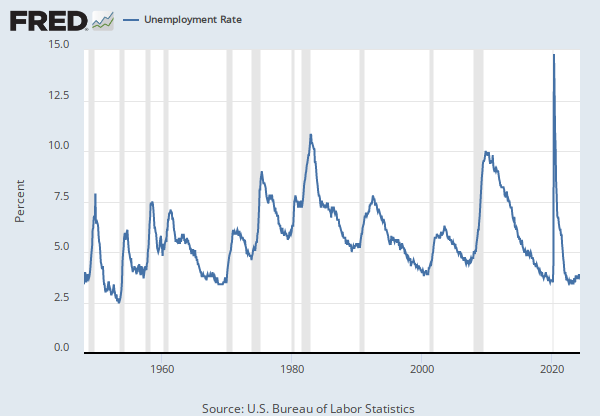


Content Suggestions








Other Formats
Job Openings: Total Nonfarm
Monthly, Not Seasonally Adjusted Rate, Monthly, Not Seasonally Adjusted Rate, Monthly, Seasonally AdjustedUnemployment Level
Monthly, Not Seasonally AdjustedLabor Force Participation Rate
Monthly, Not Seasonally AdjustedRelated Categories
Job Openings (Levels and Rates)
Job Openings and Labor Turnover (JOLTS)
Population, Employment, & Labor Markets
Unemployment Level
Current Population Survey (Household Survey)
Civilian Labor Force Participation Rate