Federal Reserve Economic Data
Notes
Source: Federal Reserve Bank of St. Louis
Release: Selected Real Retail Sales Series
Units:
Frequency:
Notes:
The data in this series are calculated using two series, and as such only update when those series update. This series is constructed from Advance Retail and Food Services Sales (RSAFS) deflated using the Consumer Price Index for All Urban Consumers (1982-84=100) (CPIAUCSL).
Suggested Citation:
Federal Reserve Bank of St. Louis, Advance Real Retail and Food Services Sales [RRSFS], retrieved from FRED, Federal Reserve Bank of St. Louis; https://fred.stlouisfed.org/series/RRSFS, .
Source: Federal Reserve Bank of St. Louis
Release: Selected Real Retail Sales Series
Units:
Frequency:
Notes:
Deflated Using the Consumer Price Index for All Urban Consumers (1982-84=100)
The U.S. Census Bureau maintained time series of monthly sales and end-of-month inventory estimates of retailers based on the Standard Industrial Classification (SIC) system. The SIC-based time series were discontinued as the North American Industry Classification System (NAICS) time series were newly introduced.
http://www2.census.gov/retail/releases/benchmark/annpub00.pdf
Suggested Citation:
Federal Reserve Bank of St. Louis, Real Retail Sales (DISCONTINUED) [RSALES], retrieved from FRED, Federal Reserve Bank of St. Louis; https://fred.stlouisfed.org/series/RSALES, .
Source: Board of Governors of the Federal Reserve System (US)
Release: G.17 Industrial Production and Capacity Utilization
Units:
Frequency:
Notes:
The Federal Reserve's monthly index of industrial production and the related capacity indexes and capacity utilization rates cover manufacturing, mining, and electric and gas utilities. The industrial sector, together with construction, accounts for the bulk of the variation in national output over the course of the business cycle. The industrial detail provided by these measures helps illuminate structural developments in the economy. The industrial production (IP) index measures the real output of all relevant establishments located in the United States, regardless of their ownership, but not those located in U.S. territories. For more information, see the explanatory notes issued by the Board of Governors. For recent updates, see the announcements issued by the Board of Governors.
Suggested Citation:
Board of Governors of the Federal Reserve System (US), Industrial Production: Total Index [INDPRO], retrieved from FRED, Federal Reserve Bank of St. Louis; https://fred.stlouisfed.org/series/INDPRO, .
Source: U.S. Bureau of Labor Statistics
Release: Employment Situation
Units:
Frequency:
Notes:
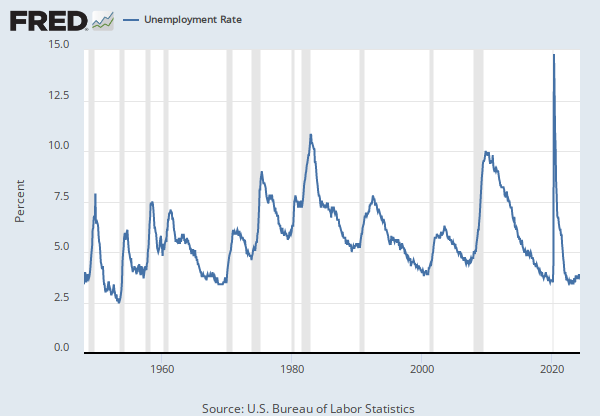
The unemployment rate represents the number of unemployed as a percentage of the labor force. Labor force data are restricted to people 16 years of age and older, who currently reside in 1 of the 50 states or the District of Columbia, who do not reside in institutions (e.g., penal and mental facilities, homes for the aged), and who are not on active duty in the Armed Forces.
This rate is also defined as the U-3 measure of labor underutilization.
The series comes from the 'Current Population Survey (Household Survey)'
The source code is: LNS14000000
Suggested Citation:
U.S. Bureau of Labor Statistics, Unemployment Rate [UNRATE], retrieved from FRED, Federal Reserve Bank of St. Louis; https://fred.stlouisfed.org/series/UNRATE, .
Release Tables
Employment Situation
- Monthly, Seasonally Adjusted (population data is not adjusted for seasonal variation; not seasonally adjusted version used)
- Table A-10. Selected unemployment indicators, Seasonally adjusted: Monthly, Unemployment Rates
- Table A-15. Alternative measures of labor underutilization: Monthly, Seasonally Adjusted
G.17 Industrial Production and Capacity Utilization
Related Data and Content
Data Suggestions Based On Your Search











Content Suggestions










Other Formats
Industrial Production: Total Index
Annual, Not Seasonally Adjusted Monthly, Not Seasonally Adjusted Quarterly, Not Seasonally Adjusted Quarterly, Seasonally AdjustedUnemployment Rate
Monthly, Not Seasonally AdjustedRelated Categories
Retail Trade
Production & Business Activity
Industrial Production & Capacity Utilization
Unemployment Rate
Current Population Survey (Household Survey)
Population, Employment, & Labor Markets
Releases
More
Series from Selected Real Retail Sales Series
More
Series from G.17 Industrial Production and Capacity Utilization
More
Series from Employment Situation
Tags
Retail Trade
Food
Sales
Retail
Services
St. Louis Fed
Real
Seasonally Adjusted
Copyrighted: Citation Required
Monthly
Nation
United States of America
Discontinued
Headline Figure
G.17 Industr. Production & Capacity Utilization
Industrial Production
Production
Industry
Board of Governors
Indexes
Public Domain: Citation Requested
Labor Underutilization
Civilian
16 Years +
Labor
Current Population Survey (Household Survey)
Unemployment
Rate
Bureau of Labor Statistics