Notes
Source: U.S. Bureau of Labor Statistics
Release: Consumer Price Index
Units:
Frequency:
Suggested Citation:
U.S. Bureau of Labor Statistics, Consumer Price Index for All Urban Consumers: Rent of Primary Residence in Detroit-Warren-Dearborn, MI (CBSA) [CUURA208SEHA], retrieved from FRED, Federal Reserve Bank of St. Louis; https://fred.stlouisfed.org/series/CUURA208SEHA, .
Source: U.S. Bureau of Labor Statistics
Release: Consumer Price Index
Units:
Frequency:
Notes:
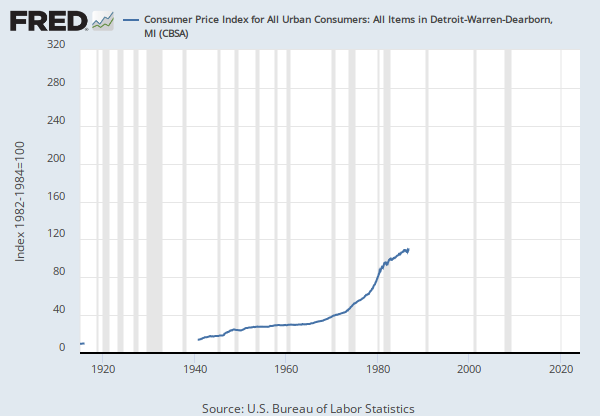
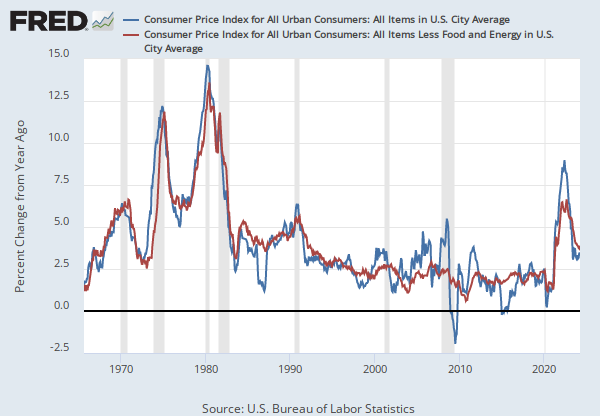
The Consumer Price Index for All Urban Consumers: All Items (CPIAUCSL) is a price index of a basket of goods and services paid by urban consumers. Percent changes in the price index measure the inflation rate between any two time periods. The most common inflation metric is the percent change from one year ago. It can also represent the buying habits of urban consumers. This particular index includes roughly 88 percent of the total population, accounting for wage earners, clerical workers, technical workers, self-employed, short-term workers, unemployed, retirees, and those not in the labor force.
The CPIs are based on prices for food, clothing, shelter, and fuels; transportation fares; service fees (e.g., water and sewer service); and sales taxes. Prices are collected monthly from about 4,000 housing units and approximately 26,000 retail establishments across 87 urban areas. To calculate the index, price changes are averaged with weights representing their importance in the spending of the particular group. The index measures price changes (as a percent change) from a predetermined reference date. In addition to the original unadjusted index distributed, the Bureau of Labor Statistics also releases a seasonally adjusted index. The unadjusted series reflects all factors that may influence a change in prices. However, it can be very useful to look at the seasonally adjusted CPI, which removes the effects of seasonal changes, such as weather, school year, production cycles, and holidays.
The CPI can be used to recognize periods of inflation and deflation. Significant increases in the CPI within a short time frame might indicate a period of inflation, and significant decreases in CPI within a short time frame might indicate a period of deflation. However, because the CPI includes volatile food and oil prices, it might not be a reliable measure of inflationary and deflationary periods. For a more accurate detection, the core CPI (CPILFESL) is often used. When using the CPI, please note that it is not applicable to all consumers and should not be used to determine relative living costs. Additionally, the CPI is a statistical measure vulnerable to sampling error since it is based on a sample of prices and not the complete average.
For more information on the CPI, see the Handbook of Methods, the release notes and announcements, and the Frequently Asked Questions (FAQs).
Suggested Citation:
U.S. Bureau of Labor Statistics, Consumer Price Index for All Urban Consumers: All Items in U.S. City Average [CPIAUCSL], retrieved from FRED, Federal Reserve Bank of St. Louis; https://fred.stlouisfed.org/series/CPIAUCSL, .
Source: U.S. Census Bureau
Release: Housing Units Authorized By Building Permits
Units:
Frequency:
Notes:
This series represents the total number of building permits for all structure types. Structure types include 1-unit, 2-unit, 3-unit, 4-unit, and 5-unit or more.
The Saint Louis Federal Reserve Bank uses the most recent Metropolitan Statistical Area definitions released by the Office of Management and Budget. For more information on specific definitions visit here.
Suggested Citation:
U.S. Census Bureau, New Private Housing Structures Authorized by Building Permits for Detroit-Warren-Dearborn, MI (MSA) [DETR826BPPRIV], retrieved from FRED, Federal Reserve Bank of St. Louis; https://fred.stlouisfed.org/series/DETR826BPPRIV, .
Source: U.S. Census Bureau
Release: Housing Units Authorized By Building Permits
Units:
Frequency:
Notes:
This series represents the total number of building permits for all structure types. Structure types include 1-unit, 2-unit, 3-unit, 4-unit, and 5-unit or more.
The Federal Reserve Bank of St. Louis seasonally adjusts this series by using the 'statsmodels' library from Python with default parameter settings. The package uses the U.S. Bureau of the Census X-13ARIMA-SEATS Seasonal Adjustment Program. More information on the 'statsmodels' X-13ARIMA-SEATS package can be found here. More information on X-13ARIMA-SEATS can be found here.
Many series include both seasonally adjusted (SA) and not seasonally adjusted (NSA) data. Occasionally, updates to the data will not include sufficient seasonal factors to trigger a seasonal adjustment. In these cases, the NSA series will be updated normally; but the SA series will also be updated with the NSA data. The NSA series can be located here here.
Some seasonally adjusted series may exhibit negative values because they are created from a seasonal adjustment process regardless of the actual meaning or interpretation of the given indicator.
Suggested Citation:
U.S. Census Bureau, New Private Housing Structures Authorized by Building Permits for Detroit-Warren-Dearborn, MI (MSA) [DETR826BPPRIVSA], retrieved from FRED, Federal Reserve Bank of St. Louis; https://fred.stlouisfed.org/series/DETR826BPPRIVSA, .
Release Tables
Related Data and Content
Data Suggestions Based On Your Search










Content Suggestions






Other Formats
Consumer Price Index for All Urban Consumers: Rent of Primary Residence in Detroit-Warren-Dearborn, MI (CBSA)
Semiannual, Not Seasonally AdjustedConsumer Price Index for All Urban Consumers: All Items in U.S. City Average
Monthly, Not Seasonally Adjusted Semiannual, Not Seasonally AdjustedNew Private Housing Structures Authorized by Building Permits for Detroit-Warren-Dearborn, MI (MSA)
Monthly, Not Seasonally AdjustedRelated Categories
Detroit-Ann Arbor-Flint, MI (CMSA)
CPI for MSAs and Consolidated MSAs
Michigan
States
U.S. Regional Data
Consumer Price Indexes (CPI and PCE)
Prices
Detroit-Warren-Dearborn, MI
MSAs
Releases
Tags
Detroit
Core-Based Statistical Area
Primary
Rent
Michigan
Urban
Consumer
Consumer Price Index
Metropolitan Statistical Area
Inflation
Price Index
Indexes
Price
Bureau of Labor Statistics
Monthly
Public Domain: Citation Requested
United States of America
Not Seasonally Adjusted
Headline Figure
Average
All Items
Seasonally Adjusted
Nation
Permits
Buildings
New
Housing
Private
Census