Notes
Source: S&P Dow Jones Indices LLC
Release: S&P Cotality Case-Shiller Home Price Indices
Units:
Frequency:
Notes:
For more information regarding the index, please visit Standard & Poor's.
Copyright © 2016, S&P Dow Jones Indices LLC. All rights reserved. Reproduction of Home Price Index for Boston, Massachusetts in any form is prohibited except with the prior written permission of S&P Dow Jones Indices LLC "S&P". S&P does not guarantee the accuracy, adequacy, completeness or availability of any information and is not responsible for any errors or omissions, regardless of the cause or for the results obtained from the use of such information. S&P DISCLAIMS ANY AND ALL EXPRESS OR IMPLIED WARRANTIES, INCLUDING, BUT NOT LIMITED TO, ANY WARRANTIES OF MERCHANTABILITY OR FITNESS FOR A PARTICULAR PURPOSE OR USE. In no event shall S&P be liable for any direct, indirect, special or consequential damages, costs, expenses, legal fees, or losses (including lost income or lost profit and opportunity costs) in connection with subscriber's or others' user of Home Price Index for Boston, Massachusetts.
Permission to reproduce this series can be requested from index_services@spdji.com. More contact details are available from http://us.spindices.com/contact-us/, including phone numbers for all of its regional offices.
Suggested Citation:
S&P Dow Jones Indices LLC, S&P Cotality Case-Shiller MA-Boston Home Price Index [BOXRSA], retrieved from FRED, Federal Reserve Bank of St. Louis; https://fred.stlouisfed.org/series/BOXRSA, .
Source: U.S. Bureau of Labor Statistics
Release: Consumer Price Index
Units:
Frequency:
Suggested Citation:
U.S. Bureau of Labor Statistics, Consumer Price Index for All Urban Consumers: Owners' Equivalent Rent of Residences in Boston-Cambridge-Newton, MA-NH (CBSA) [CUURA103SEHC], retrieved from FRED, Federal Reserve Bank of St. Louis; https://fred.stlouisfed.org/series/CUURA103SEHC, .
Source: U.S. Bureau of Labor Statistics
Source: Federal Reserve Bank of St. Louis
Release: Quarterly Census of Employment and Wages
Units:
Frequency:
Notes:
Average weekly wages are the wages paid by unemployment insurance covered employers during the calendar quarter, regardless of when the services were performed. Included in wages are pay for vacation and other paid leave, bonuses, stock options, tips, the cash value of meals and lodging, and in some States, contributions to deferred compensation plans (such as 401(k) plans).
The data were retrieved from the BLS API on the "Updated" date referenced above the graph. BLS.gov cannot vouch for the data or analyses derived from these data after the data have been retrieved from BLS.gov. "
Suggested Citation:
U.S. Bureau of Labor Statistics and Federal Reserve Bank of St. Louis, Average Weekly Wages for Employees in Total Covered Establishments in Boston-Cambridge-Quincy, MA-NH (MSA) [ENUC144640010], retrieved from FRED, Federal Reserve Bank of St. Louis; https://fred.stlouisfed.org/series/ENUC144640010, .
Source: U.S. Bureau of Labor Statistics
Release: Employment Situation
Units:
Frequency:
Notes:
The series comes from the 'Current Employment Statistics (Establishment Survey).'
The source code is: CES0500000003
The Average Hourly Earnings of All Private Employees is a measure of the average hourly earnings of all private employees on a “gross” basis, including premium pay for overtime and late-shift work. These differ from wage rates in that average hourly earnings measure the actual return to a worker for a set period of time, rather than the amount contracted for a unit of work, the wage rate. This measure excludes benefits, irregular bonuses, retroactive pay, and payroll taxes paid by the employer.
Average Hourly Earnings are collected in the Current Employment Statistics (CES) program and published by the BLS. It is provided on a monthly basis, so this data is used in part by macroeconomists as an initial economic indicator of current trends. Progressions in earnings specifically help policy makers understand some of the pressures driving inflation.
It is important to note that this series measures the average hourly earnings of the pool of workers in each period. Thus, changes in average hourly earnings can be due to either changes in the set of workers observed in a given period, or due to changes in earnings. For instance, in recessions that lead to the disproportionate increase of unemployment in lower-wage jobs, average hourly earnings can increase due to changes in the pool of workers rather than due to the widespread increase of hourly earnings at the worker-level.
For more information, see:
U.S. Bureau of Labor Statistics, CES Overview
U.S. Bureau of Labor Statistics, BLS Handbook of Methods: Chapter 2. Employment, Hours, and Earnings from the Establishment Survey
Suggested Citation:
U.S. Bureau of Labor Statistics, Average Hourly Earnings of All Employees, Total Private [CES0500000003], retrieved from FRED, Federal Reserve Bank of St. Louis; https://fred.stlouisfed.org/series/CES0500000003, .
Release Tables
Consumer Price Index
Employment Situation
S&P Cotality Case-Shiller Home Price Indices
Related Data and Content
Data Suggestions Based On Your Search


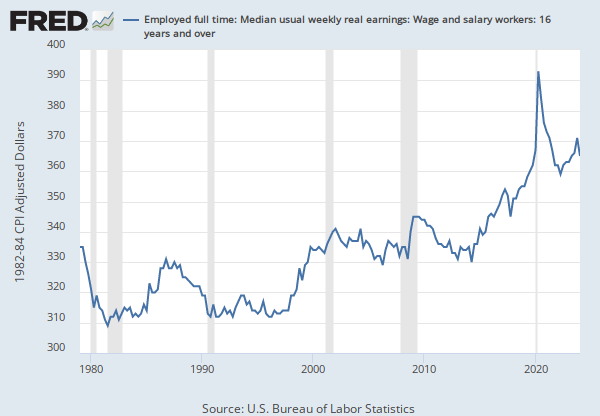


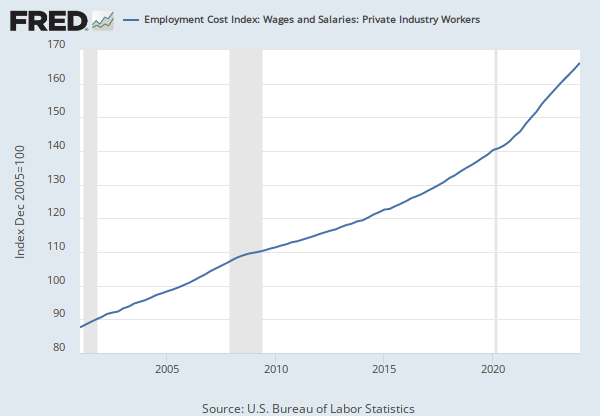


Content Suggestions
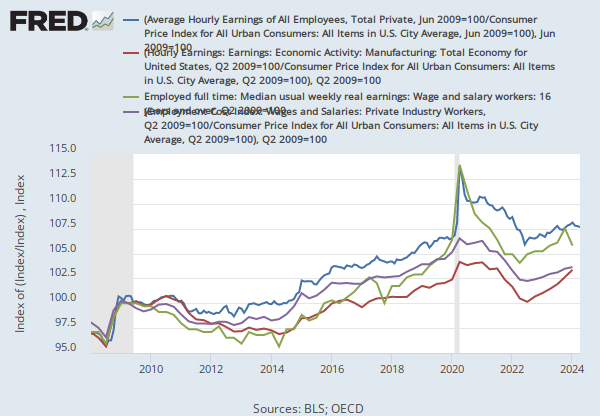


Other Formats
S&P Cotality Case-Shiller MA-Boston Home Price Index
Monthly, Not Seasonally AdjustedAverage Weekly Wages for Employees in Total Covered Establishments in Boston-Cambridge-Quincy, MA-NH (MSA)
Quarterly, Seasonally AdjustedAverage Hourly Earnings of All Employees, Total Private
Monthly, Not Seasonally AdjustedRelated Categories
House Price Indexes
Prices
Boston-Brockton-Nashua, MA-NH-ME-CT (CMSA)
CPI for MSAs and Consolidated MSAs
New Hampshire
Boston-Brockton-Nashua, MA-NH-ME-CT (CMSA)
CPI for MSAs and Consolidated MSAs
Massachusetts
Boston-Brockton-Nashua, MA-NH-ME-CT (CMSA)
CPI for MSAs and Consolidated MSAs
Maine
Boston-Brockton-Nashua, MA-NH-ME-CT (CMSA)
CPI for MSAs and Consolidated MSAs
Connecticut
States
U.S. Regional Data
Boston-Cambridge-Newton, MA-NH
MSAs
Boston-Cambridge-Newton, MA-NH
MSAs
Total Private
Current Employment Statistics (Establishment Survey)
Population, Employment, & Labor Markets
Releases
More
Series from S&P Cotality Case-Shiller Home Price Indices
More
Series from Consumer Price Index
More
Series from Quarterly Census of Employment and Wages
More
Series from Employment Situation
Tags
Boston
New Hampshire
S&P Cotality Case-Shiller Home Price Indices
S&P Dow Jones Indices LLC
Massachusetts
Copyrighted: Pre-Approval Required
House Price Index
Housing
Metropolitan Statistical Area
Price Index
Indexes
Price
Seasonally Adjusted
Monthly
United States of America
Core-Based Statistical Area
Maine
Connecticut
Rent
Urban
Consumer
Consumer Price Index
Inflation
Bureau of Labor Statistics
Public Domain: Citation Requested
Not Seasonally Adjusted
Covered
Quarterly Census of Employment & Wages
Establishments
Average
Wages
St. Louis Fed
Employment
Quarterly
Current Employment Statistics Survey (Establishment Survey)
Earnings
Hours
Private
Nation