Notes
Source: World Bank
Release: World Development Indicators
Units:
Frequency:
Notes:
Gini index measures the extent to which the distribution of income or consumption expenditure among individuals or households within an economy deviates from a perfectly equal distribution. A Lorenz curve plots the cumulative percentages of total income received against the cumulative number of recipients, starting with the poorest individual or household. The Gini index measures the area between the Lorenz curve and a hypothetical line of absolute equality, expressed as a percentage of the maximum area under the line. Thus a Gini index of 0 represents perfect equality, while an index of 100 implies perfect inequality.
Data are based on primary household survey data obtained from government statistical agencies and World Bank country departments. For more information and methodology, please see PovcalNet (http://iresearch.worldbank.org/PovcalNet/index.htm).
Source Indicator: SI.POV.GINI
World Bank collection of development indicators, compiled from officially recognized international sources. It presents the most current and accurate global development data available and includes national, regional, and global estimates. The World Bank labels these annual series, but several observations are missing.
Suggested Citation:
World Bank, GINI Index for China [SIPOVGINICHN], retrieved from FRED, Federal Reserve Bank of St. Louis; https://fred.stlouisfed.org/series/SIPOVGINICHN, .
Source: World Bank
Release: World Development Indicators
Units:
Frequency:
Notes:
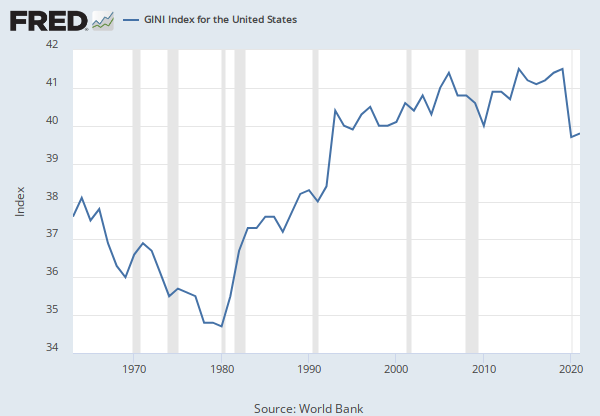
Gini index measures the extent to which the distribution of income or consumption expenditure among individuals or households within an economy deviates from a perfectly equal distribution. A Lorenz curve plots the cumulative percentages of total income received against the cumulative number of recipients, starting with the poorest individual or household. The Gini index measures the area between the Lorenz curve and a hypothetical line of absolute equality, expressed as a percentage of the maximum area under the line. Thus a Gini index of 0 represents perfect equality, while an index of 100 implies perfect inequality.
Data are based on primary household survey data obtained from government statistical agencies and World Bank country departments. For more information and methodology, please see PovcalNet.
Source Indicator: SI.POV.GINI
World Bank collection of development indicators, compiled from officially recognized international sources. It presents the most current and accurate global development data available and includes national, regional, and global estimates. The World Bank labels these annual series, but several observations are missing.
Suggested Citation:
World Bank, GINI Index for the United States [SIPOVGINIUSA], retrieved from FRED, Federal Reserve Bank of St. Louis; https://fred.stlouisfed.org/series/SIPOVGINIUSA, .
Source: U.S. Census Bureau
Release: Income and Poverty in the United States
Units:
Frequency:
Notes:
Beginning with the 2003 Current Population Survey, there are revisions to the available race categories. Respondents are allowed to report more than one race, making selections from a "flash-card" listing. These six race categories are: White, Black or African American, American Indian or Alaskan Native, Asian, Native Hawaiian or Other Pacific Islander, and Other race. The last category includes any other race except the five mentioned. Because of these changes, data on race are not directly comparable to previous series. White Alone, Black Alone, and Asian Alone refer to people who reported White, Black, or Asian and did not report any other race category. Hispanic Origin refers to persons answering the question asking if the person is Spanish, Hispanic, or Latino. If their response is "yes", a follow-up question determines a specific ethnic origin, asking the person to select from a flash-card listing. These selections are Mexican, Mexican-American, Chicano, Puerto Rican, Cuban, Cuban American, or some other Spanish, Hispanic, or Latino group. Use caution when interpreting changes in the racial composition of the U.S. over time.
Suggested Citation:
U.S. Census Bureau, Income Gini Ratio for Households by Race of Householder, All Races [GINIALLRH], retrieved from FRED, Federal Reserve Bank of St. Louis; https://fred.stlouisfed.org/series/GINIALLRH, .
Release Tables
Income and Poverty in the United States
Related Data and Content
Data Suggestions Based On Your Search




Content Suggestions



Related Categories
Income Distribution
Population, Employment, & Labor Markets
Indicators
International Data
Income Distribution
Population, Employment, & Labor Markets
Releases
More
Series from World Development Indicators
More
Series from Income and Poverty in the United States