Notes
Source: U.S. Bureau of Labor Statistics
Release: Employment Situation
Units:
Frequency:
Notes:
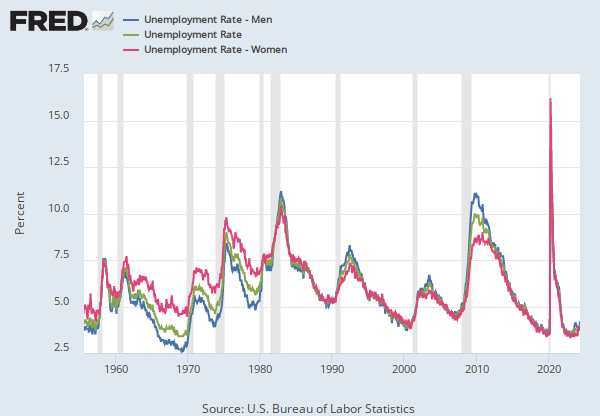
The unemployment rate represents the number of unemployed as a percentage of the labor force. Labor force data are restricted to people 16 years of age and older, who currently reside in 1 of the 50 states or the District of Columbia, who do not reside in institutions (e.g., penal and mental facilities, homes for the aged), and who are not on active duty in the Armed Forces.
This rate is also defined as the U-3 measure of labor underutilization.
The series comes from the 'Current Population Survey (Household Survey)'
The source code is: LNS14000000
Suggested Citation:
U.S. Bureau of Labor Statistics, Unemployment Rate [UNRATE], retrieved from FRED, Federal Reserve Bank of St. Louis; https://fred.stlouisfed.org/series/UNRATE, .
Source: U.S. Bureau of Labor Statistics
Release: Weekly and Hourly Earnings from the Current Population Survey
Units:
Frequency:
Notes:
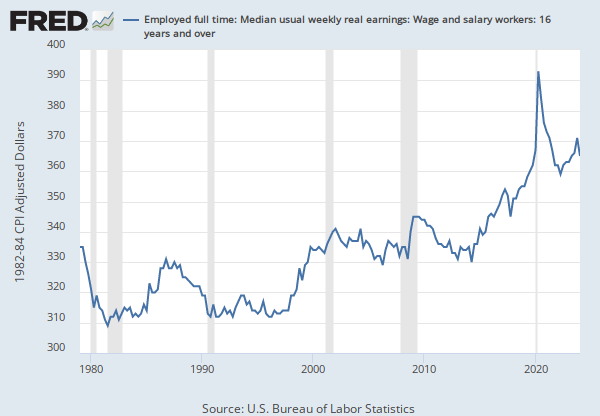
Data measure usual weekly earnings of wage and salary workers. Wage and salary workers are workers who receive wages, salaries, commissions, tips, payment in kind, or piece rates. The group includes employees in both the private and public sectors but, for the purposes of the earnings series, it excludes all self-employed persons, both those with incorporated businesses and those with unincorporated businesses.
Usual weekly earnings represent earnings before taxes and other deductions and include any overtime pay, commissions, or tips usually received (at the main job in the case of multiple jobholders). Prior to 1994, respondents were asked how much they usually earned per week. Since January 1994, respondents have been asked to identify the easiest way for them to report earnings (hourly, weekly, biweekly, twice monthly, monthly, annually, or other) and how much they usually earn in the reported time period. Earnings reported on a basis other than weekly are converted to a weekly equivalent. The term "usual" is determined by each respondent's own understanding of the term. If the respondent asks for a definition of "usual," interviewers are instructed to define the term as more than half the weeks worked during the past 4 or 5 months. For more information see https://www.bls.gov/cps/earnings.htm
The series comes from the 'Current Population Survey (Household Survey)'
The source code is: LEU0252881600
Suggested Citation:
U.S. Bureau of Labor Statistics, Employed full time: Median usual weekly real earnings: Wage and salary workers: 16 years and over [LEU0252881600A], retrieved from FRED, Federal Reserve Bank of St. Louis; https://fred.stlouisfed.org/series/LEU0252881600A, .
Source: U.S. Bureau of Labor Statistics
Release: Total Factor Productivity for Major Industries
Units:
Frequency:
Notes:
The efficiency at which labor hours are utilized in producing output of goods and services, measured as output per hour of labor.
For more information, please go to https://www.bls.gov/mfp/
Source Indicator: MPU4910063
Suggested Citation:
U.S. Bureau of Labor Statistics, Private Nonfarm Business Sector: Labor Productivity [MPU4910063], retrieved from FRED, Federal Reserve Bank of St. Louis; https://fred.stlouisfed.org/series/MPU4910063, .
Release Tables
Employment Situation
- Monthly, Seasonally Adjusted (population data is not adjusted for seasonal variation; not seasonally adjusted version used)
- Table A-10. Selected unemployment indicators, Seasonally adjusted: Monthly, Unemployment Rates
- Table A-15. Alternative measures of labor underutilization: Monthly, Seasonally Adjusted
Total Factor Productivity for Major Industries
Weekly and Hourly Earnings from the Current Population Survey
Related Data and Content
Data Suggestions Based On Your Search






Content Suggestions











Other Formats
Unemployment Rate
Monthly, Not Seasonally AdjustedEmployed full time: Median usual weekly real earnings: Wage and salary workers: 16 years and over
Quarterly, Not Seasonally Adjusted Quarterly, Seasonally AdjustedPrivate Nonfarm Business Sector: Labor Productivity
Index 2017=100, Annual, Not Seasonally AdjustedRelated Categories
Unemployment Rate
Current Population Survey (Household Survey)
Population, Employment, & Labor Markets
Earnings
Nonfarm Business
Productivity & Costs
Releases
More
Series from Employment Situation
More
Series from Weekly and Hourly Earnings from the Current Population Survey
More
Series from Total Factor Productivity for Major Industries
Tags
Labor Underutilization
Headline Figure
Civilian
16 Years +
Labor
Current Population Survey (Household Survey)
Unemployment
Rate
Seasonally Adjusted
Bureau of Labor Statistics
Monthly
Nation
Public Domain: Citation Requested
United States of America
Full-Time
Salaries
Earnings
Workers
Wages
Median
Employment
Real
Annual
Not Seasonally Adjusted
Productivity
Sector
Nonfarm
Business
Private