Notes
Source: U.S. Bureau of Labor Statistics
Release: Job Openings and Labor Turnover Survey
Units:
Frequency:
Notes:
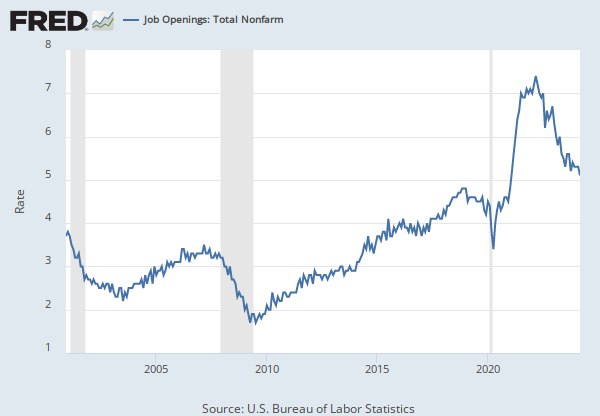
Total Nonfarm Job Openings are a measure of all jobs that are not filled on the last business day of the month. A job is considered open if a specific position exists and there is work available for it, the job can be started within 30 days, and there is active recruiting for the position.
Total Nonfarm Job Openings are measured by the Job Openings and Labor Turnover Survey (JOLTS) and published by the Bureau of Labor Statistics (BLS). These data are a unique economic indicator of unmet demand for labor and labor shortages. Economists, government officials, and researchers use Job Openings as a measure of tightness within job markets.
Note that the set of available job openings may decline because openings become filled, or because previous openings are removed without filling positions.
For more information, see:
U.S. Bureau of Labor Statistics, Job Openings and Labor Turnover Survey Overview Page
U.S. Bureau of Labor Statistics, Data Definitions
Suggested Citation:
U.S. Bureau of Labor Statistics, Job Openings: Total Nonfarm [JTSJOL], retrieved from FRED, Federal Reserve Bank of St. Louis; https://fred.stlouisfed.org/series/JTSJOL, .
Source: Federal Reserve Bank of Atlanta
Release: Sticky Price CPI
Units:
Frequency:
Notes:
The Sticky Price Consumer Price Index (CPI) is calculated from a subset of goods and services included in the CPI that change price relatively infrequently. Because these goods and services change price relatively infrequently, they are thought to incorporate expectations about future inflation to a greater degree than prices that change on a more frequent basis. One possible explanation for sticky prices could be the costs firms incur when changing price.
To obtain more information about this release see: Michael F. Bryan, and Brent H. Meyer. “Are Some Prices in the CPI More Forward Looking Than Others? We Think So.” Economic Commentary (Federal Reserve Bank of Cleveland) (May 19, 2010): 1–6. https://doi.org/10.26509/frbc-ec-201002.
Suggested Citation:
Federal Reserve Bank of Atlanta, Sticky Price Consumer Price Index less Food and Energy [CORESTICKM159SFRBATL], retrieved from FRED, Federal Reserve Bank of St. Louis; https://fred.stlouisfed.org/series/CORESTICKM159SFRBATL, .
Release Tables
Job Openings and Labor Turnover Survey
Related Data and Content
Data Suggestions Based On Your Search


Content Suggestions


Other Formats
Job Openings: Total Nonfarm
Monthly, Not Seasonally Adjusted Rate, Monthly, Not Seasonally Adjusted Rate, Monthly, Seasonally AdjustedSticky Price Consumer Price Index less Food and Energy
3-Month Annualized Percent Change, Monthly, Seasonally Adjusted Percent Change, Monthly, Seasonally Adjusted Percent Change at Annual Rate, Monthly, Seasonally AdjustedRelated Categories
Job Openings (Levels and Rates)
Job Openings and Labor Turnover (JOLTS)
Population, Employment, & Labor Markets
Special Indexes
Consumer Price Indexes (CPI and PCE)
Prices
Releases
Tags
Job Openings
Vacancy
Job Openings and Labor Turnover
Nonfarm
Seasonally Adjusted
Bureau of Labor Statistics
Monthly
Nation
Public Domain: Citation Requested
United States of America
Sticky
Atlanta Fed
Core Inflation
Consumer Price Index
Inflation
Price Index
Rate
Indexes
Price
Copyrighted: Citation Required