Notes
Source: Board of Governors of the Federal Reserve System (US)
Release: H.15 Selected Interest Rates
Units:
Frequency:
Notes:
For further information regarding treasury constant maturity data, please refer to the H.15 Statistical Release notes and Treasury Yield Curve Methodology.
For questions on the data, please contact the data source. For questions on FRED functionality, please contact us here.
Suggested Citation:
Board of Governors of the Federal Reserve System (US), Market Yield on U.S. Treasury Securities at 10-Year Constant Maturity, Quoted on an Investment Basis [DGS10], retrieved from FRED, Federal Reserve Bank of St. Louis; https://fred.stlouisfed.org/series/DGS10, .
Source: U.S. Bureau of Labor Statistics
Release: Consumer Price Index
Units:
Frequency:
Notes:
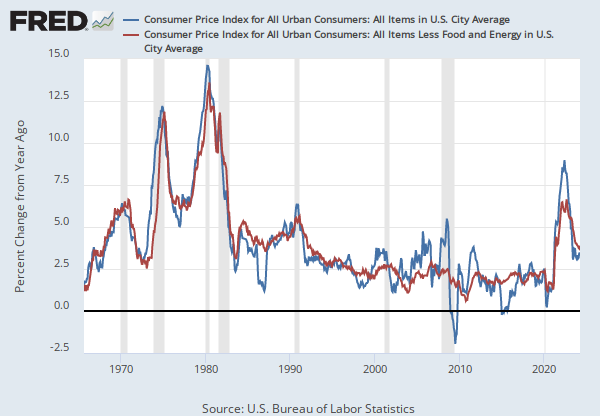
The Consumer Price Index for All Urban Consumers: All Items (CPIAUCSL) is a price index of a basket of goods and services paid by urban consumers. Percent changes in the price index measure the inflation rate between any two time periods. The most common inflation metric is the percent change from one year ago. It can also represent the buying habits of urban consumers. This particular index includes roughly 88 percent of the total population, accounting for wage earners, clerical workers, technical workers, self-employed, short-term workers, unemployed, retirees, and those not in the labor force.
The CPIs are based on prices for food, clothing, shelter, and fuels; transportation fares; service fees (e.g., water and sewer service); and sales taxes. Prices are collected monthly from about 4,000 housing units and approximately 26,000 retail establishments across 87 urban areas. To calculate the index, price changes are averaged with weights representing their importance in the spending of the particular group. The index measures price changes (as a percent change) from a predetermined reference date. In addition to the original unadjusted index distributed, the Bureau of Labor Statistics also releases a seasonally adjusted index. The unadjusted series reflects all factors that may influence a change in prices. However, it can be very useful to look at the seasonally adjusted CPI, which removes the effects of seasonal changes, such as weather, school year, production cycles, and holidays.
The CPI can be used to recognize periods of inflation and deflation. Significant increases in the CPI within a short time frame might indicate a period of inflation, and significant decreases in CPI within a short time frame might indicate a period of deflation. However, because the CPI includes volatile food and oil prices, it might not be a reliable measure of inflationary and deflationary periods. For a more accurate detection, the core CPI (CPILFESL) is often used. When using the CPI, please note that it is not applicable to all consumers and should not be used to determine relative living costs. Additionally, the CPI is a statistical measure vulnerable to sampling error since it is based on a sample of prices and not the complete average.
For more information on the CPI, see the Handbook of Methods, the release notes and announcements, and the Frequently Asked Questions (FAQs).
Suggested Citation:
U.S. Bureau of Labor Statistics, Consumer Price Index for All Urban Consumers: All Items in U.S. City Average [CPIAUCSL], retrieved from FRED, Federal Reserve Bank of St. Louis; https://fred.stlouisfed.org/series/CPIAUCSL, .
Source: National Bureau of Economic Research
Release: NBER Macrohistory Database
Units:
Frequency:
Notes:
Series Is Presented Here As Two Variables--(1)--Original Data, 1919-1944 (2)--Original Data, 1941-1967. Data Were Computed By The Average Of Daily Figures. Data Include Yields In The Partially Tax Exempt Catagory; Data For 1919-1925 Are Callable After Eight Years; Data For 1926-1944, After Twelve Years. Data For 1919-October 15, 1925 Also Include Certain Liberty Loan Issues. Source: Federal Reserve Bulletin, December 1938, P. 1045 And Following Monthly Issues Through March 1944 (Checked With U.S. Department Of Commerce, Survey Of Current Business, March 1939, P. 18, And Following Issues).
This NBER data series m13033a appears on the NBER website in Chapter 13 at http://www.nber.org/databases/macrohistory/contents/chapter13.html.
NBER Indicator: m13033a
Suggested Citation:
National Bureau of Economic Research, Yield on Long-Term United States Bonds for United States [M1333AUSM156NNBR], retrieved from FRED, Federal Reserve Bank of St. Louis; https://fred.stlouisfed.org/series/M1333AUSM156NNBR, .
Source: U.S. Bureau of Labor Statistics
Release: Consumer Price Index
Units:
Frequency:
Notes:
Handbook of Methods
Understanding the CPI: Frequently Asked Questions
Suggested Citation:
U.S. Bureau of Labor Statistics, Consumer Price Index for All Urban Consumers: All Items in U.S. City Average [CPIAUCNS], retrieved from FRED, Federal Reserve Bank of St. Louis; https://fred.stlouisfed.org/series/CPIAUCNS, .
Source: National Bureau of Economic Research
Release: NBER Macrohistory Database
Units:
Frequency:
Notes:
Series Is Presented Here As Two Variables--(1)--Original Data, 1919-1944 (2)--Original Data, 1941-1967. Yield Is The Average For Taxable U.S. Bonds, Averages Being Computed On Basis Of The Mean Of Closing Bid And Ask Quotations On The Over-The-Counter-Market In New York City. Data For 1941-March 1952 Refer To Bonds Which Were Neither Due Or Callable For At Least Fifteen Years; Data For April 1952-March 1953, At Least Twelve Years; Data For April 1953-October 1955, From Twelve To Twenty Years; For November 1955-1967, From Ten To Twenty Years. Data For 1958-1962 Were Figured On Averages Of Daily Figures, Therefore Discrepancies May Result When Averages Of Weekly Figures Are Taken. Source: U.S. Treasury Department, Treasury Bulletin Of February 1948, And Following Monthly Issues (See Issues Of Federal Reserve Board Bulletins, May 1945, October 1947, January 1958, P. 84, And Following Monthly Issues.
This NBER data series m13033b appears on the NBER website in Chapter 13 at http://www.nber.org/databases/macrohistory/contents/chapter13.html.
NBER Indicator: m13033b
Suggested Citation:
National Bureau of Economic Research, Yield on Long-Term United States Bonds for United States [M1333BUSM156NNBR], retrieved from FRED, Federal Reserve Bank of St. Louis; https://fred.stlouisfed.org/series/M1333BUSM156NNBR, .
Release Tables
Consumer Price Index
- CPI for U.S. City Average: Monthly, Seasonally Adjusted
- CPI for U.S. City Average: Monthly, Not Seasonally Adjusted
H.15 Selected Interest Rates
Related Data and Content
Data Suggestions Based On Your Search














Content Suggestions







Other Formats
Market Yield on U.S. Treasury Securities at 10-Year Constant Maturity, Quoted on an Investment Basis
Annual, Not Seasonally Adjusted Monthly, Not Seasonally Adjusted Weekly, Not Seasonally AdjustedConsumer Price Index for All Urban Consumers: All Items in U.S. City Average
Monthly, Seasonally Adjusted Semiannual, Not Seasonally AdjustedYield on Long-Term United States Bonds for United States
Monthly, Not Seasonally AdjustedRelated Categories
Treasury Constant Maturity
Interest Rates
Money, Banking, & Finance
Consumer Price Indexes (CPI and PCE)
Prices
Interest Rates
NBER Macrohistory Database
Academic Data
Releases
More
Series from H.15 Selected Interest Rates
More
Series from Consumer Price Index
More
Series from NBER Macrohistory Database
Tags
10-Year
H.15 Selected Interest Rates
Maturity
Treasury
Interest Rate
Interest
Daily
Board of Governors
Rate
Nation
Public Domain: Citation Requested
United States of America
Not Seasonally Adjusted
Headline Figure
Average
All Items
Urban
Consumer
Consumer Price Index
Inflation
Price Index
Indexes
Seasonally Adjusted
Price
Bureau of Labor Statistics
Monthly
Long-Term
National Bureau of Economic Research
Bonds
Yield
Copyrighted: Citation Required