Federal Reserve Economic Data
Notes
Source: U.S. Bureau of Economic Analysis
Release: Gross Domestic Product
Units:
Frequency:
Notes:
BEA Account Code: A191RC
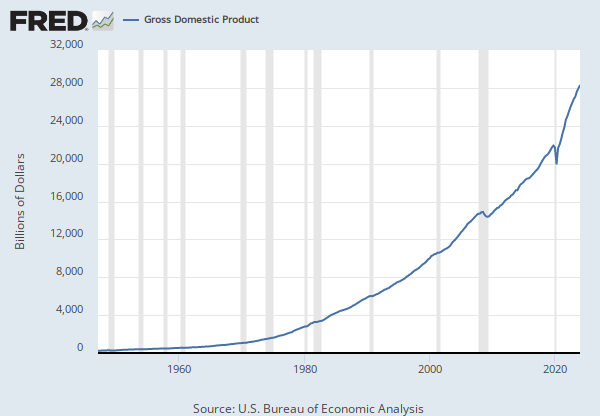
Gross domestic product (GDP), the featured measure of U.S. output, is the market value of the goods and services produced by labor and property located in the United States.For more information, see the Guide to the National Income and Product Accounts of the United States (NIPA) and the Bureau of Economic Analysis.
Suggested Citation:
U.S. Bureau of Economic Analysis, Gross Domestic Product [GDP], retrieved from FRED, Federal Reserve Bank of St. Louis; https://fred.stlouisfed.org/series/GDP, .
Source: U.S. Bureau of Economic Analysis
Release: Personal Income and Outlays
Units:
Frequency:
Notes:
Population includes resident population plus armed forces overseas. The monthly estimate is the average of estimates for the first of the month and the first of the following month.
BEA Account Code: B230RC
A Guide to the National Income and Product Accounts of the United States (NIPA) - (http://www.bea.gov/national/pdf/nipaguid.pdf)
Suggested Citation:
U.S. Bureau of Economic Analysis, Population [POPTHM], retrieved from FRED, Federal Reserve Bank of St. Louis; https://fred.stlouisfed.org/series/POPTHM, .
Source: U.S. Bureau of Economic Analysis
Release: Gross Domestic Product
Units:
Frequency:
Notes:
BEA Account Code: B4701C
For more information about this series, please see http://www.bea.gov/national/.
Suggested Citation:
U.S. Bureau of Economic Analysis, Hours worked by full-time and part-time employees [B4701C0A222NBEA], retrieved from FRED, Federal Reserve Bank of St. Louis; https://fred.stlouisfed.org/series/B4701C0A222NBEA, .
Source: U.S. Bureau of Economic Analysis
Release: Gross Domestic Product
Units:
Frequency:
Notes:
BEA Account Code: NA000334
Suggested Citation:
U.S. Bureau of Economic Analysis, Gross Domestic Product [NA000334Q], retrieved from FRED, Federal Reserve Bank of St. Louis; https://fred.stlouisfed.org/series/NA000334Q, .
Source: U.S. Bureau of Labor Statistics
Release: Employment Situation
Units:
Frequency:
Notes:
Average weekly hours relate to the average hours per worker for which pay was received and is different from standard or scheduled hours. Factors such as unpaid absenteeism, labor turnover, part-time work, and stoppages cause average weekly hours to be lower than scheduled hours of work for an establishment. Group averages further reflect changes in the workweek of component industries. Average weekly hours are the total weekly hours divided by the employees paid for those hours.
Production and related employees include working supervisors and all nonsupervisory employees (including group leaders and trainees) engaged in fabricating, processing, assembling, inspecting, receiving, storing, handling, packing, warehousing, shipping, trucking, hauling, maintenance, repair, janitorial, guard services, product development, auxiliary production for plant's own use (for example, power plant), recordkeeping, and other services closely associated with the above production operations.
Nonsupervisory employees include those individuals in private, service-providing industries who are not above the working-supervisor level. This group includes individuals such as office and clerical workers, repairers, salespersons, operators, drivers, physicians, lawyers, accountants, nurses, social workers, research aides, teachers, drafters, photographers, beauticians, musicians, restaurant workers, custodial workers, attendants, line installers and repairers, laborers, janitors, guards, and other employees at similar occupational levels whose services are closely associated with those of the employees listed.
The series comes from the 'Current Employment Statistics (Establishment Survey).'
The source code is: CES0500000007
Suggested Citation:
U.S. Bureau of Labor Statistics, Average Weekly Hours of Production and Nonsupervisory Employees, Total Private [AWHNONAG], retrieved from FRED, Federal Reserve Bank of St. Louis; https://fred.stlouisfed.org/series/AWHNONAG, .
Source: U.S. Bureau of Economic Analysis
Release: Supplemental Estimates, Underlying Detail Tables
Units:
Frequency:
Notes:
BEA Account Code: DHSGRC
For further information, please visit the source website at http://www.bea.gov/national/ .
Suggested Citation:
U.S. Bureau of Economic Analysis, Personal Consumption Expenditures by Type of Product: Services: Household Consumption Expenditures: Housing [DHSGRC0], retrieved from FRED, Federal Reserve Bank of St. Louis; https://fred.stlouisfed.org/series/DHSGRC0, .
Source: U.S. Bureau of Economic Analysis
Release: Gross Domestic Product
Units:
Frequency:
Notes:
BEA Account Code: DHLCRC
For more information about this series, please see http://www.bea.gov/national/.
Suggested Citation:
U.S. Bureau of Economic Analysis, Personal consumption expenditures: Services: Health care [DHLCRC1Q027SBEA], retrieved from FRED, Federal Reserve Bank of St. Louis; https://fred.stlouisfed.org/series/DHLCRC1Q027SBEA, .
Source: U.S. Bureau of Labor Statistics
Release: Productivity and Costs
Units:
Frequency:
Suggested Citation:
U.S. Bureau of Labor Statistics, Nonfarm Business Sector: Hours Worked for All Workers [HOANBS], retrieved from FRED, Federal Reserve Bank of St. Louis; https://fred.stlouisfed.org/series/HOANBS, .
Source: Organization for Economic Co-operation and Development
Release: Main Economic Indicators
Units:
Frequency:
Notes:
OECD Data Filters:
REF_AREA: USA
MEASURE: WAP
UNIT_MEASURE: PS
TRANSFORMATION: _Z
ADJUSTMENT: N
SEX: _T
AGE: Y25T54
ACTIVITY: _Z
FREQ: M
All OECD data should be cited as follows: OECD (year), (dataset name), (data source) DOI or https://data-explorer.oecd.org/. (accessed on (date)).
Suggested Citation:
Organization for Economic Co-operation and Development, Infra-Annual Labor Statistics: Working-Age Population Total: From 25 to 54 Years for United States [LFWA25TTUSM647N], retrieved from FRED, Federal Reserve Bank of St. Louis; https://fred.stlouisfed.org/series/LFWA25TTUSM647N, .
Source: Organization for Economic Co-operation and Development
Release: Main Economic Indicators
Units:
Frequency:
Notes:
OECD Data Filters:
REF_AREA: USA
MEASURE: WAP
UNIT_MEASURE: PS
TRANSFORMATION: _Z
ADJUSTMENT: Y
SEX: _T
AGE: Y55T64
ACTIVITY: _Z
FREQ: M
All OECD data should be cited as follows: OECD (year), (dataset name), (data source) DOI or https://data-explorer.oecd.org/. (accessed on (date)).
Suggested Citation:
Organization for Economic Co-operation and Development, Infra-Annual Labor Statistics: Working-Age Population Total: From 55 to 64 Years for United States [LFWA55TTUSM647S], retrieved from FRED, Federal Reserve Bank of St. Louis; https://fred.stlouisfed.org/series/LFWA55TTUSM647S, .
Release Tables
Employment Situation
Gross Domestic Product
- Table 1.1.5. Gross Domestic Product: Quarterly
- Table 1.2.5. Gross Domestic Product by Major Type of Product: Quarterly
- Table 1.3.5. Gross Value Added by Sector: Quarterly
- Table 1.4.5. Relation of Gross Domestic Product, Gross Domestic Purchases, and Final Sales to Domestic Purchasers: Quarterly
- Table 1.5.5. Gross Domestic Product, Expanded Detail: Quarterly
- Table 1.7.5. Relation of Gross Domestic Product, Gross National Product, Net National Product, National Income, and Personal Income: Quarterly
- Table 1.17.5. Gross Domestic Product, Gross Domestic Income, and Other Major NIPA Aggregates: Quarterly
- Table 2.3.5. Personal Consumption Expenditures by Major Type of Product: Quarterly
- Table 8.1.5. Gross Domestic Product, Not Seasonally Adjusted, Quarterly
Main Economic Indicators
- Labor Force Survey - quarterly levels, Monthly, Not Seasonally Adjusted
- Labor Force Survey - quarterly levels, Monthly, Seasonally Adjusted
Personal Income and Outlays
Productivity and Costs
Related Data and Content
Data Suggestions Based On Your Search









Content Suggestions









Other Formats
Gross Domestic Product
Annual, Not Seasonally Adjusted Annual, Not Seasonally Adjusted Index 2017=100, Quarterly, Not Seasonally Adjusted Millions of Dollars, Quarterly, Not Seasonally Adjusted Percent Change from Preceding Period, Annual, Not Seasonally Adjusted Percent Change from Preceding Period, Quarterly, Seasonally Adjusted Annual RatePopulation
Annual, Not Seasonally Adjusted Quarterly, Not Seasonally AdjustedAverage Weekly Hours of Production and Nonsupervisory Employees, Total Private
Monthly, Not Seasonally AdjustedPersonal consumption expenditures: Services: Health care
Annual, Not Seasonally AdjustedNonfarm Business Sector: Hours Worked for All Workers
Percent Change at Annual Rate, Quarterly, Seasonally Adjusted Percent Change from Quarter One Year Ago, Quarterly, Seasonally AdjustedInfra-Annual Labor Statistics: Working-Age Population Total: From 25 to 54 Years for United States
Annual, Not Seasonally Adjusted Annual, Seasonally Adjusted Monthly, Seasonally Adjusted Quarterly, Not Seasonally Adjusted Quarterly, Seasonally AdjustedInfra-Annual Labor Statistics: Working-Age Population Total: From 55 to 64 Years for United States
Annual, Not Seasonally Adjusted Annual, Seasonally Adjusted Monthly, Not Seasonally Adjusted Quarterly, Not Seasonally Adjusted Quarterly, Seasonally AdjustedRelated Categories
GDP/GNP
National Income & Product Accounts
National Accounts
Population
Population, Employment, & Labor Markets
Full-time & Part-time Employees
Industry
Total Private
Current Employment Statistics (Establishment Survey)
Personal Income & Outlays
Personal Consumption Expenditures
Nonfarm Business
Productivity & Costs
Labor Force
Population, Employment, & Labor Markets
Indicators
United States
Countries
International Data
Releases
More
Series from Gross Domestic Product
More
Series from Personal Income and Outlays
More
Series from Employment Situation
More
Series from Supplemental Estimates, Underlying Detail Tables
More
Series from Productivity and Costs
More
Series from Main Economic Indicators
Tags
National Income and Product Accounts
Bureau of Economic Analysis
Gross Domestic Product
Quarterly
Seasonally Adjusted
Nation
Public Domain: Citation Requested
United States of America
Population
Monthly
Not Seasonally Adjusted
Part-Time
Full-Time
Hours
Employment
Annual
Nonsupervisory
Headline Figure
Current Employment Statistics Survey (Establishment Survey)
Production
Private
Bureau of Labor Statistics
Personal Consumption Expenditures
Consumption Expenditures
Consumption
Households
Personal
Housing
Services
Health
Nonfarm
Sector
Business
Working-Age
25 to 54 Years
Main Economic Indicators
Org. for Economic Co-operation and Development
Copyrighted: Citation Required
55 to 64 Years