Notes
Source: Federal Reserve Bank of St. Louis
Release: St. Louis Fed Financial Stress Index
Units:
Frequency:
Notes:
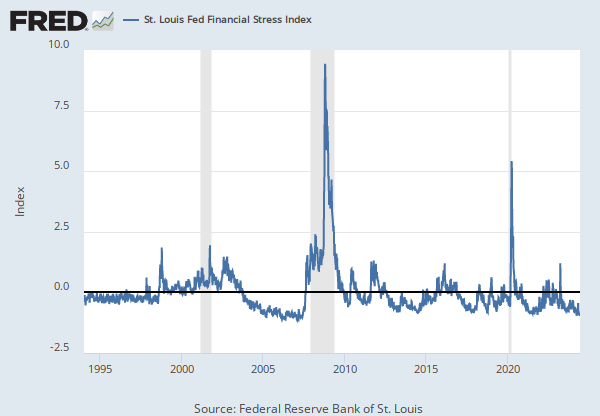
The STLFSI4 measures the degree of financial stress in the markets and is constructed from 18 weekly data series: seven interest rate series, six yield spreads and five other indicators. Each of these variables captures some aspect of financial stress. Accordingly, as the level of financial stress in the economy changes, the data series are likely to move together.
How to Interpret the Index:
The average value of the index, which begins in late 1993, is designed to be zero. Thus, zero is viewed as representing normal financial market conditions. Values below zero suggest below-average financial market stress, while values above zero suggest above-average financial market stress.
More information:
The STLFSI4 is the third revision (i.e., STLFSI3 and STLFSI2 of the original STLFSI. Whereas the STLFSI3 used the past 90-day average backward-looking secured overnight financing rate (SOFR) in two of their yield spreads, the STLFSI4 uses the 90-day forward-looking SOFR in its place. For more information, see "The St. Louis Fed’s Financial Stress Index, Version 4.0". For information on earlier STLFSIs, see "Measuring Financial Market Stress", "The St. Louis Fed’s Financial Stress Index, Version 2.0.", and "The St. Louis Fed’s Financial Stress Index, Version 3.0".
Suggested Citation:
Federal Reserve Bank of St. Louis, St. Louis Fed Financial Stress Index [STLFSI4], retrieved from FRED, Federal Reserve Bank of St. Louis; https://fred.stlouisfed.org/series/STLFSI4, .
Source: Federal Reserve Bank of Kansas City
Release: Kansas City Financial Stress Index
Units:
Frequency:
Notes:
Starting with the September 14, 2021, release, the SNL U.S. Bank index, an underlying index used in the calculation of the KCFSI, has been replaced with the S&P U.S. BMI Banks Index on the S&P Capital IQ platform. As the replacement index provides limited historical data, the KCFSI uses predicted values for the S&P U.S. BMI Banks Index between 1989 and 2004, resulting from a linear regression of the replacement index against the original index. This methodology produces highly correlated values of the current KCFSI with previous values, suggesting a minimal effect on the KCFSI. To obtain further information please see: Financial Stress: What Is It, How Can It Be Measured, and Why Does It Matter?.
Suggested Citation:
Federal Reserve Bank of Kansas City, Kansas City Financial Stress Index [KCFSI], retrieved from FRED, Federal Reserve Bank of St. Louis; https://fred.stlouisfed.org/series/KCFSI, .
Source: Federal Reserve Bank of Chicago
Release: Chicago Fed National Financial Conditions Index
Units:
Frequency:
Notes:
The Chicago Fed's National Financial Conditions Index (NFCI) provides a comprehensive weekly update on U.S. financial conditions in money markets, debt and equity markets and the traditional and "shadow" banking systems. Positive values of the NFCI indicate financial conditions that are tighter than average, while negative values indicate financial conditions that are looser than average.
For further information, please visit the Federal Reserve Bank of Chicago.
Suggested Citation:
Federal Reserve Bank of Chicago, Chicago Fed National Financial Conditions Index [NFCI], retrieved from FRED, Federal Reserve Bank of St. Louis; https://fred.stlouisfed.org/series/NFCI, .
Related Data and Content
Data Suggestions Based On Your Search










Content Suggestions


Related Categories
Releases
More
Series from St. Louis Fed Financial Stress Index
More
Series from Kansas City Financial Stress Index
More
Series from Chicago Fed National Financial Conditions Index