Notes
Source: U.S. Census Bureau
Release: Income and Poverty in the United States
Units:
Frequency:
Notes:
Income in 2025 C-CPI-U (2000-2025) and R-CPI-U-RS (pre-2000) adjusted dollars.
Suggested Citation:
U.S. Census Bureau, Real Median Household Income in the United States [MEHOINUSA672N], retrieved from FRED, Federal Reserve Bank of St. Louis; https://fred.stlouisfed.org/series/MEHOINUSA672N, .
Source: U.S. Bureau of Economic Analysis
Release: Gross Domestic Product
Units:
Frequency:
Notes:
BEA Account Code: A191RX
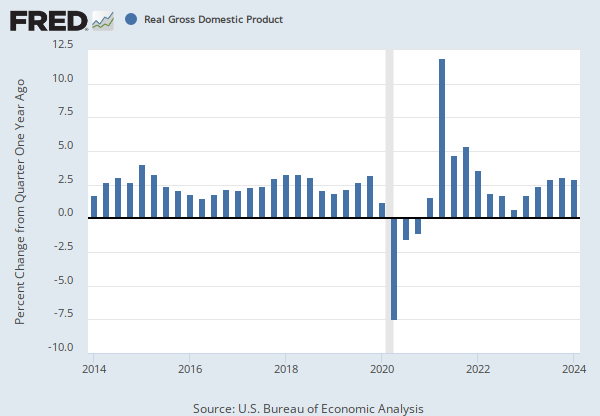
Real gross domestic product is the inflation adjusted value of the goods and services produced by labor and property located in the United States.For more information see the Guide to the National Income and Product Accounts of the United States (NIPA). For more information, please visit the Bureau of Economic Analysis.
Suggested Citation:
U.S. Bureau of Economic Analysis, Real Gross Domestic Product [GDPC1], retrieved from FRED, Federal Reserve Bank of St. Louis; https://fred.stlouisfed.org/series/GDPC1, .
Source: U.S. Census Bureau
Release: Families and Living Arrangements
Units:
Frequency:
Notes:
Household is an occupied housing unit.
Householder is a person in whose name the housing unit is rented or owned. This person must be at least 15 years old.
Family household is a household in which there is at least 1 person present who is related to the householder by birth, marriage or adoption.
Family is used to refer to a family household. In general, family consists of those related to each other by birth, marriage or adoption.
This data uses the householder's person weight to describe characteristics of people living in households. As a result, estimates of the number of households do not match estimates of housing units from the Housing Vacancy Survey (HVS). The HVS is weighted to housing units, rather than the population, in order to more accurately estimate the number of occupied and vacant housing units. For more information about the source and accuracy statement of the Annual Social and Economic Supplement (ASEC) of the Current Population Survey (CPS) see the technical documentation accessible at: http://www.census.gov/programs-surveys/cps/technical-documentation/complete.html
Suggested Citation:
U.S. Census Bureau, Total Households [TTLHH], retrieved from FRED, Federal Reserve Bank of St. Louis; https://fred.stlouisfed.org/series/TTLHH, .
Release Tables
Families and Living Arrangements
Gross Domestic Product
- Table 1.1.6. Real Gross Domestic Product, Chained Dollars: Quarterly
- Table 1.2.6. Real Gross Domestic Product by Major Type of Product, Chained Dollars: Quarterly
- Table 1.3.6. Real Gross Value Added by Sector, Chained Dollars: Quarterly
- Table 1.4.6. Relation of Real Gross Domestic Product, Real Gross Domestic Purchases, and Real Final Sales to Domestic Purchasers, Chained Dollars: Quarterly
- Table 1.5.6. Real Gross Domestic Product, Expanded Detail, Chained Dollars: Quarterly
- Table 1.7.6. Relation of Real Gross Domestic Product, Real Gross National Product, and Real Net National Product, Chained Dollars: Quarterly
- Table 1.8.6. Command-Basis Real Gross Domestic Product and Gross National Product, Chained Dollars: Quarterly
- Table 1.17.6. Real Gross Domestic Product, Real Gross Domestic Income, and Other Major NIPA Aggregates, Chained Dollars: Quarterly
Income and Poverty in the United States
Related Data and Content
Data Suggestions Based On Your Search







Content Suggestions









Other Formats
Annual, Not Seasonally Adjusted
Quarterly, Not Seasonally Adjusted
Index 2017=100, Quarterly, Not Seasonally Adjusted
Percent Change from Preceding Period, Annual, Not Seasonally Adjusted
Percent Change from Preceding Period, Quarterly, Seasonally Adjusted Annual Rate
Percent Change from Quarter One Year Ago, Quarterly, Not Seasonally Adjusted
Percent Change from Quarter One Year Ago, Quarterly, Seasonally Adjusted
Related Categories
Income Distribution
Population, Employment, & Labor Markets
GDP/GNP
National Income & Product Accounts
National Accounts
Population
Releases
More
Series from Income and Poverty in the United States
More
Series from Gross Domestic Product
More
Series from Families and Living Arrangements
Tags
Households
Median
Income
Real
Census
Annual
Nation
Public Domain: Citation Requested
United States of America
Not Seasonally Adjusted
Headline Figure
National Income and Product Accounts
Bureau of Economic Analysis
Gross Domestic Product
Quarterly
Seasonally Adjusted
Current Population Survey (Household Survey)