Notes
Source: U.S. Bureau of Labor Statistics
Release: Employment Situation
Units:
Frequency:
Notes:
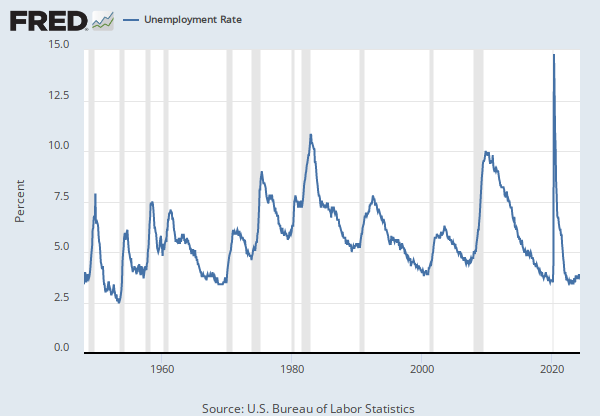
The unemployment rate represents the number of unemployed as a percentage of the labor force. Labor force data are restricted to people 16 years of age and older, who currently reside in 1 of the 50 states or the District of Columbia, who do not reside in institutions (e.g., penal and mental facilities, homes for the aged), and who are not on active duty in the Armed Forces.
This rate is also defined as the U-3 measure of labor underutilization.
The series comes from the 'Current Population Survey (Household Survey)'
The source code is: LNS14000000
Suggested Citation:
U.S. Bureau of Labor Statistics, Unemployment Rate [UNRATE], retrieved from FRED, Federal Reserve Bank of St. Louis; https://fred.stlouisfed.org/series/UNRATE, .
Source: U.S. Bureau of Labor Statistics
Release: Employment Situation
Units:
Frequency:
Notes:
The series comes from the 'Current Population Survey (Household Survey)'
The source code is: LNS11300000
The Labor Force Participation Rate is defined by the Current Population Survey (CPS) as “the number of people in the labor force as a percentage of the civilian noninstitutional population […] the participation rate is the percentage of the population that is either working or actively looking for work.”
The Labor Force Participation Rate is collected in the CPS and published by the BLS. It is provided on a monthly basis, so this data is used in part by macroeconomists as an initial economic indicator of current labor market trends. The labor force participation rate helps government agencies, financial markets, and researchers gauge the overall health of the economy.
Note that long-run changes in labor force participation may reflect secular economic trends that are unrelated to the overall health of the economy. For instance, demographic changes such as the aging of population can lead to a secular increase of exits from the labor force, shrinking the labor force and decreasing the labor force participation rate.
For more information, see:
U.S. Bureau of Labor Statistics, CES Overview
U.S. Bureau of Labor Statistics, Concepts and Definitions (CPS)
Suggested Citation:
U.S. Bureau of Labor Statistics, Labor Force Participation Rate [CIVPART], retrieved from FRED, Federal Reserve Bank of St. Louis; https://fred.stlouisfed.org/series/CIVPART, .
Source: U.S. Bureau of Economic Analysis
Release: Personal Income and Outlays
Units:
Frequency:
Notes:
BEA Account Code: B069RC
A Guide to the National Income and Product Accounts of the United States (NIPA) - (http://www.bea.gov/national/pdf/nipaguid.pdf)
Suggested Citation:
U.S. Bureau of Economic Analysis, Personal interest payments [B069RC1], retrieved from FRED, Federal Reserve Bank of St. Louis; https://fred.stlouisfed.org/series/B069RC1, .
Source: U.S. Census Bureau
Release: Income and Poverty in the United States
Units:
Frequency:
Notes:
Household data are collected as of March.
As stated in the Census's "Source and Accuracy of Estimates for Income, Poverty, and Health Insurance Coverage in the United States: 2011" (http://www.census.gov/hhes/www/p60_243sa.pdf):
Estimation of Median Incomes. The Census Bureau has changed the methodology for computing median income over time. The Census Bureau has computed medians using either Pareto interpolation or linear interpolation. Currently, we are using linear interpolation to estimate all medians. Pareto interpolation assumes a decreasing density of population within an income interval, whereas linear interpolation assumes a constant density of population within an income interval. The Census Bureau calculated estimates of median income and associated standard errors for 1979 through 1987 using Pareto interpolation if the estimate was larger than $20,000 for people or $40,000 for families and households. This is because the width of the income interval containing the estimate is greater than $2,500.
We calculated estimates of median income and associated standard errors for 1976, 1977, and 1978 using Pareto interpolation if the estimate was larger than $12,000 for people or $18,000 for families and households. This is because the width of the income interval containing the estimate is greater than $1,000. All other estimates of median income and associated standard errors for 1976 through 2011 (2012 ASEC) and almost all of the estimates of median income and associated standard errors for 1975 and earlier were calculated using linear interpolation.
Thus, use caution when comparing median incomes above $12,000 for people or $18,000 for families and households for different years. Median incomes below those levels are more comparable from year to year since they have always been calculated using linear interpolation. For an indication of the comparability of medians calculated using Pareto interpolation with medians calculated using linear interpolation, see Series P-60, Number 114, Money Income in 1976 of Families and Persons in the United States (www2.census.gov/prod2/popscan/p60-114.pdf).
Suggested Citation:
U.S. Census Bureau, Median Household Income in the United States [MEHOINUSA646N], retrieved from FRED, Federal Reserve Bank of St. Louis; https://fred.stlouisfed.org/series/MEHOINUSA646N, .
Release Tables
Employment Situation
- Monthly, Seasonally Adjusted (population data is not adjusted for seasonal variation; not seasonally adjusted version used)
- Table A-10. Selected unemployment indicators, Seasonally adjusted: Monthly, Unemployment Rates
- Table A-15. Alternative measures of labor underutilization: Monthly, Seasonally Adjusted
Income and Poverty in the United States
Personal Income and Outlays
Related Data and Content
Data Suggestions Based On Your Search











Content Suggestions











Other Formats
Unemployment Rate
Monthly, Not Seasonally AdjustedLabor Force Participation Rate
Monthly, Not Seasonally AdjustedPersonal interest payments
Annual, Not Seasonally Adjusted Quarterly, Seasonally Adjusted Annual RateRelated Categories
Unemployment Rate
Current Population Survey (Household Survey)
Population, Employment, & Labor Markets
Civilian Labor Force Participation Rate
Personal Income & Outlays
National Income & Product Accounts
National Accounts
Income Distribution
Releases
More
Series from Employment Situation
More
Series from Personal Income and Outlays
More
Series from Income and Poverty in the United States
Tags
Labor Underutilization
Headline Figure
Civilian
16 Years +
Current Population Survey (Household Survey)
Labor
Unemployment
Rate
Seasonally Adjusted
Bureau of Labor Statistics
Monthly
Nation
Public Domain: Citation Requested
United States of America
Participation
Labor Force
Payments
Personal
National Income and Product Accounts
Interest
Bureau of Economic Analysis
Households
Income
Median
Census
Annual
Not Seasonally Adjusted