Notes
Source: Federal Reserve Bank of St. Louis
Release: St. Louis Fed Financial Stress Index
Units:
Frequency:
Notes:
The methodology for the St. Louis Fed's Financial Stress Index was revised and this series is discontinued. The new version, STLFSI3, can be found here.
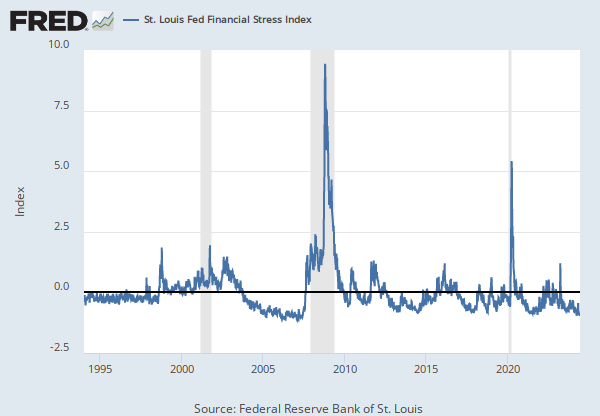
The STLFSI measures the degree of financial stress in the markets and is constructed from 18 weekly data series: seven interest rate series, six yield spreads and five other indicators. Each of these variables captures some aspect of financial stress. Accordingly, as the level of financial stress in the economy changes, the data series are likely to move together.
How to Interpret the Index:
The average value of the index, which begins in late 1993, is designed to be zero. Thus, zero is viewed as representing normal financial market conditions. Values below zero suggest below-average financial market stress, while values above zero suggest above-average financial market stress.
More information:
For additional information on the STLFSI and its construction, see "Measuring Financial Market Stress" and the related appendix.
See this list of the components that are used to construct the STLFSI.
As of 07/15/2010 the Vanguard Financial Exchange-Traded Fund series has been replaced with the S&P 500 Financials Index. This change was made to facilitate a more timely and automated updating of the FSI. Switching from the Vanguard series to the S&P series produced no meaningful change in the index.
Copyright, 2016, Federal Reserve Bank of St. Louis.
Suggested Citation:
Federal Reserve Bank of St. Louis, St. Louis Fed Financial Stress Index (DISCONTINUED) [STLFSI], retrieved from FRED, Federal Reserve Bank of St. Louis; https://fred.stlouisfed.org/series/STLFSI, .
Source: Federal Reserve Bank of Cleveland
Release: Cleveland Financial Stress Index
Units:
Frequency:
Notes:
In May of 2016, the source discovered errors in the calculation of the CFSI and began a detailed review of the index and its underlying model. Following that review, the source decided to discontinue the CFSI. https://www.clevelandfed.org/en/our-research/indicators-and-data/cleveland-financial-stress-index.aspx
The source has posted to their website a message regarding this release: Cleveland Financial Stress Index under review and a revised index expected in the fourth quarter of 2016. A thorough review of the index is being conducted to both simplify the index and enhance its robustness, while also taking into consideration changes in financial markets and institutions. This review and the revisions to the CFSI are expected to be completed sometime during the fourth quarter of this year, and additional details will be made available at that time. Thank you for your patience while we improve the CFSI.
The CFSI is designed to track distress in the US financial system on a continuous basis giving the financial-system supervisors the ability to monitor stressful episodes as they are building in the economy. Such early detection is important because financial stress can quickly be amplified when stress is occurring in more than one market. The CFSI tracks stress in six types of markets: credit markets, equity markets, foreign exchange markets, funding markets (interbank markets), real estate markets, and securitization markets. The CFSI is a coincident indicator of systemic stress, where a high value of CFSI indicates high systemic financial stress. Units of CFSI are expressed as standardized differences from the mean (z-scores).
The CFSI data for weekends and holidays is extrapolated.
To interpret the stress continuum, CFSI is first divided it into four levels or grades. The grade thresholds are dynamic and move slowly over time. The four grades are:
Grade Description Range
Grade 1 Low stress period CFSI < -0.733
Grade 2 Normal stress period -0.733 ≥ CFSI < 0.544
Grade 3 Moderate stress period 0.544 ≥ CFSI < 1.82
Grade 4 Significant stress period CFSI ≥ 1.82
Suggested Citation:
Federal Reserve Bank of Cleveland, Cleveland Financial Stress Index (DISCONTINUED) [CFSI], retrieved from FRED, Federal Reserve Bank of St. Louis; https://fred.stlouisfed.org/series/CFSI, .
Source: Federal Reserve Bank of Kansas City
Release: Kansas City Financial Stress Index
Units:
Frequency:
Notes:
Starting with the September 14, 2021, release, the SNL U.S. Bank index, an underlying index used in the calculation of the KCFSI, has been replaced with the S&P U.S. BMI Banks Index on the S&P Capital IQ platform. As the replacement index provides limited historical data, the KCFSI uses predicted values for the S&P U.S. BMI Banks Index between 1989 and 2004, resulting from a linear regression of the replacement index against the original index. This methodology produces highly correlated values of the current KCFSI with previous values, suggesting a minimal effect on the KCFSI. To obtain further information please see: Financial Stress: What Is It, How Can It Be Measured, and Why Does It Matter?.
Suggested Citation:
Federal Reserve Bank of Kansas City, Kansas City Financial Stress Index [KCFSI], retrieved from FRED, Federal Reserve Bank of St. Louis; https://fred.stlouisfed.org/series/KCFSI, .
Source: Federal Reserve Bank of Chicago
Release: Chicago Fed National Financial Conditions Index
Units:
Frequency:
Notes:
The Chicago Fed's National Financial Conditions Index (NFCI) provides a comprehensive weekly update on U.S. financial conditions in money markets, debt and equity markets and the traditional and "shadow" banking systems. Positive values of the NFCI indicate financial conditions that are tighter than average, while negative values indicate financial conditions that are looser than average.
For further information, please visit the Federal Reserve Bank of Chicago.
Suggested Citation:
Federal Reserve Bank of Chicago, Chicago Fed National Financial Conditions Index [NFCI], retrieved from FRED, Federal Reserve Bank of St. Louis; https://fred.stlouisfed.org/series/NFCI, .
Related Data and Content
Data Suggestions Based On Your Search










Content Suggestions



Other Formats
Related Categories
Releases
More
Series from St. Louis Fed Financial Stress Index
More
Series from Cleveland Financial Stress Index
More
Series from Kansas City Financial Stress Index
More
Series from Chicago Fed National Financial Conditions Index
Tags
St. Louis Financial Stress Index
Financial Stress Index
Financial
Weekly
Discontinued
St. Louis Fed
Indexes
Copyrighted: Citation Required
Nation
United States of America
Not Seasonally Adjusted
Cleveland Financial Stress Index
Cleveland Fed
Daily
Kansas City Financial Stress Index
Kansas City Fed
Monthly
Chicago Fed National Financial Conditions Index
Chicago Fed