Notes
Source: U.S. Bureau of Labor Statistics
Release: Employment Situation
Units:
Frequency:
Notes:
The series comes from the 'Current Population Survey (Household Survey)'
The source code is: LNS13000000
The Unemployment Level is the aggregate measure of people currently unemployed in the US. Someone in the labor force is defined as unemployed if they were not employed during the survey reference week, were available for work, and made at least one active effort to find a job during the 4-week survey period.
The Unemployment Level is collected in the CPS and published by the BLS. It is provided on a monthly basis, so this data is used in part by macroeconomists as an initial economic indicator of current trends. The Unemployment Level helps government agencies, financial markets, and researchers gauge the overall health of the economy.
Note that individuals that are not employed but not actively looking for a job are not counted as unemployed. For instance, declines in the Unemployment Level may either reflect movements of unemployed individuals into the labor force because they found a job, or movements of unemployed individuals out of the labor force because they stopped looking to find a job.
For more information, see:
U.S. Bureau of Labor Statistics, CES Overview
U.S. Bureau of Labor Statistics, BLS Handbook of Methods: Chapter 2. Employment, Hours, and Earnings from the Establishment Survey
Suggested Citation:
U.S. Bureau of Labor Statistics, Unemployment Level [UNEMPLOY], retrieved from FRED, Federal Reserve Bank of St. Louis; https://fred.stlouisfed.org/series/UNEMPLOY, .
Source: U.S. Bureau of Labor Statistics
Release: Employment Situation
Units:
Frequency:
Notes:
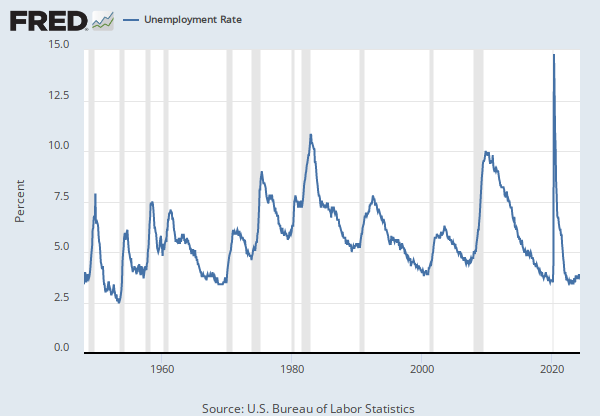
The unemployment rate represents the number of unemployed as a percentage of the labor force. Labor force data are restricted to people 16 years of age and older, who currently reside in 1 of the 50 states or the District of Columbia, who do not reside in institutions (e.g., penal and mental facilities, homes for the aged), and who are not on active duty in the Armed Forces.
This rate is also defined as the U-3 measure of labor underutilization.
The series comes from the 'Current Population Survey (Household Survey)'
The source code is: LNS14000000
Suggested Citation:
U.S. Bureau of Labor Statistics, Unemployment Rate [UNRATE], retrieved from FRED, Federal Reserve Bank of St. Louis; https://fred.stlouisfed.org/series/UNRATE, .
Source: U.S. Congressional Budget Office
Release: Budget and Economic Outlook
Units:
Frequency:
Notes:
Starting with the July, 2021 report: An Update to the Budget and Economic Outlook: 2021 to 2031, this series was renamed from "Natural Rate of Unemployment (Long-Term)" to "Noncyclical Rate of Unemployment".
The natural rate of unemployment (NAIRU) is the rate of unemployment arising from all sources except fluctuations in aggregate demand. Estimates of potential GDP are based on the long-term natural rate. (CBO did not make explicit adjustments to the short-term natural rate for structural factors before the recent downturn.) The short-term natural rate incorporates structural factors that are temporarily boosting the natural rate beginning in 2008. The short-term natural rate is used to gauge the amount of current and projected slack in labor markets, which is a key input into CBO's projections of inflation.
Suggested Citation:
U.S. Congressional Budget Office, Noncyclical Rate of Unemployment [NROU], retrieved from FRED, Federal Reserve Bank of St. Louis; https://fred.stlouisfed.org/series/NROU, .
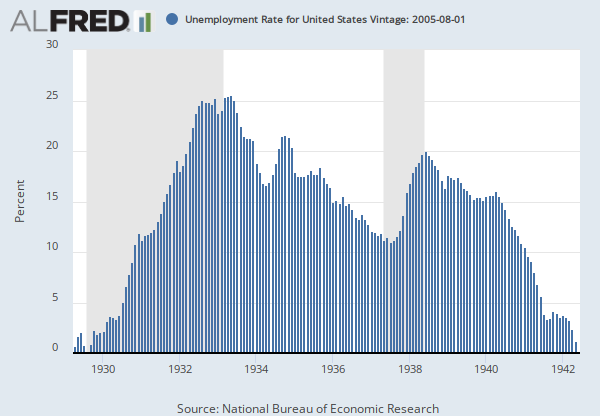
Source: National Bureau of Economic Research
Release: NBER Macrohistory Database
Units:
Frequency:
Notes:
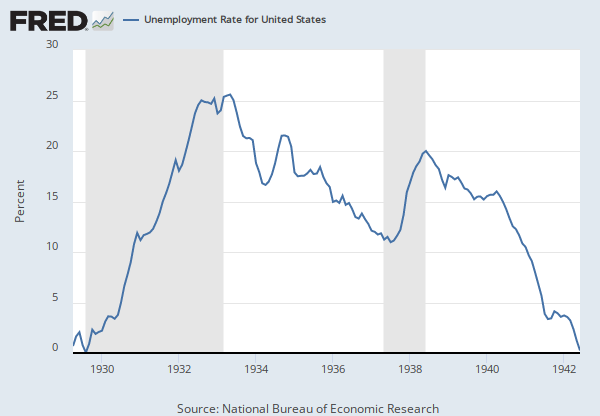
Series Is Presented Here As Three Variables--(1)--Seasonally Adjusted Data, 1929-1942 (2)--Seasonally Adjusted Data, 1940-1946 (3)--Original Data, 1947-1966. Source: National Industrial Conference Board, Published By G.H. Moore, Business Cycle Indicators, Vol. Ii, P. 35 And 123.
This NBER data series m08292a appears on the NBER website in Chapter 8 at http://www.nber.org/databases/macrohistory/contents/chapter08.html.
NBER Indicator: m08292a
Suggested Citation:
National Bureau of Economic Research, Unemployment Rate for United States [M0892AUSM156SNBR], retrieved from FRED, Federal Reserve Bank of St. Louis; https://fred.stlouisfed.org/series/M0892AUSM156SNBR, .
Source: National Bureau of Economic Research
Release: NBER Macrohistory Database
Units:
Frequency:
Notes:
Series Is Presented Here As Three Variables--(1)--Seasonally Adjusted, 1929-1942 (2)--Seasonally Adjusted, 1940-1946 (3)--Original Data, 1947-1966. Data Are Unemployment Expressed As A Percentage Of The Civilian Labor Force. Source: United States Bureau Of The Census, Current Population Reports: Labor Force Series P-50, Nos. 2, 13, And 19 (1940-1946, 1947-1948, And 1949 Annual Reports). Data Were Derived From NBER Series On Unemployment And Civilian Labor Force.
This NBER data series m08292b appears on the NBER website in Chapter 8 at http://www.nber.org/databases/macrohistory/contents/chapter08.html.
NBER Indicator: m08292b
Suggested Citation:
National Bureau of Economic Research, Unemployment Rate for United States [M0892BUSM156SNBR], retrieved from FRED, Federal Reserve Bank of St. Louis; https://fred.stlouisfed.org/series/M0892BUSM156SNBR, .
Source: National Bureau of Economic Research
Release: NBER Macrohistory Database
Units:
Frequency:
Notes:
Series Is Presented Here As Three Variables--(1)--Seasonally Adjusted, 1929-1942 (2)--Seasonally Adjusted, 1940-1946 (3)--Original Data, 1947-1966. Beginning In April 1962 Labor Force Estimates Are Based On The 1960 Population Census. Source: Employment And Earnings And Monthly Report On The Labor Force, Vol. 13, No. 9, March 1967.
This NBER data series m08292c appears on the NBER website in Chapter 8 at http://www.nber.org/databases/macrohistory/contents/chapter08.html.
NBER Indicator: m08292c
Suggested Citation:
National Bureau of Economic Research, Unemployment Rate for United States [M0892CUSM156NNBR], retrieved from FRED, Federal Reserve Bank of St. Louis; https://fred.stlouisfed.org/series/M0892CUSM156NNBR, .
Release Tables
Employment Situation
Employment Situation
- Monthly, Seasonally Adjusted (population data is not adjusted for seasonal variation; not seasonally adjusted version used)
- Table A-10. Selected unemployment indicators, Seasonally adjusted: Monthly, Numbers of unemployed workers
- Table A-10. Selected unemployment indicators, Seasonally adjusted: Monthly, Unemployment Rates
- Table A-15. Alternative measures of labor underutilization: Monthly, Seasonally Adjusted
Related Data and Content
Data Suggestions Based On Your Search












Content Suggestions














Other Formats
Unemployment Level
Monthly, Not Seasonally AdjustedUnemployment Rate
Monthly, Not Seasonally AdjustedUnemployment Rate for United States
Monthly, Seasonally Adjusted Monthly, Seasonally Adjusted Quarterly, Seasonally AdjustedRelated Categories
Unemployment Level
Current Population Survey (Household Survey)
Population, Employment, & Labor Markets
Unemployment Rate
Income and Employment
NBER Macrohistory Database
Academic Data
Releases
More
Series from Employment Situation
More
Series from Budget and Economic Outlook
More
Series from NBER Macrohistory Database
Tags
16 Years +
Current Population Survey (Household Survey)
Unemployment
Seasonally Adjusted
Bureau of Labor Statistics
Monthly
Nation
Public Domain: Citation Requested
United States of America
Labor Underutilization
Headline Figure
Civilian
Labor
Rate
Non-Accelerating Inflation Rate of Unemployment
Congressional Budget Office
Projection
Long-Term
Quarterly
Not Seasonally Adjusted
National Bureau of Economic Research
Copyrighted: Citation Required