Federal Reserve Economic Data
Notes
Source: Federal Reserve Bank of Atlanta
Release: Sticky Price CPI
Units:
Frequency:
Notes:
The Sticky Price Consumer Price Index (CPI) is calculated from a subset of goods and services included in the CPI that change price relatively infrequently. Because these goods and services change price relatively infrequently, they are thought to incorporate expectations about future inflation to a greater degree than prices that change on a more frequent basis. One possible explanation for sticky prices could be the costs firms incur when changing price.
To obtain more information about this release see: Michael F. Bryan, and Brent H. Meyer. “Are Some Prices in the CPI More Forward Looking Than Others? We Think So.” Economic Commentary (Federal Reserve Bank of Cleveland) (May 19, 2010): 1–6. https://doi.org/10.26509/frbc-ec-201002.
Suggested Citation:
Federal Reserve Bank of Atlanta, Sticky Price Consumer Price Index less Shelter [STICKCPIXSHLTRM159SFRBATL], retrieved from FRED, Federal Reserve Bank of St. Louis; https://fred.stlouisfed.org/series/STICKCPIXSHLTRM159SFRBATL, .
Source: U.S. Census Bureau
Source: U.S. Department of Housing and Urban Development
Release: New Residential Sales
Units:
Frequency:
Suggested Citation:
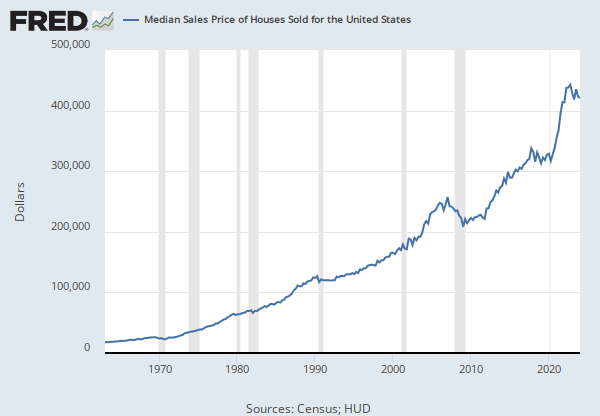
U.S. Census Bureau and U.S. Department of Housing and Urban Development, Median Sales Price of Houses Sold for the United States [MSPUS], retrieved from FRED, Federal Reserve Bank of St. Louis; https://fred.stlouisfed.org/series/MSPUS, .
Source: S&P Dow Jones Indices LLC
Release: S&P Cotality Case-Shiller Home Price Indices
Units:
Frequency:
Notes:
For more information regarding the index, please visit Standard & Poor's. There is more information about home price sales pairs in the Methodology section. Copyright, 2016, Standard & Poor's Financial Services LLC. Reprinted with permission.
Suggested Citation:
S&P Dow Jones Indices LLC, S&P Cotality Case-Shiller U.S. National Home Price Index [CSUSHPINSA], retrieved from FRED, Federal Reserve Bank of St. Louis; https://fred.stlouisfed.org/series/CSUSHPINSA, .
Source: Federal Reserve Bank of Atlanta
Release: Sticky Price CPI
Units:
Frequency:
Notes:
The Sticky Price Consumer Price Index (CPI) is calculated from a subset of goods and services included in the CPI that change price relatively infrequently. Because these goods and services change price relatively infrequently, they are thought to incorporate expectations about future inflation to a greater degree than prices that change on a more frequent basis. One possible explanation for sticky prices could be the costs firms incur when changing price.
To obtain more information about this release see: Michael F. Bryan, and Brent H. Meyer. “Are Some Prices in the CPI More Forward Looking Than Others? We Think So.” Economic Commentary (Federal Reserve Bank of Cleveland) (May 19, 2010): 1–6. https://doi.org/10.26509/frbc-ec-201002.
Suggested Citation:
Federal Reserve Bank of Atlanta, Sticky Price Consumer Price Index less Food and Energy [CORESTICKM159SFRBATL], retrieved from FRED, Federal Reserve Bank of St. Louis; https://fred.stlouisfed.org/series/CORESTICKM159SFRBATL, .
Release Tables
New Residential Sales
- Median and Average Sales Price of Houses Sold by Region
- Median and Average Sales Price of Houses Sold by Type of Financing
S&P Cotality Case-Shiller Home Price Indices
Related Data and Content
Data Suggestions Based On Your Search














Content Suggestions



Other Formats
Sticky Price Consumer Price Index less Shelter
3-Month Annualized Percent Change, Monthly, Seasonally Adjusted Percent Change, Monthly, Seasonally Adjusted Percent Change at Annual Rate, Monthly, Seasonally AdjustedS&P Cotality Case-Shiller U.S. National Home Price Index
Monthly, Seasonally AdjustedSticky Price Consumer Price Index less Food and Energy
3-Month Annualized Percent Change, Monthly, Seasonally Adjusted Percent Change, Monthly, Seasonally Adjusted Percent Change at Annual Rate, Monthly, Seasonally AdjustedRelated Categories
Special Indexes
Consumer Price Indexes (CPI and PCE)
Prices
New Residential Sales
Housing
Production & Business Activity
House Price Indexes
Releases
More
Series from Sticky Price CPI
More
Series from New Residential Sales
More
Series from S&P Cotality Case-Shiller Home Price Indices
Tags
Sticky
Shelter
Atlanta Fed
Consumer Price Index
Price Index
Rate
Indexes
Price
Seasonally Adjusted
Copyrighted: Citation Required
Monthly
Nation
United States of America
New Residential Sales
Housing and Urban Development
Sales
Housing
Median
Quarterly
Census
Public Domain: Citation Requested
Not Seasonally Adjusted
S&P Cotality Case-Shiller Home Price Indices
S&P Dow Jones Indices LLC
Copyrighted: Pre-Approval Required
House Price Index
Core Inflation
Inflation