Notes
Source: Federal Reserve Bank of St. Louis
Release: Money Zero Maturity (MZM)
Units:
Frequency:
Notes:
This series has been discontinued and will no longer be updated. The institutional money market funds (WIMFSL) and small-denomination time deposits (WSMTIME) components used to calculate this series has been discontinued by the Board of Governors and are no longer available in the H.6 statistical release, Money Stock Measures.
For further information about the changes to the H.6 statistical release, please see the announcements provided by the source.
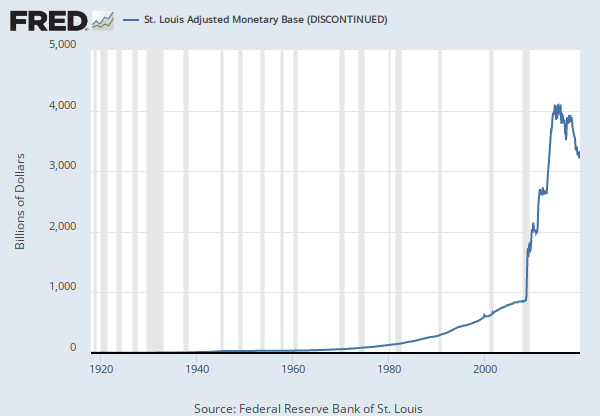
M2 less small-denomination time deposits plus institutional money market funds.
Money Zero Maturity is calculated by the Federal Reserve Bank of St. Louis.
Suggested Citation:
Federal Reserve Bank of St. Louis, MZM Money Stock (DISCONTINUED) [MZM], retrieved from FRED, Federal Reserve Bank of St. Louis; https://fred.stlouisfed.org/series/MZM, .
Source: U.S. Bureau of Economic Analysis
Release: Gross Domestic Product
Units:
Frequency:
Notes:
BEA Account Code: A191RC
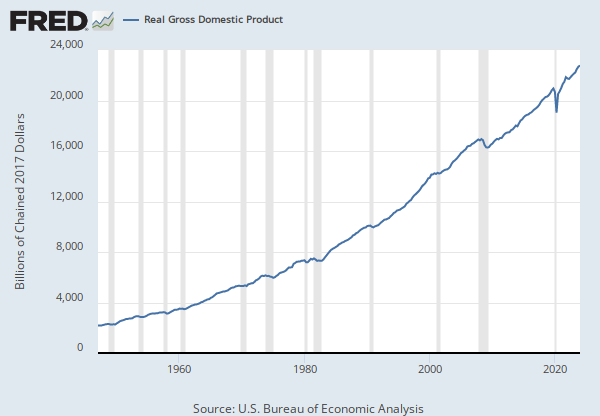
Gross domestic product (GDP), the featured measure of U.S. output, is the market value of the goods and services produced by labor and property located in the United States.For more information, see the Guide to the National Income and Product Accounts of the United States (NIPA) and the Bureau of Economic Analysis.
Suggested Citation:
U.S. Bureau of Economic Analysis, Gross Domestic Product [GDP], retrieved from FRED, Federal Reserve Bank of St. Louis; https://fred.stlouisfed.org/series/GDP, .
Source: U.S. Bureau of Labor Statistics
Release: Employment Situation
Units:
Frequency:
Notes:
The series comes from the 'Current Population Survey (Household Survey)'
The source code is: LNS13000000
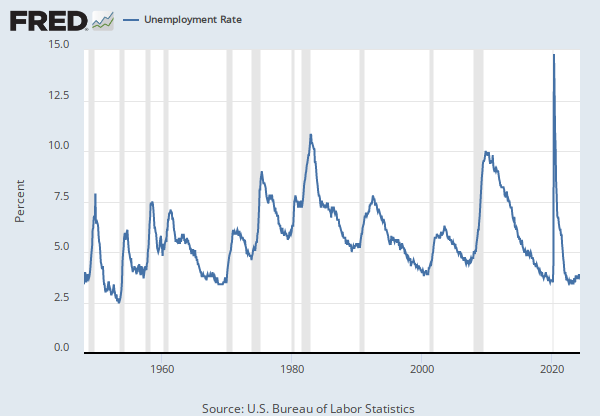
The Unemployment Level is the aggregate measure of people currently unemployed in the US. Someone in the labor force is defined as unemployed if they were not employed during the survey reference week, were available for work, and made at least one active effort to find a job during the 4-week survey period.
The Unemployment Level is collected in the CPS and published by the BLS. It is provided on a monthly basis, so this data is used in part by macroeconomists as an initial economic indicator of current trends. The Unemployment Level helps government agencies, financial markets, and researchers gauge the overall health of the economy.
Note that individuals that are not employed but not actively looking for a job are not counted as unemployed. For instance, declines in the Unemployment Level may either reflect movements of unemployed individuals into the labor force because they found a job, or movements of unemployed individuals out of the labor force because they stopped looking to find a job.
For more information, see:
U.S. Bureau of Labor Statistics, CES Overview
U.S. Bureau of Labor Statistics, BLS Handbook of Methods: Chapter 2. Employment, Hours, and Earnings from the Establishment Survey
Suggested Citation:
U.S. Bureau of Labor Statistics, Unemployment Level [UNEMPLOY], retrieved from FRED, Federal Reserve Bank of St. Louis; https://fred.stlouisfed.org/series/UNEMPLOY, .
Release Tables
Employment Situation
Employment Situation
- Monthly, Seasonally Adjusted (population data is not adjusted for seasonal variation; not seasonally adjusted version used)
- Table A-10. Selected unemployment indicators, Seasonally adjusted: Monthly, Numbers of unemployed workers
Gross Domestic Product
- Table 1.1.5. Gross Domestic Product: Quarterly
- Table 1.2.5. Gross Domestic Product by Major Type of Product: Quarterly
- Table 1.3.5. Gross Value Added by Sector: Quarterly
- Table 1.4.5. Relation of Gross Domestic Product, Gross Domestic Purchases, and Final Sales to Domestic Purchasers: Quarterly
- Table 1.5.5. Gross Domestic Product, Expanded Detail: Quarterly
- Table 1.7.5. Relation of Gross Domestic Product, Gross National Product, Net National Product, National Income, and Personal Income: Quarterly
- Table 1.17.5. Gross Domestic Product, Gross Domestic Income, and Other Major NIPA Aggregates: Quarterly
Related Data and Content
Data Suggestions Based On Your Search









Content Suggestions








Other Formats
MZM Money Stock (DISCONTINUED)
Monthly, Not Seasonally Adjusted Monthly, Seasonally Adjusted Weekly, Not Seasonally AdjustedGross Domestic Product
Annual, Not Seasonally Adjusted Annual, Not Seasonally Adjusted Index 2017=100, Quarterly, Not Seasonally Adjusted Millions of Dollars, Quarterly, Not Seasonally Adjusted Percent Change from Preceding Period, Annual, Not Seasonally Adjusted Percent Change from Preceding Period, Quarterly, Seasonally Adjusted Annual RateUnemployment Level
Monthly, Not Seasonally AdjustedRelated Categories
MZM
Monetary Data
Money, Banking, & Finance
GDP/GNP
National Income & Product Accounts
National Accounts
Unemployment Level
Current Population Survey (Household Survey)
Population, Employment, & Labor Markets
Releases
More
Series from Money Zero Maturity (MZM)
More
Series from Gross Domestic Product
More
Series from Employment Situation
Tags
MZM Money Stock
Monetary Aggregates
Weekly
Discontinued
St. Louis Fed
Seasonally Adjusted
Copyrighted: Citation Required
Nation
United States of America
National Income and Product Accounts
Bureau of Economic Analysis
Gross Domestic Product
Quarterly
Public Domain: Citation Requested
16 Years +
Current Population Survey (Household Survey)
Unemployment
Bureau of Labor Statistics
Monthly