Notes
Source: Organization for Economic Co-operation and Development
Release: Main Economic Indicators
Units:
Frequency:
Notes:
OECD Data Filters:
REF_AREA: USA
MEASURE: CPI
UNIT_MEASURE: PA
METHODOLOGY: N
EXPENDITURE: _T
ADJUSTMENT: N
TRANSFORMATION: GY
FREQ: A
All OECD data should be cited as follows: OECD (year), (dataset name), (data source) DOI or https://data-explorer.oecd.org/. (accessed on (date)).
Suggested Citation:
Organization for Economic Co-operation and Development, Consumer Price Indices (CPIs, HICPs), COICOP 1999: Consumer Price Index: Total for United States [CPALTT01USA659N], retrieved from FRED, Federal Reserve Bank of St. Louis; https://fred.stlouisfed.org/series/CPALTT01USA659N, .
Source: National Bureau of Economic Research
Release: NBER Macrohistory Database
Units:
Frequency:
Notes:
Prior To 1953, This Series Was Called The"Index Of Cost Of Living." Data Have Been Converted To The Average 1957-1959 Base By Bls. Prior To September, 1940, Only Fuel And Food Components Were Monthly, All Other Components Were Priced At Intervals Of 3, 4, And 6 Months (See Survey Of Current Business, May, 1941; Also Monthly Labor Review, August, 1940, And Bls Bulletin Nos. 699 (1941) And 966 (1949) For Detailed Information). The Early Segment Of This Series Represents Monthly Interpolations By The Department Of Commerce. Beginning In 1943, The Index Shows The Results Of A Revision, Begun In 1940, Of The Rent Component (Correction Of New Unit Bias). In January, 1950, A Revision Of Population And Commodity Weights Begins To Be Incorporated In The Index (Monthly Labor Review, March, 1951); Series Is Considered To Be Continuous. A Major Revision Of The Index Took Place In January, 1953; Hereafter Called"Consumer Price Index." Beginning With Indexes For January, 1966, Data For Six Additional Areas (Cincinnati, Houston, Kansas City, Milwaukee, Minneapolis-St. Paul, And San Diego) Have Been Incorporated Into The National Consumer Price Index. These Areas Were"Linked" Into The Consumer Price Index As Of December, 1965 And Were First Used In Calculating The December, 1965-January, 1966 Price Change. Source: Bls Release, "Consumer Price Index--U.S.: All Items, 1913- 1960, Series A; Bcd, February, 1967 For 1961-1965; March, 1968 For 1966-February, 1968.
This NBER data series m04128 appears on the NBER website in Chapter 4 at http://www.nber.org/databases/macrohistory/contents/chapter04.html.
NBER Indicator: m04128
Suggested Citation:
National Bureau of Economic Research, Consumer Price Index, All Items for United States [M04128USM350NNBR], retrieved from FRED, Federal Reserve Bank of St. Louis; https://fred.stlouisfed.org/series/M04128USM350NNBR, .
Source: U.S. Bureau of Labor Statistics
Release: Employment Situation
Units:
Frequency:
Notes:
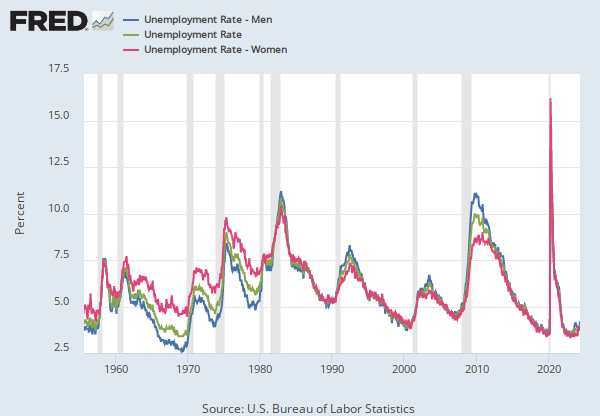
The unemployment rate represents the number of unemployed as a percentage of the labor force. Labor force data are restricted to people 16 years of age and older, who currently reside in 1 of the 50 states or the District of Columbia, who do not reside in institutions (e.g., penal and mental facilities, homes for the aged), and who are not on active duty in the Armed Forces.
This rate is also defined as the U-3 measure of labor underutilization.
The series comes from the 'Current Population Survey (Household Survey)'
The source code is: LNS14000000
Suggested Citation:
U.S. Bureau of Labor Statistics, Unemployment Rate [UNRATE], retrieved from FRED, Federal Reserve Bank of St. Louis; https://fred.stlouisfed.org/series/UNRATE, .
Source: National Bureau of Economic Research
Release: NBER Macrohistory Database
Units:
Frequency:
Notes:
Series Is Presented Here As Three Variables--(1)--Seasonally Adjusted Data, 1929-1942 (2)--Seasonally Adjusted Data, 1940-1946 (3)--Original Data, 1947-1966. Source: National Industrial Conference Board, Published By G.H. Moore, Business Cycle Indicators, Vol. Ii, P. 35 And 123.
This NBER data series m08292a appears on the NBER website in Chapter 8 at http://www.nber.org/databases/macrohistory/contents/chapter08.html.
NBER Indicator: m08292a
Suggested Citation:
National Bureau of Economic Research, Unemployment Rate for United States [M0892AUSM156SNBR], retrieved from FRED, Federal Reserve Bank of St. Louis; https://fred.stlouisfed.org/series/M0892AUSM156SNBR, .
Source: National Bureau of Economic Research
Release: NBER Macrohistory Database
Units:
Frequency:
Notes:
Series Is Presented Here As Three Variables--(1)--Seasonally Adjusted, 1929-1942 (2)--Seasonally Adjusted, 1940-1946 (3)--Original Data, 1947-1966. Data Are Unemployment Expressed As A Percentage Of The Civilian Labor Force. Source: United States Bureau Of The Census, Current Population Reports: Labor Force Series P-50, Nos. 2, 13, And 19 (1940-1946, 1947-1948, And 1949 Annual Reports). Data Were Derived From NBER Series On Unemployment And Civilian Labor Force.
This NBER data series m08292b appears on the NBER website in Chapter 8 at http://www.nber.org/databases/macrohistory/contents/chapter08.html.
NBER Indicator: m08292b
Suggested Citation:
National Bureau of Economic Research, Unemployment Rate for United States [M0892BUSM156SNBR], retrieved from FRED, Federal Reserve Bank of St. Louis; https://fred.stlouisfed.org/series/M0892BUSM156SNBR, .
Release Tables
Employment Situation
- Monthly, Seasonally Adjusted (population data is not adjusted for seasonal variation; not seasonally adjusted version used)
- Table A-10. Selected unemployment indicators, Seasonally adjusted: Monthly, Unemployment Rates
- Table A-15. Alternative measures of labor underutilization: Monthly, Seasonally Adjusted
Related Data and Content
Data Suggestions Based On Your Search















Content Suggestions












Other Formats
Consumer Price Indices (CPIs, HICPs), COICOP 1999: Consumer Price Index: Total for United States
Contribution to growth rate, over 1 year, Monthly, Not Seasonally Adjusted Annual, Not Seasonally Adjusted Monthly, Not Seasonally Adjusted Monthly, Not Seasonally Adjusted Quarterly, Not Seasonally Adjusted Index 2015=100, Annual, Not Seasonally Adjusted Index 2015=100, Annual, Not Seasonally Adjusted Index 2015=100, Annual, Seasonally Adjusted Index 2015=100, Monthly, Not Seasonally Adjusted Index 2015=100, Monthly, Not Seasonally Adjusted Index 2015=100, Monthly, Seasonally Adjusted Index 2015=100, Quarterly, Not Seasonally Adjusted Index 2015=100, Quarterly, Seasonally AdjustedUnemployment Rate
Monthly, Not Seasonally AdjustedUnemployment Rate for United States
Monthly, Not Seasonally Adjusted Monthly, Seasonally Adjusted Quarterly, Seasonally AdjustedRelated Categories
All Items
Consumer Price Indexes
Prices
Indicators
United States
Countries
International Data
Prices
NBER Macrohistory Database
Academic Data
Unemployment Rate
Current Population Survey (Household Survey)
Population, Employment, & Labor Markets
Income and Employment
Releases
More
Series from Main Economic Indicators
More
Series from NBER Macrohistory Database
More
Series from Employment Situation
Tags
All Items
Consumer Price Index
Main Economic Indicators
Org. for Economic Co-operation and Development
Price Index
Indexes
Price
Copyrighted: Citation Required
Annual
Nation
United States of America
Not Seasonally Adjusted
National Bureau of Economic Research
Monthly
Labor Underutilization
Headline Figure
Civilian
16 Years +
Current Population Survey (Household Survey)
Labor
Unemployment
Rate
Seasonally Adjusted
Bureau of Labor Statistics
Public Domain: Citation Requested