Federal Reserve Economic Data
Notes
Source: U.S. Bureau of Labor Statistics
Release: Weekly and Hourly Earnings from the Current Population Survey
Units:
Frequency:
Notes:
Data measure usual weekly earnings of wage and salary workers. Wage and salary workers are workers who receive wages, salaries, commissions, tips, payment in kind, or piece rates. The group includes employees in both the private and public sectors but, for the purposes of the earnings series, it excludes all self-employed persons, both those with incorporated businesses and those with unincorporated businesses.
Usual weekly earnings represent earnings before taxes and other deductions and include any overtime pay, commissions, or tips usually received (at the main job in the case of multiple jobholders). Prior to 1994, respondents were asked how much they usually earned per week. Since January 1994, respondents have been asked to identify the easiest way for them to report earnings (hourly, weekly, biweekly, twice monthly, monthly, annually, or other) and how much they usually earn in the reported time period. Earnings reported on a basis other than weekly are converted to a weekly equivalent. The term "usual" is determined by each respondent's own understanding of the term. If the respondent asks for a definition of "usual," interviewers are instructed to define the term as more than half the weeks worked during the past 4 or 5 months. Visit the BLS for more information.
The series comes from the 'Current Population Survey (Household Survey)'
The source code is: LES1252881600
Suggested Citation:
U.S. Bureau of Labor Statistics, Employed full time: Median usual weekly real earnings: Wage and salary workers: 16 years and over [LES1252881600Q], retrieved from FRED, Federal Reserve Bank of St. Louis; https://fred.stlouisfed.org/series/LES1252881600Q, .
Source: U.S. Bureau of Labor Statistics
Release: Employment Situation
Units:
Frequency:
Notes:
All Employees: Total Nonfarm, commonly known as Total Nonfarm Payroll, is a measure of the number of U.S. workers in the economy that excludes proprietors, private household employees, unpaid volunteers, farm employees, and the unincorporated self-employed. This measure accounts for approximately 80 percent of the workers who contribute to Gross Domestic Product (GDP).
This measure provides useful insights into the current economic situation because it can represent the number of jobs added or lost in an economy. Increases in employment might indicate that businesses are hiring which might also suggest that businesses are growing. Additionally, those who are newly employed have increased their personal incomes, which means (all else constant) their disposable incomes have also increased, thus fostering further economic expansion.
Generally, the U.S. labor force and levels of employment and unemployment are subject to fluctuations due to seasonal changes in weather, major holidays, and the opening and closing of schools. The Bureau of Labor Statistics (BLS) adjusts the data to offset the seasonal effects to show non-seasonal changes: for example, women's participation in the labor force; or a general decline in the number of employees, a possible indication of a downturn in the economy. To closely examine seasonal and non-seasonal changes, the BLS releases two monthly statistical measures: the seasonally adjusted All Employees: Total Nonfarm (PAYEMS) and All Employees: Total Nonfarm (PAYNSA), which is not seasonally adjusted.
The series comes from the 'Current Employment Statistics (Establishment Survey).'
The source code is: CES0000000001
Suggested Citation:
U.S. Bureau of Labor Statistics, All Employees, Total Nonfarm [PAYEMS], retrieved from FRED, Federal Reserve Bank of St. Louis; https://fred.stlouisfed.org/series/PAYEMS, .
Source: U.S. Bureau of Economic Analysis
Release: Gross Domestic Product
Units:
Frequency:
Notes:
BEA Account Code: A191RX
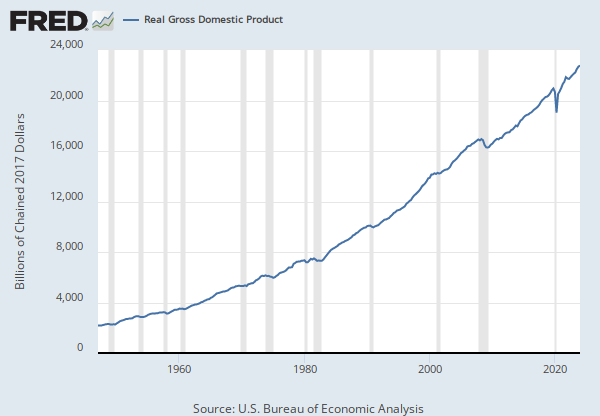
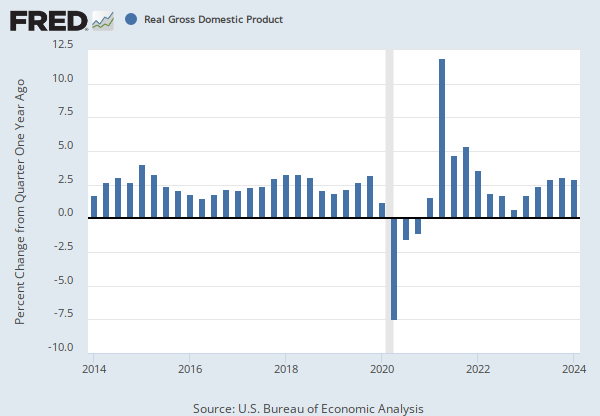
Real gross domestic product is the inflation adjusted value of the goods and services produced by labor and property located in the United States.For more information see the Guide to the National Income and Product Accounts of the United States (NIPA). For more information, please visit the Bureau of Economic Analysis.
Suggested Citation:
U.S. Bureau of Economic Analysis, Real Gross Domestic Product [GDPC1], retrieved from FRED, Federal Reserve Bank of St. Louis; https://fred.stlouisfed.org/series/GDPC1, .
Source: U.S. Bureau of Labor Statistics
Release: Consumer Price Index
Units:
Frequency:
Suggested Citation:
U.S. Bureau of Labor Statistics, Consumer Price Index for All Urban Consumers: Owners' Equivalent Rent of Residences in U.S. City Average [CUSR0000SEHC], retrieved from FRED, Federal Reserve Bank of St. Louis; https://fred.stlouisfed.org/series/CUSR0000SEHC, .
Source: U.S. Bureau of Economic Analysis
Release: Personal Income and Outlays
Units:
Frequency:
Notes:
Population includes resident population plus armed forces overseas. The monthly estimate is the average of estimates for the first of the month and the first of the following month.
BEA Account Code: B230RC
A Guide to the National Income and Product Accounts of the United States (NIPA) - (http://www.bea.gov/national/pdf/nipaguid.pdf)
Suggested Citation:
U.S. Bureau of Economic Analysis, Population [POPTHM], retrieved from FRED, Federal Reserve Bank of St. Louis; https://fred.stlouisfed.org/series/POPTHM, .
Source: Board of Governors of the Federal Reserve System (US)
Release: H.8 Assets and Liabilities of Commercial Banks in the United States
Units:
Frequency:
Notes:
For questions on the data, please contact the data source. For questions on FRED functionality, please contact us here.
Suggested Citation:
Board of Governors of the Federal Reserve System (US), Loans and Leases in Bank Credit, All Commercial Banks [TOTLL], retrieved from FRED, Federal Reserve Bank of St. Louis; https://fred.stlouisfed.org/series/TOTLL, .
Source: U.S. Bureau of Labor Statistics
Release: Consumer Price Index
Units:
Frequency:
Notes:
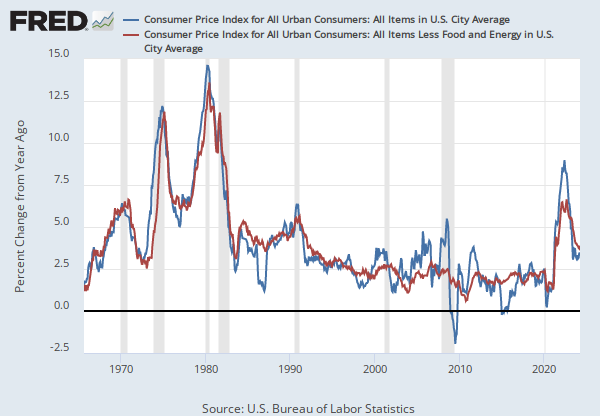
The Consumer Price Index for All Urban Consumers: All Items (CPIAUCSL) is a price index of a basket of goods and services paid by urban consumers. Percent changes in the price index measure the inflation rate between any two time periods. The most common inflation metric is the percent change from one year ago. It can also represent the buying habits of urban consumers. This particular index includes roughly 88 percent of the total population, accounting for wage earners, clerical workers, technical workers, self-employed, short-term workers, unemployed, retirees, and those not in the labor force.
The CPIs are based on prices for food, clothing, shelter, and fuels; transportation fares; service fees (e.g., water and sewer service); and sales taxes. Prices are collected monthly from about 4,000 housing units and approximately 26,000 retail establishments across 87 urban areas. To calculate the index, price changes are averaged with weights representing their importance in the spending of the particular group. The index measures price changes (as a percent change) from a predetermined reference date. In addition to the original unadjusted index distributed, the Bureau of Labor Statistics also releases a seasonally adjusted index. The unadjusted series reflects all factors that may influence a change in prices. However, it can be very useful to look at the seasonally adjusted CPI, which removes the effects of seasonal changes, such as weather, school year, production cycles, and holidays.
The CPI can be used to recognize periods of inflation and deflation. Significant increases in the CPI within a short time frame might indicate a period of inflation, and significant decreases in CPI within a short time frame might indicate a period of deflation. However, because the CPI includes volatile food and oil prices, it might not be a reliable measure of inflationary and deflationary periods. For a more accurate detection, the core CPI (CPILFESL) is often used. When using the CPI, please note that it is not applicable to all consumers and should not be used to determine relative living costs. Additionally, the CPI is a statistical measure vulnerable to sampling error since it is based on a sample of prices and not the complete average.
For more information on the CPI, see the Handbook of Methods, the release notes and announcements, and the Frequently Asked Questions (FAQs).
Suggested Citation:
U.S. Bureau of Labor Statistics, Consumer Price Index for All Urban Consumers: All Items in U.S. City Average [CPIAUCSL], retrieved from FRED, Federal Reserve Bank of St. Louis; https://fred.stlouisfed.org/series/CPIAUCSL, .
Release Tables
Consumer Price Index
Employment Situation
Gross Domestic Product
- Table 1.1.6. Real Gross Domestic Product, Chained Dollars: Quarterly
- Table 1.2.6. Real Gross Domestic Product by Major Type of Product, Chained Dollars: Quarterly
- Table 1.3.6. Real Gross Value Added by Sector, Chained Dollars: Quarterly
- Table 1.4.6. Relation of Real Gross Domestic Product, Real Gross Domestic Purchases, and Real Final Sales to Domestic Purchasers, Chained Dollars: Quarterly
- Table 1.5.6. Real Gross Domestic Product, Expanded Detail, Chained Dollars: Quarterly
- Table 1.7.6. Relation of Real Gross Domestic Product, Real Gross National Product, and Real Net National Product, Chained Dollars: Quarterly
- Table 1.8.6. Command-Basis Real Gross Domestic Product and Gross National Product, Chained Dollars: Quarterly
- Table 1.17.6. Real Gross Domestic Product, Real Gross Domestic Income, and Other Major NIPA Aggregates, Chained Dollars: Quarterly
H.8 Assets and Liabilities of Commercial Banks in the United States
Personal Income and Outlays
Weekly and Hourly Earnings from the Current Population Survey
Related Data and Content
Data Suggestions Based On Your Search




















Content Suggestions












Other Formats
Employed full time: Median usual weekly real earnings: Wage and salary workers: 16 years and over
Annual, Not Seasonally Adjusted Quarterly, Not Seasonally AdjustedAll Employees, Total Nonfarm
Monthly, Not Seasonally AdjustedReal Gross Domestic Product
Annual, Not Seasonally Adjusted Quarterly, Not Seasonally Adjusted Index 2017=100, Quarterly, Not Seasonally Adjusted Percent Change from Preceding Period, Annual, Not Seasonally Adjusted Percent Change from Preceding Period, Quarterly, Seasonally Adjusted Annual Rate Percent Change from Quarter One Year Ago, Quarterly, Not Seasonally Adjusted Percent Change from Quarter One Year Ago, Quarterly, Seasonally AdjustedConsumer Price Index for All Urban Consumers: Owners' Equivalent Rent of Residences in U.S. City Average
Monthly, Not Seasonally Adjusted Semiannual, Not Seasonally AdjustedPopulation
Annual, Not Seasonally Adjusted Quarterly, Not Seasonally AdjustedLoans and Leases in Bank Credit, All Commercial Banks
Monthly, Not Seasonally Adjusted Monthly, Seasonally Adjusted Weekly, Not Seasonally Adjusted Percent Change at Annual Rate, Annual, Seasonally Adjusted Percent Change at Annual Rate, Monthly, Seasonally Adjusted Percent Change at Annual Rate, Quarterly, Seasonally AdjustedConsumer Price Index for All Urban Consumers: All Items in U.S. City Average
Monthly, Not Seasonally Adjusted Semiannual, Not Seasonally AdjustedRelated Categories
Earnings
Current Population Survey (Household Survey)
Population, Employment, & Labor Markets
Total Nonfarm
Current Employment Statistics (Establishment Survey)
GDP/GNP
National Income & Product Accounts
National Accounts
Housing
Consumer Price Indexes (CPI and PCE)
Prices
Population
All Commercial Banks
Commercial Banking
Banking
Money, Banking, & Finance
Releases
More
Series from Weekly and Hourly Earnings from the Current Population Survey
More
Series from Employment Situation
More
Series from Gross Domestic Product
More
Series from Consumer Price Index
More
Series from Personal Income and Outlays
More
Series from H.8 Assets and Liabilities of Commercial Banks in the United States
Tags
Full-Time
Salaries
Workers
Earnings
16 Years +
Wages
Median
Real
Employment
Quarterly
Seasonally Adjusted
Bureau of Labor Statistics
Nation
Public Domain: Citation Requested
United States of America
Headline Figure
Payrolls
Current Employment Statistics Survey (Establishment Survey)
Nonfarm
Monthly
National Income and Product Accounts
Bureau of Economic Analysis
Gross Domestic Product
Rent
Urban
Consumer
Consumer Price Index
Inflation
Price Index
Indexes
Price
Population
Not Seasonally Adjusted
Leases
H.8 Assets & Liabilities of US Commercial Banks
Credits
Commercial
Weekly
Loans
Banks
Depository Institutions
Board of Governors
All Items
Average