Notes
Source: Federal Reserve Bank of St. Louis
Release: St. Louis Fed Economic News Index
Units:
Frequency:
Notes:
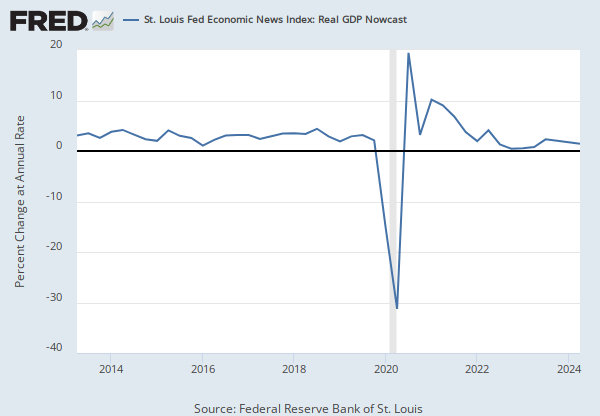
St. Louis Fed’s Economic News Index (ENI) uses economic content from key monthly economic data releases to forecast the growth of real GDP during that quarter. In general, the most-current observation is revised multiple times throughout the quarter. The final forecasted value (before the BEA’s release of the advance estimate of GDP) is the static, historical value for that quarter. For more information, see Grover, Sean P.; Kliesen, Kevin L.; and McCracken, Michael W.: A Macroeconomic News Index for Constructing Nowcasts of U.S. Real Gross Domestic Product Growth.
Suggested Citation:
Federal Reserve Bank of St. Louis, St. Louis Fed Economic News Index: Real GDP Nowcast [STLENI], retrieved from FRED, Federal Reserve Bank of St. Louis; https://fred.stlouisfed.org/series/STLENI, .
Source: U.S. Bureau of Economic Analysis
Release: Gross Domestic Product
Units:
Frequency:
Notes:
BEA Account Code: A191RX
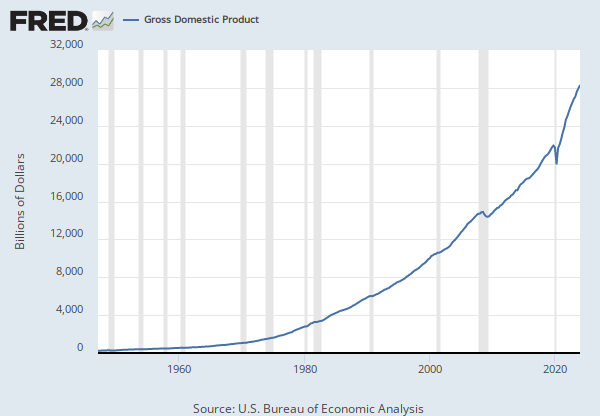
Real gross domestic product is the inflation adjusted value of the goods and services produced by labor and property located in the United States.For more information see the Guide to the National Income and Product Accounts of the United States (NIPA). For more information, please visit the Bureau of Economic Analysis.
Suggested Citation:
U.S. Bureau of Economic Analysis, Real Gross Domestic Product [GDPC1], retrieved from FRED, Federal Reserve Bank of St. Louis; https://fred.stlouisfed.org/series/GDPC1, .
Source: U.S. Bureau of Economic Analysis
Release: Personal Income and Outlays
Units:
Frequency:
Notes:
BEA Account Code: W875RX
A Guide to the National Income and Product Accounts of the United States (NIPA) - (http://www.bea.gov/national/pdf/nipaguid.pdf)
Suggested Citation:
U.S. Bureau of Economic Analysis, Real personal income excluding current transfer receipts [W875RX1], retrieved from FRED, Federal Reserve Bank of St. Louis; https://fred.stlouisfed.org/series/W875RX1, .
Source: U.S. Bureau of Labor Statistics
Release: Employment Situation
Units:
Frequency:
Notes:
All Employees: Total Nonfarm, commonly known as Total Nonfarm Payroll, is a measure of the number of U.S. workers in the economy that excludes proprietors, private household employees, unpaid volunteers, farm employees, and the unincorporated self-employed. This measure accounts for approximately 80 percent of the workers who contribute to Gross Domestic Product (GDP).
This measure provides useful insights into the current economic situation because it can represent the number of jobs added or lost in an economy. Increases in employment might indicate that businesses are hiring which might also suggest that businesses are growing. Additionally, those who are newly employed have increased their personal incomes, which means (all else constant) their disposable incomes have also increased, thus fostering further economic expansion.
Generally, the U.S. labor force and levels of employment and unemployment are subject to fluctuations due to seasonal changes in weather, major holidays, and the opening and closing of schools. The Bureau of Labor Statistics (BLS) adjusts the data to offset the seasonal effects to show non-seasonal changes: for example, women's participation in the labor force; or a general decline in the number of employees, a possible indication of a downturn in the economy. To closely examine seasonal and non-seasonal changes, the BLS releases two monthly statistical measures: the seasonally adjusted All Employees: Total Nonfarm (PAYEMS) and All Employees: Total Nonfarm (PAYNSA), which is not seasonally adjusted.
The series comes from the 'Current Employment Statistics (Establishment Survey).'
The source code is: CES0000000001
Suggested Citation:
U.S. Bureau of Labor Statistics, All Employees, Total Nonfarm [PAYEMS], retrieved from FRED, Federal Reserve Bank of St. Louis; https://fred.stlouisfed.org/series/PAYEMS, .
Source: Federal Reserve Bank of Atlanta
Release: GDPNow
Units:
Frequency:
Notes:
GDPNow is a nowcasting model for gross domestic product (GDP) growth that synthesizes the bridge equation approach relating GDP subcomponents to monthly source data with factor model and Bayesian vector autoregression approaches. The GDPNow model forecasts GDP growth by aggregating 13 subcomponents that make up GDP with the chain-weighting methodology used by the US Bureau of Economic Analysis.
The Federal Reserve Bank of Atlanta's GDPNow release complements the quarterly GDP release from the Bureau of Economic Analysis (BEA). The Atlanta Fed recalculates and updates their GDPNow forecasts (called "nowcasts") throughout the quarter as new data are released, up until the BEA releases its "advance estimate" of GDP for that quarter. The St. Louis Fed constructs a quarterly time series for this dataset, in which both historical and current observations values are combined. In general, the most-current observation is revised multiple times throughout the quarter. The final forecasted value (before the BEA's release of the advance estimate of GDP) is the static, historical value for that quarter.
For futher information visit the Federal Reserve Bank of Atlanta.
Suggested Citation:
Federal Reserve Bank of Atlanta, GDPNow [GDPNOW], retrieved from FRED, Federal Reserve Bank of St. Louis; https://fred.stlouisfed.org/series/GDPNOW, .
Release Tables
Employment Situation
Gross Domestic Product
- Table 1.1.6. Real Gross Domestic Product, Chained Dollars: Quarterly
- Table 1.2.6. Real Gross Domestic Product by Major Type of Product, Chained Dollars: Quarterly
- Table 1.3.6. Real Gross Value Added by Sector, Chained Dollars: Quarterly
- Table 1.4.6. Relation of Real Gross Domestic Product, Real Gross Domestic Purchases, and Real Final Sales to Domestic Purchasers, Chained Dollars: Quarterly
- Table 1.5.6. Real Gross Domestic Product, Expanded Detail, Chained Dollars: Quarterly
- Table 1.7.6. Relation of Real Gross Domestic Product, Real Gross National Product, and Real Net National Product, Chained Dollars: Quarterly
- Table 1.8.6. Command-Basis Real Gross Domestic Product and Gross National Product, Chained Dollars: Quarterly
- Table 1.17.6. Real Gross Domestic Product, Real Gross Domestic Income, and Other Major NIPA Aggregates, Chained Dollars: Quarterly
Personal Income and Outlays
Related Data and Content
Data Suggestions Based On Your Search





Content Suggestions










Other Formats
Real Gross Domestic Product
Annual, Not Seasonally Adjusted Quarterly, Not Seasonally Adjusted Index 2017=100, Quarterly, Not Seasonally Adjusted Percent Change from Preceding Period, Annual, Not Seasonally Adjusted Percent Change from Preceding Period, Quarterly, Seasonally Adjusted Annual Rate Percent Change from Quarter One Year Ago, Quarterly, Not Seasonally Adjusted Percent Change from Quarter One Year Ago, Quarterly, Seasonally AdjustedReal personal income excluding current transfer receipts
Annual, Not Seasonally Adjusted Quarterly, Seasonally Adjusted Annual RateAll Employees, Total Nonfarm
Monthly, Not Seasonally AdjustedRelated Categories
GDP/GNP
National Income & Product Accounts
National Accounts
Personal Income & Outlays
Total Nonfarm
Current Employment Statistics (Establishment Survey)
Population, Employment, & Labor Markets
Releases
More
Series from St. Louis Fed Economic News Index
More
Series from Gross Domestic Product
More
Series from Personal Income and Outlays
More
Series from Employment Situation
More
Series from GDPNow
Tags
Nowcast
Projection
St. Louis Fed
Real
Gross Domestic Product
Rate
Quarterly
Indexes
Seasonally Adjusted
Copyrighted: Citation Required
Nation
United States of America
Headline Figure
National Income and Product Accounts
Bureau of Economic Analysis
Public Domain: Citation Requested
Transfers
Receipts
Personal Income
Personal
Income
Monthly
Payrolls
Current Employment Statistics Survey (Establishment Survey)
Nonfarm
Employment
Bureau of Labor Statistics
Atlanta Fed