Notes
Source: U.S. Bureau of Economic Analysis
Release: Gross Domestic Product
Units:
Frequency:
Notes:
BEA Account Code: A191RC
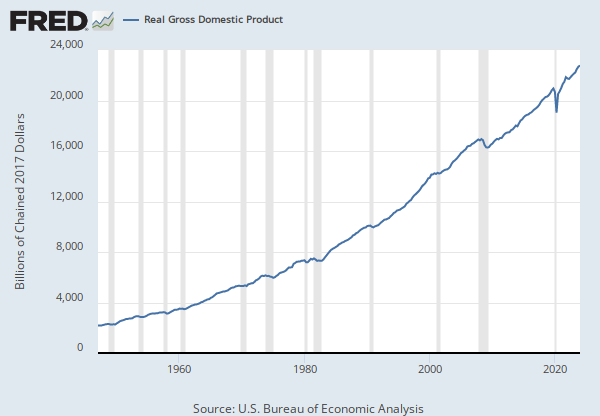
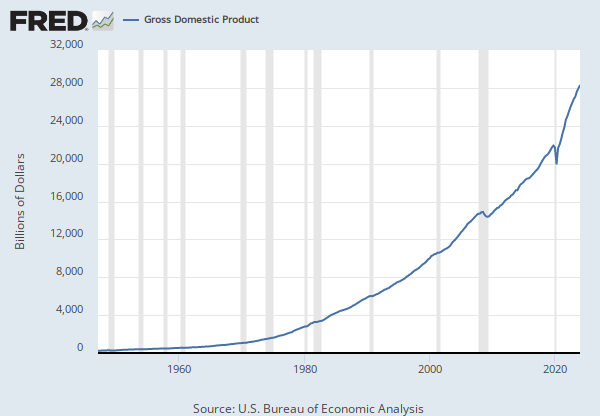
Gross domestic product (GDP), the featured measure of U.S. output, is the market value of the goods and services produced by labor and property located in the United States.For more information, see the Guide to the National Income and Product Accounts of the United States (NIPA) and the Bureau of Economic Analysis.
Suggested Citation:
U.S. Bureau of Economic Analysis, Gross Domestic Product [GDP], retrieved from FRED, Federal Reserve Bank of St. Louis; https://fred.stlouisfed.org/series/GDP, .
Source: U.S. Congressional Budget Office
Release: Budget and Economic Outlook
Units:
Frequency:
Suggested Citation:
U.S. Congressional Budget Office, Nominal Potential Gross Domestic Product [NGDPPOT], retrieved from FRED, Federal Reserve Bank of St. Louis; https://fred.stlouisfed.org/series/NGDPPOT, .
Source: U.S. Bureau of Labor Statistics
Release: Employment Situation
Units:
Frequency:
Notes:
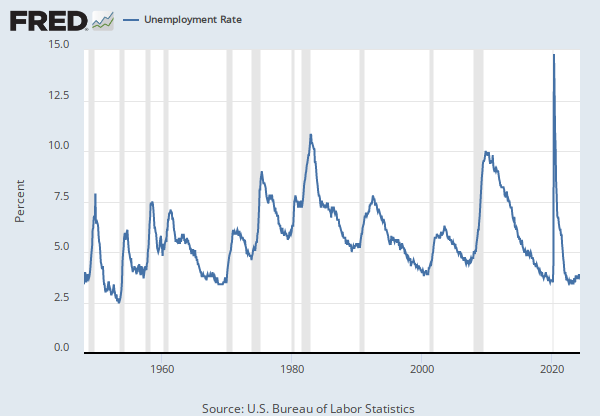
The unemployment rate represents the number of unemployed as a percentage of the labor force. Labor force data are restricted to people 16 years of age and older, who currently reside in 1 of the 50 states or the District of Columbia, who do not reside in institutions (e.g., penal and mental facilities, homes for the aged), and who are not on active duty in the Armed Forces.
This rate is also defined as the U-3 measure of labor underutilization.
The series comes from the 'Current Population Survey (Household Survey)'
The source code is: LNS14000000
Suggested Citation:
U.S. Bureau of Labor Statistics, Unemployment Rate [UNRATE], retrieved from FRED, Federal Reserve Bank of St. Louis; https://fred.stlouisfed.org/series/UNRATE, .
Source: U.S. Congressional Budget Office
Release: Budget and Economic Outlook
Units:
Frequency:
Notes:
Starting with the July, 2021 report: An Update to the Budget and Economic Outlook: 2021 to 2031, this series was renamed from "Natural Rate of Unemployment (Long-Term)" to "Noncyclical Rate of Unemployment".
The natural rate of unemployment (NAIRU) is the rate of unemployment arising from all sources except fluctuations in aggregate demand. Estimates of potential GDP are based on the long-term natural rate. (CBO did not make explicit adjustments to the short-term natural rate for structural factors before the recent downturn.) The short-term natural rate incorporates structural factors that are temporarily boosting the natural rate beginning in 2008. The short-term natural rate is used to gauge the amount of current and projected slack in labor markets, which is a key input into CBO's projections of inflation.
Suggested Citation:
U.S. Congressional Budget Office, Noncyclical Rate of Unemployment [NROU], retrieved from FRED, Federal Reserve Bank of St. Louis; https://fred.stlouisfed.org/series/NROU, .
Source: Board of Governors of the Federal Reserve System (US)
Release: G.17 Industrial Production and Capacity Utilization
Units:
Frequency:
Notes:
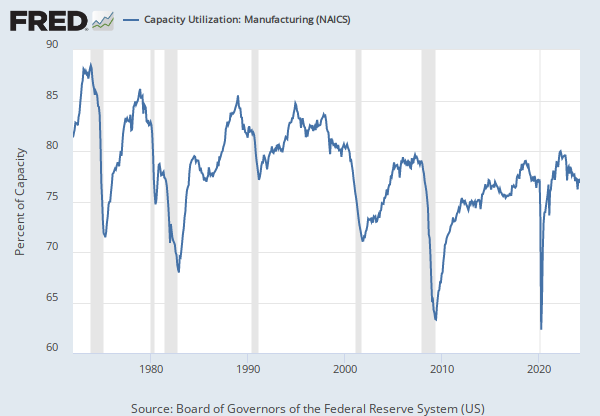
The Federal Reserve Board constructs estimates of capacity and capacity utilization for industries in manufacturing, mining, and electric and gas utilities. For a given industry, the capacity utilization rate is equal to an output index (seasonally adjusted) divided by a capacity index. The Federal Reserve Board's capacity indexes attempt to capture the concept of sustainable maximum output -- the greatest level of output a plant can maintain within the framework of a realistic work schedule, after factoring in normal downtime and assuming sufficient availability of inputs to operate the capital in place.
The Federal Reserve's monthly index of industrial production and the related capacity indexes and capacity utilization rates cover manufacturing, mining, and electric and gas utilities. The industrial sector, together with construction, accounts for the bulk of the variation in national output over the course of the business cycle. The industrial detail provided by these measures helps illuminate structural developments in the economy. The industrial production (IP) index measures the real output of all relevant establishments located in the United States, regardless of their ownership, but not those located in U.S. territories. For more information, see the explanatory notes issued by the Board of Governors. For recent updates, see the announcements issued by the Board of Governors.
Suggested Citation:
Board of Governors of the Federal Reserve System (US), Capacity Utilization: Total Index [TCU], retrieved from FRED, Federal Reserve Bank of St. Louis; https://fred.stlouisfed.org/series/TCU, .
Release Tables
Employment Situation
- Monthly, Seasonally Adjusted (population data is not adjusted for seasonal variation; not seasonally adjusted version used)
- Table A-10. Selected unemployment indicators, Seasonally adjusted: Monthly, Unemployment Rates
- Table A-15. Alternative measures of labor underutilization: Monthly, Seasonally Adjusted
G.17 Industrial Production and Capacity Utilization
- Industrial Production and Capacity Utilization: Summary: Monthly, Seasonally Adjusted
- Capacity Utilization: Monthly, Seasonally Adjusted
Gross Domestic Product
- Table 1.1.5. Gross Domestic Product: Quarterly
- Table 1.2.5. Gross Domestic Product by Major Type of Product: Quarterly
- Table 1.3.5. Gross Value Added by Sector: Quarterly
- Table 1.4.5. Relation of Gross Domestic Product, Gross Domestic Purchases, and Final Sales to Domestic Purchasers: Quarterly
- Table 1.5.5. Gross Domestic Product, Expanded Detail: Quarterly
- Table 1.7.5. Relation of Gross Domestic Product, Gross National Product, Net National Product, National Income, and Personal Income: Quarterly
- Table 1.17.5. Gross Domestic Product, Gross Domestic Income, and Other Major NIPA Aggregates: Quarterly
Related Data and Content
Data Suggestions Based On Your Search








Content Suggestions










Other Formats
Gross Domestic Product
Annual, Not Seasonally Adjusted Annual, Not Seasonally Adjusted Index 2017=100, Quarterly, Not Seasonally Adjusted Millions of Dollars, Quarterly, Not Seasonally Adjusted Percent Change from Preceding Period, Annual, Not Seasonally Adjusted Percent Change from Preceding Period, Quarterly, Seasonally Adjusted Annual RateUnemployment Rate
Monthly, Not Seasonally AdjustedCapacity Utilization: Total Index
Annual, Seasonally Adjusted Quarterly, Seasonally AdjustedRelated Categories
GDP/GNP
National Income & Product Accounts
National Accounts
Unemployment Rate
Current Population Survey (Household Survey)
Population, Employment, & Labor Markets
Industrial Production & Capacity Utilization
Production & Business Activity
Releases
More
Series from Gross Domestic Product
More
Series from Budget and Economic Outlook
More
Series from Employment Situation
More
Series from G.17 Industrial Production and Capacity Utilization
Tags
National Income and Product Accounts
Bureau of Economic Analysis
Gross Domestic Product
Quarterly
Seasonally Adjusted
Nation
Public Domain: Citation Requested
United States of America
Congressional Budget Office
Projection
Not Seasonally Adjusted
Labor Underutilization
Headline Figure
Civilian
16 Years +
Current Population Survey (Household Survey)
Labor
Unemployment
Rate
Bureau of Labor Statistics
Monthly
Non-Accelerating Inflation Rate of Unemployment
Long-Term
Capacity Utilization
Capacity
G.17 Industr. Production & Capacity Utilization
Board of Governors
Industry
Indexes