Federal Reserve Economic Data
Notes
Source: Federal Reserve Bank of St. Louis
Release: St. Louis Fed Economic News Index
Units:
Frequency:
Notes:
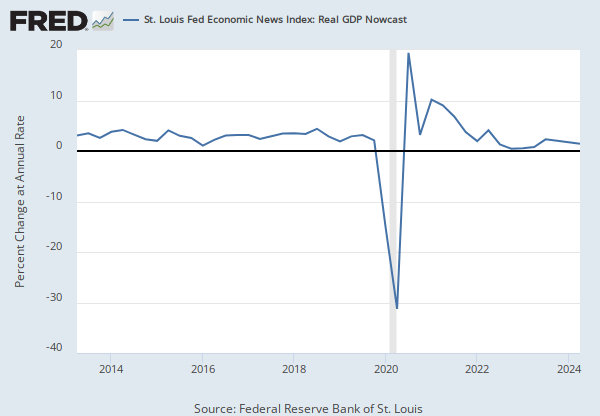
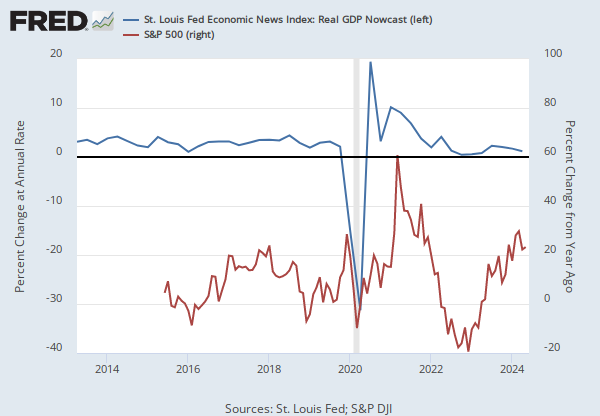
St. Louis Fed’s Economic News Index (ENI) uses economic content from key monthly economic data releases to forecast the growth of real GDP during that quarter. In general, the most-current observation is revised multiple times throughout the quarter. The final forecasted value (before the BEA’s release of the advance estimate of GDP) is the static, historical value for that quarter. For more information, see Grover, Sean P.; Kliesen, Kevin L.; and McCracken, Michael W.: A Macroeconomic News Index for Constructing Nowcasts of U.S. Real Gross Domestic Product Growth.
Suggested Citation:
Federal Reserve Bank of St. Louis, St. Louis Fed Economic News Index: Real GDP Nowcast [STLENI], retrieved from FRED, Federal Reserve Bank of St. Louis; https://fred.stlouisfed.org/series/STLENI, .
Source: U.S. Federal Open Market Committee
Source: Federal Reserve Bank of St. Louis
Release: Summary of Economic Projections
Units:
Frequency:
Notes:
Projections of real gross domestic product growth are fourth-quarter growth rates, that is, percentage changes from the fourth quarter of the prior year to the fourth quarter of the indicated year. Each participant's projections are based on his or her assessment of appropriate monetary policy. The range for each variable in a given year includes all participants' projections, from lowest to highest, for that variable in the given year; the central tendencies exclude the three highest and three lowest projections for each year. This series represents the midpoint of the central tendency forecast's high and low values established by the Federal Open Market Committee.
Digitized originals of this release can be found at https://fraser.stlouisfed.org/publication/?pid=677.
Suggested Citation:
U.S. Federal Open Market Committee and Federal Reserve Bank of St. Louis, FOMC Summary of Economic Projections for the Growth Rate of Real Gross Domestic Product, Central Tendency, Midpoint [GDPC1CTM], retrieved from FRED, Federal Reserve Bank of St. Louis; https://fred.stlouisfed.org/series/GDPC1CTM, .
Source: U.S. Congressional Budget Office
Release: Budget and Economic Outlook
Units:
Frequency:
Notes:
Real potential GDP is the CBO’s estimate of the output the economy would produce with a high rate of use of its capital and labor resources. The data is adjusted to remove the effects of inflation.
Suggested Citation:
U.S. Congressional Budget Office, Real Potential Gross Domestic Product [GDPPOT], retrieved from FRED, Federal Reserve Bank of St. Louis; https://fred.stlouisfed.org/series/GDPPOT, .
Source: Federal Reserve Bank of Atlanta
Release: GDPNow
Units:
Frequency:
Notes:
GDPNow is a nowcasting model for gross domestic product (GDP) growth that synthesizes the bridge equation approach relating GDP subcomponents to monthly source data with factor model and Bayesian vector autoregression approaches. The GDPNow model forecasts GDP growth by aggregating 13 subcomponents that make up GDP with the chain-weighting methodology used by the US Bureau of Economic Analysis.
The Federal Reserve Bank of Atlanta's GDPNow release complements the quarterly GDP release from the Bureau of Economic Analysis (BEA). The Atlanta Fed recalculates and updates their GDPNow forecasts (called "nowcasts") throughout the quarter as new data are released, up until the BEA releases its "advance estimate" of GDP for that quarter. The St. Louis Fed constructs a quarterly time series for this dataset, in which both historical and current observations values are combined. In general, the most-current observation is revised multiple times throughout the quarter. The final forecasted value (before the BEA's release of the advance estimate of GDP) is the static, historical value for that quarter.
For futher information visit the Federal Reserve Bank of Atlanta.
Suggested Citation:
Federal Reserve Bank of Atlanta, GDPNow [GDPNOW], retrieved from FRED, Federal Reserve Bank of St. Louis; https://fred.stlouisfed.org/series/GDPNOW, .
Release Tables
Summary of Economic Projections
Related Data and Content
Data Suggestions Based On Your Search






Content Suggestions


Related Categories
Releases
More
Series from St. Louis Fed Economic News Index
More
Series from Summary of Economic Projections
More
Series from Budget and Economic Outlook
More
Series from GDPNow
Tags
Nowcast
Projection
St. Louis Fed
Real
Gross Domestic Product
Rate
Quarterly
Indexes
Seasonally Adjusted
Copyrighted: Citation Required
Nation
United States of America
Federal Open Market Committee
Federal Open Markets Committee
Board of Governors
Annual
Public Domain: Citation Requested
Not Seasonally Adjusted
Congressional Budget Office
Atlanta Fed
Headline Figure