Notes
Source: Federal Reserve Bank of St. Louis
Release: Money Velocity
Units:
Frequency:
Notes:
This series has been discontinued and will no longer be updated. The institutional money market funds component (IMFSL) used to calculate MZM has been discontinued by the Board of Governors and is no longer available in the H.6 statistical release, Money Stock Measures. For further information about the changes to the H.6 statistical release, please see the announcements provided by the source.
Calculated as the ratio of quarterly nominal GDP (GDP) to the quarterly average of MZM money stock (MZMSL).
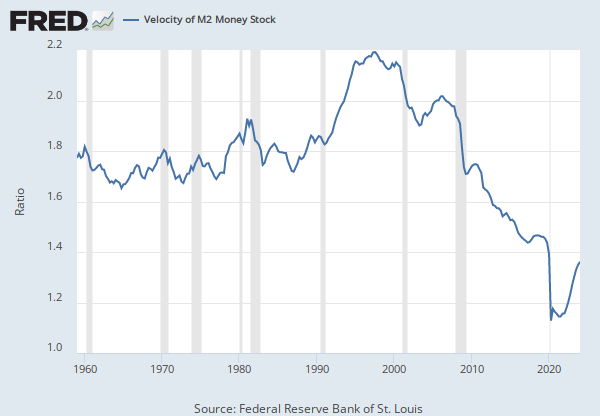
The velocity of money is the frequency at which one unit of currency is used to purchase domestically- produced goods and services within a given time period. In other words, it is the number of times one dollar is spent to buy goods and services per unit of time. If the velocity of money is increasing, then more transactions are occurring between individuals in an economy.
The frequency of currency exchange can be used to determine the velocity of a given component of the money supply, providing some insight into whether consumers and businesses are saving or spending their money. There are several components of the money supply,: M1, M2, and MZM (M3 is no longer tracked by the Federal Reserve); these components are arranged on a spectrum of narrowest to broadest. Consider M1, the narrowest component. M1 is the money supply of currency in circulation (notes and coins, traveler’s checks [non-bank issuers], demand deposits, and checkable deposits). A decreasing velocity of M1 might indicate fewer short- term consumption transactions are taking place. We can think of shorter- term transactions as consumption we might make on an everyday basis.
The broader M2 component includes M1 in addition to saving deposits, certificates of deposit (less than $100,000), and money market deposits for individuals. Comparing the velocities of M1 and M2 provides some insight into how quickly the economy is spending and how quickly it is saving.
MZM (money with zero maturity) is the broadest component and consists of the supply of financial assets redeemable at par on demand: notes and coins in circulation, traveler’s checks (non-bank issuers), demand deposits, other checkable deposits, savings deposits, and all money market funds. The velocity of MZM helps determine how often financial assets are switching hands within the economy.
Suggested Citation:
Federal Reserve Bank of St. Louis, Velocity of MZM Money Stock (DISCONTINUED) [MZMV], retrieved from FRED, Federal Reserve Bank of St. Louis; https://fred.stlouisfed.org/series/MZMV, .
Source: U.S. Bureau of Labor Statistics
Release: Employment Situation
Units:
Frequency:
Notes:
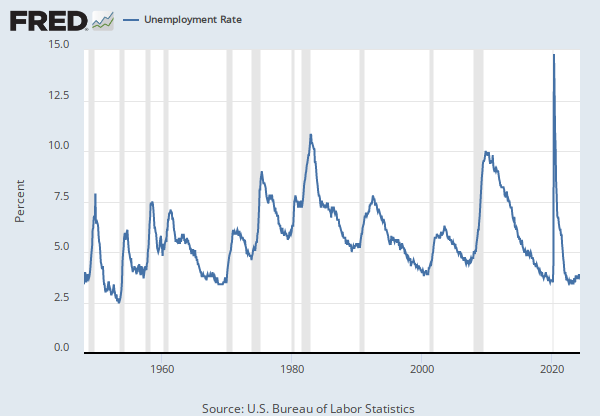
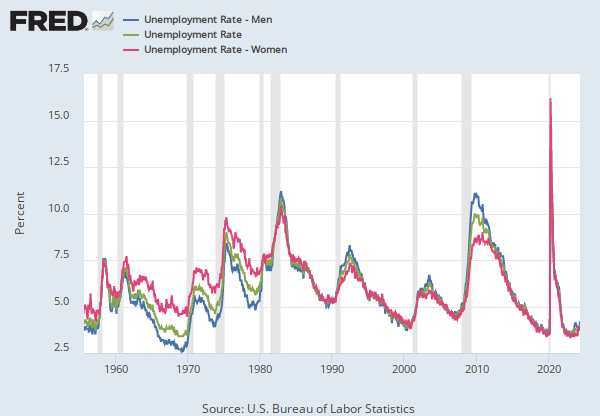
The unemployment rate represents the number of unemployed as a percentage of the labor force. Labor force data are restricted to people 16 years of age and older, who currently reside in 1 of the 50 states or the District of Columbia, who do not reside in institutions (e.g., penal and mental facilities, homes for the aged), and who are not on active duty in the Armed Forces.
This rate is also defined as the U-3 measure of labor underutilization.
The series comes from the 'Current Population Survey (Household Survey)'
The source code is: LNS14000000
Suggested Citation:
U.S. Bureau of Labor Statistics, Unemployment Rate [UNRATE], retrieved from FRED, Federal Reserve Bank of St. Louis; https://fred.stlouisfed.org/series/UNRATE, .
Source: U.S. Bureau of Economic Analysis
Release: Gross Domestic Product
Units:
Frequency:
Notes:
BEA Account Code: A191RX
Real gross domestic product is the inflation adjusted value of the goods and services produced by labor and property located in the United States.For more information see the Guide to the National Income and Product Accounts of the United States (NIPA). For more information, please visit the Bureau of Economic Analysis.
Suggested Citation:
U.S. Bureau of Economic Analysis, Real Gross Domestic Product [GDPC1], retrieved from FRED, Federal Reserve Bank of St. Louis; https://fred.stlouisfed.org/series/GDPC1, .
Source: Board of Governors of the Federal Reserve System (US)
Release: H.10 Foreign Exchange Rates
Units:
Frequency:
Notes:
Noon buying rates in New York City for cable transfers payable in foreign currencies.
For questions on the data, please contact the data source. For questions on FRED functionality, please contact us here.
Suggested Citation:
Board of Governors of the Federal Reserve System (US), South Korean Won to U.S. Dollar Spot Exchange Rate [DEXKOUS], retrieved from FRED, Federal Reserve Bank of St. Louis; https://fred.stlouisfed.org/series/DEXKOUS, .
Release Tables
Employment Situation
- Monthly, Seasonally Adjusted (population data is not adjusted for seasonal variation; not seasonally adjusted version used)
- Table A-10. Selected unemployment indicators, Seasonally adjusted: Monthly, Unemployment Rates
- Table A-15. Alternative measures of labor underutilization: Monthly, Seasonally Adjusted
Gross Domestic Product
- Table 1.1.6. Real Gross Domestic Product, Chained Dollars: Quarterly
- Table 1.2.6. Real Gross Domestic Product by Major Type of Product, Chained Dollars: Quarterly
- Table 1.3.6. Real Gross Value Added by Sector, Chained Dollars: Quarterly
- Table 1.4.6. Relation of Real Gross Domestic Product, Real Gross Domestic Purchases, and Real Final Sales to Domestic Purchasers, Chained Dollars: Quarterly
- Table 1.5.6. Real Gross Domestic Product, Expanded Detail, Chained Dollars: Quarterly
- Table 1.7.6. Relation of Real Gross Domestic Product, Real Gross National Product, and Real Net National Product, Chained Dollars: Quarterly
- Table 1.8.6. Command-Basis Real Gross Domestic Product and Gross National Product, Chained Dollars: Quarterly
- Table 1.17.6. Real Gross Domestic Product, Real Gross Domestic Income, and Other Major NIPA Aggregates, Chained Dollars: Quarterly
H.10 Foreign Exchange Rates
Related Data and Content
Data Suggestions Based On Your Search












Content Suggestions











Other Formats
Unemployment Rate
Monthly, Not Seasonally AdjustedReal Gross Domestic Product
Annual, Not Seasonally Adjusted Quarterly, Not Seasonally Adjusted Index 2017=100, Quarterly, Not Seasonally Adjusted Percent Change from Preceding Period, Annual, Not Seasonally Adjusted Percent Change from Preceding Period, Quarterly, Seasonally Adjusted Annual Rate Percent Change from Quarter One Year Ago, Quarterly, Not Seasonally Adjusted Percent Change from Quarter One Year Ago, Quarterly, Seasonally AdjustedSouth Korean Won to U.S. Dollar Spot Exchange Rate
Annual, Not Seasonally Adjusted Monthly, Not Seasonally AdjustedRelated Categories
Money Velocity
Monetary Data
Money, Banking, & Finance
Unemployment Rate
Current Population Survey (Household Survey)
Population, Employment, & Labor Markets
GDP/GNP
National Income & Product Accounts
National Accounts
South Korea
By Country
Daily Rates
Exchange Rates
Releases
More
Series from Money Velocity
More
Series from Employment Situation
More
Series from Gross Domestic Product
More
Series from H.10 Foreign Exchange Rates
Tags
MZM Money Stock
Velocity
Monetary Aggregates
Discontinued
St. Louis Fed
Quarterly
Seasonally Adjusted
Copyrighted: Citation Required
Nation
United States of America
Labor Underutilization
Headline Figure
Civilian
16 Years +
Current Population Survey (Household Survey)
Labor
Unemployment
Rate
Bureau of Labor Statistics
Monthly
Public Domain: Citation Requested
National Income and Product Accounts
Real
Bureau of Economic Analysis
Gross Domestic Product
H.10 Foreign Exchange Rates
Korea
Exchange Rate
Currency
Daily
Board of Governors
Not Seasonally Adjusted