Notes
Source: U.S. Bureau of Economic Analysis
Release: Gross Domestic Product
Units:
Frequency:
Notes:
BEA Account Code: A191RX
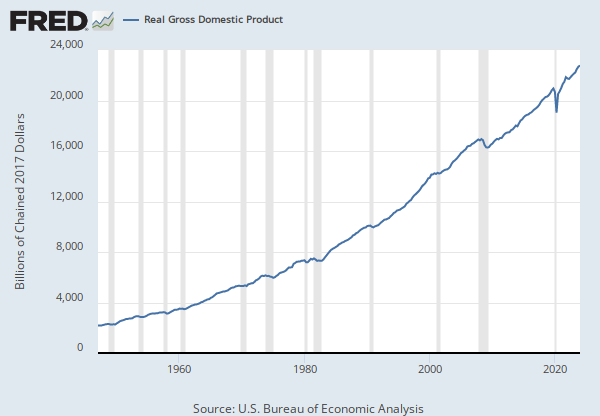
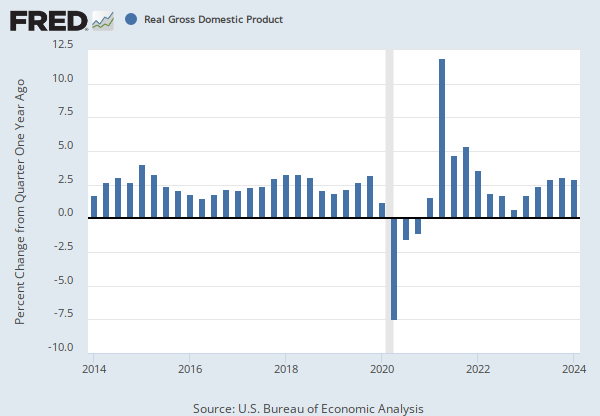
Real gross domestic product is the inflation adjusted value of the goods and services produced by labor and property located in the United States.For more information see the Guide to the National Income and Product Accounts of the United States (NIPA). For more information, please visit the Bureau of Economic Analysis.
Suggested Citation:
U.S. Bureau of Economic Analysis, Real Gross Domestic Product [GDPC1], retrieved from FRED, Federal Reserve Bank of St. Louis; https://fred.stlouisfed.org/series/GDPC1, .
Source: Board of Governors of the Federal Reserve System (US)
Release: G.17 Industrial Production and Capacity Utilization
Units:
Frequency:
Notes:
The Federal Reserve's monthly index of industrial production and the related capacity indexes and capacity utilization rates cover manufacturing, mining, and electric and gas utilities. The industrial sector, together with construction, accounts for the bulk of the variation in national output over the course of the business cycle. The industrial detail provided by these measures helps illuminate structural developments in the economy. The industrial production (IP) index measures the real output of all relevant establishments located in the United States, regardless of their ownership, but not those located in U.S. territories. For more information, see the explanatory notes issued by the Board of Governors. For recent updates, see the announcements issued by the Board of Governors.
Suggested Citation:
Board of Governors of the Federal Reserve System (US), Industrial Production: Total Index [INDPRO], retrieved from FRED, Federal Reserve Bank of St. Louis; https://fred.stlouisfed.org/series/INDPRO, .
Source: U.S. Bureau of Economic Analysis
Release: Gross Domestic Product
Units:
Frequency:
Notes:
Gross domestic income is an alternative way of measuring the nation's economy, by counting the incomes earned and costs incurred in production. In theory, GDI should equal gross domestic product, but the different source data yield different results. The difference between the two measures is known as the "statistical discrepancy." BEA considers GDP more reliable because it's based on timelier, more expansive data.
BEA Account Code: A261RX
For more information about this series, please see http://www.bea.gov/national/.
Suggested Citation:
U.S. Bureau of Economic Analysis, Real gross domestic income [A261RX1Q020SBEA], retrieved from FRED, Federal Reserve Bank of St. Louis; https://fred.stlouisfed.org/series/A261RX1Q020SBEA, .
Source: Federal Reserve Bank of St. Louis
Release: Supplemental Estimates, Underlying Detail Tables, Spliced Series
Units:
Frequency:
Notes:
Real Manufacturing and Trade Industries Sales (CMRMTSPL) was first constructed by the Federal Reserve Bank of St. Louis in June 2013. It is calculated using Real Manufacturing and Trade Industries Sales (HMRMT) (https://fred.stlouisfed.org/series/HMRMT) and Real Manufacturing and Trade Industries (CMRMT) (https://fred.stlouisfed.org/series/CMRMT).
Before January 1997
lag1(HMRMT) = one observation earlier than current time period observation
HMRMT_PC = the growth rate of HMRMT
lead1(CMRMTSPL) = one observation later than current time period observation
HMRMT_PC = [HMRMT/lag1(HMRMT) –1]
CMRMTSPL= lead1(CMRMTSPL)/(1+HMRMT_PC)
After December 1996
CMRMTSPL= CMRMT
Suggested Citation:
Federal Reserve Bank of St. Louis, Real Manufacturing and Trade Industries Sales [CMRMTSPL], retrieved from FRED, Federal Reserve Bank of St. Louis; https://fred.stlouisfed.org/series/CMRMTSPL, .
Source: U.S. Bureau of Labor Statistics
Release: Employment Situation
Units:
Frequency:
Notes:
All Employees: Total Nonfarm, commonly known as Total Nonfarm Payroll, is a measure of the number of U.S. workers in the economy that excludes proprietors, private household employees, unpaid volunteers, farm employees, and the unincorporated self-employed. This measure accounts for approximately 80 percent of the workers who contribute to Gross Domestic Product (GDP).
This measure provides useful insights into the current economic situation because it can represent the number of jobs added or lost in an economy. Increases in employment might indicate that businesses are hiring which might also suggest that businesses are growing. Additionally, those who are newly employed have increased their personal incomes, which means (all else constant) their disposable incomes have also increased, thus fostering further economic expansion.
Generally, the U.S. labor force and levels of employment and unemployment are subject to fluctuations due to seasonal changes in weather, major holidays, and the opening and closing of schools. The Bureau of Labor Statistics (BLS) adjusts the data to offset the seasonal effects to show non-seasonal changes: for example, women's participation in the labor force; or a general decline in the number of employees, a possible indication of a downturn in the economy. To closely examine seasonal and non-seasonal changes, the BLS releases two monthly statistical measures: the seasonally adjusted All Employees: Total Nonfarm (PAYEMS) and All Employees: Total Nonfarm (PAYNSA), which is not seasonally adjusted.
The series comes from the 'Current Employment Statistics (Establishment Survey).'
The source code is: CES0000000001
Suggested Citation:
U.S. Bureau of Labor Statistics, All Employees, Total Nonfarm [PAYEMS], retrieved from FRED, Federal Reserve Bank of St. Louis; https://fred.stlouisfed.org/series/PAYEMS, .
Source: U.S. Bureau of Labor Statistics
Release: Employment Situation
Units:
Frequency:
Notes:
The civilian noninstitutional population is defined as: persons 16 years of age and older residing in the 50 states and the District of Columbia, who are not inmates of institutions (e.g., penal and mental facilities, homes for the aged), and who are not on active duty in the Armed Forces.
The series comes from the 'Current Population Survey (Household Survey)'
The source code is: LNS12000000
Suggested Citation:
U.S. Bureau of Labor Statistics, Employment Level [CE16OV], retrieved from FRED, Federal Reserve Bank of St. Louis; https://fred.stlouisfed.org/series/CE16OV, .
Source: U.S. Bureau of Economic Analysis
Release: Personal Income and Outlays
Units:
Frequency:
Notes:
BEA Account Code: W875RX
A Guide to the National Income and Product Accounts of the United States (NIPA) - (http://www.bea.gov/national/pdf/nipaguid.pdf)
Suggested Citation:
U.S. Bureau of Economic Analysis, Real personal income excluding current transfer receipts [W875RX1], retrieved from FRED, Federal Reserve Bank of St. Louis; https://fred.stlouisfed.org/series/W875RX1, .
Source: U.S. Bureau of Economic Analysis
Release: Personal Income and Outlays
Units:
Frequency:
Notes:
BEA Account Code: DPCERX
A Guide to the National Income and Product Accounts of the United States (NIPA)
Suggested Citation:
U.S. Bureau of Economic Analysis, Real Personal Consumption Expenditures [PCEC96], retrieved from FRED, Federal Reserve Bank of St. Louis; https://fred.stlouisfed.org/series/PCEC96, .
Release Tables
Employment Situation
Employment Situation
- Monthly, Seasonally Adjusted (population data is not adjusted for seasonal variation; not seasonally adjusted version used)
- Table A-9. Selected employment indicators: Monthly, Seasonally Adjusted
- Table B-1. Employees on nonfarm payrolls by industry sector and selected industry detail, Seasonally adjusted
G.17 Industrial Production and Capacity Utilization
- Industrial Production and Capacity Utilization: Summary: Monthly, Seasonally Adjusted
- Industrial Production Indexes: Market and Industry Group: Monthly, Seasonally Adjusted
Gross Domestic Product
- Table 1.1.6. Real Gross Domestic Product, Chained Dollars: Quarterly
- Table 1.2.6. Real Gross Domestic Product by Major Type of Product, Chained Dollars: Quarterly
- Table 1.3.6. Real Gross Value Added by Sector, Chained Dollars: Quarterly
- Table 1.4.6. Relation of Real Gross Domestic Product, Real Gross Domestic Purchases, and Real Final Sales to Domestic Purchasers, Chained Dollars: Quarterly
- Table 1.5.6. Real Gross Domestic Product, Expanded Detail, Chained Dollars: Quarterly
- Table 1.7.6. Relation of Real Gross Domestic Product, Real Gross National Product, and Real Net National Product, Chained Dollars: Quarterly
- Table 1.8.6. Command-Basis Real Gross Domestic Product and Gross National Product, Chained Dollars: Quarterly
- Table 1.17.6. Real Gross Domestic Product, Real Gross Domestic Income, and Other Major NIPA Aggregates, Chained Dollars: Quarterly
Personal Income and Outlays
Related Data and Content
Data Suggestions Based On Your Search







Content Suggestions












Other Formats
Real Gross Domestic Product
Annual, Not Seasonally Adjusted Quarterly, Not Seasonally Adjusted Index 2017=100, Quarterly, Not Seasonally Adjusted Percent Change from Preceding Period, Annual, Not Seasonally Adjusted Percent Change from Preceding Period, Quarterly, Seasonally Adjusted Annual Rate Percent Change from Quarter One Year Ago, Quarterly, Not Seasonally Adjusted Percent Change from Quarter One Year Ago, Quarterly, Seasonally AdjustedIndustrial Production: Total Index
Annual, Not Seasonally Adjusted Monthly, Not Seasonally Adjusted Quarterly, Not Seasonally Adjusted Quarterly, Seasonally AdjustedReal gross domestic income
Annual, Not Seasonally AdjustedReal Manufacturing and Trade Industries Sales
Millions of Chained 1996 Dollars, Monthly, Seasonally Adjusted Millions of Chained 1996 Dollars, Quarterly, Seasonally Adjusted Monthly, Seasonally Adjusted Quarterly, Seasonally Adjusted Quarterly, Seasonally AdjustedAll Employees, Total Nonfarm
Monthly, Not Seasonally AdjustedEmployment Level
Monthly, Not Seasonally AdjustedReal personal income excluding current transfer receipts
Annual, Not Seasonally Adjusted Quarterly, Seasonally Adjusted Annual RateReal Personal Consumption Expenditures
Annual, Not Seasonally Adjusted Quarterly, Not Seasonally Adjusted Quarterly, Seasonally Adjusted Annual Rate Index 2017=100, Quarterly, Not Seasonally Adjusted Percent Change from Preceding Period, Annual, Not Seasonally Adjusted Percent Change from Preceding Period, Monthly, Seasonally Adjusted Percent Change from Preceding Period, Quarterly, Seasonally Adjusted Annual Rate Percent Change from Quarter One Year Ago, Quarterly, Not Seasonally Adjusted Percent Change from Quarter One Year Ago, Quarterly, Seasonally AdjustedRelated Categories
GDP/GNP
National Income & Product Accounts
National Accounts
Industrial Production & Capacity Utilization
Production & Business Activity
Retail Trade
Total Nonfarm
Current Employment Statistics (Establishment Survey)
Population, Employment, & Labor Markets
Employment
Current Population Survey (Household Survey)
Personal Income & Outlays
Releases
More
Series from Gross Domestic Product
More
Series from G.17 Industrial Production and Capacity Utilization
More
Series from Supplemental Estimates, Underlying Detail Tables, Spliced Series
More
Series from Employment Situation
More
Series from Personal Income and Outlays
Tags
Headline Figure
National Income and Product Accounts
Real
Bureau of Economic Analysis
Gross Domestic Product
Quarterly
Seasonally Adjusted
Nation
Public Domain: Citation Requested
United States of America
G.17 Industr. Production & Capacity Utilization
Industrial Production
Production
Board of Governors
Industry
Indexes
Monthly
Gross Domestic Income
Income
Trade
Sales
St. Louis Fed
Manufacturing
Copyrighted: Citation Required
Payrolls
Current Employment Statistics Survey (Establishment Survey)
Nonfarm
Employment
Bureau of Labor Statistics
Civilian
16 Years +
Current Population Survey (Household Survey)
Transfers
Receipts
Personal Income
Personal
Personal Consumption Expenditures
Consumption Expenditures
Consumption