Notes
Source: U.S. Bureau of Economic Analysis
Release: Gross Domestic Product
Units:
Frequency:
Notes:
BEA Account Code: DNPERC
For more information about this series, please see http://www.bea.gov/national/.
Suggested Citation:
U.S. Bureau of Economic Analysis, Personal consumption expenditures: Services: Gross output of nonprofit institutions [DNPERC1A027NBEA], retrieved from FRED, Federal Reserve Bank of St. Louis; https://fred.stlouisfed.org/series/DNPERC1A027NBEA, .
Source: U.S. Bureau of Economic Analysis
Release: Gross Domestic Product
Units:
Frequency:
Notes:
BEA Account Code: A191RC
Suggested Citation:
U.S. Bureau of Economic Analysis, Gross Domestic Product [GDPA], retrieved from FRED, Federal Reserve Bank of St. Louis; https://fred.stlouisfed.org/series/GDPA, .
Source: Hamilton, James
Release: GDP-Based Recession Indicator Index
Units:
Frequency:
Notes:
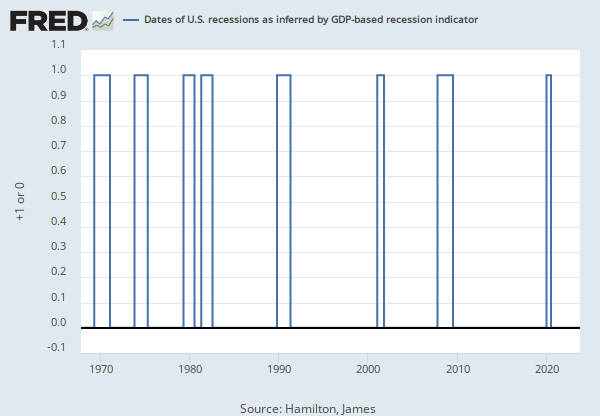
This index measures the probability that the U.S. economy was in a recession during the indicated quarter. It is based on a mathematical description of the way that recessions differ from expansions. The index corresponds to the probability (measured in percent) that the underlying true economic regime is one of recession based on the available data. Whereas the NBER business cycle dates are based on a subjective assessment of a variety of indicators that may not be released until several years after the event, this index is entirely mechanical, is based solely on currently available GDP data and is reported every quarter. Due to the possibility of data revisions and the challenges in accurately identifying the business cycle phase, the index is calculated for the quarter just preceding the most recently available GDP numbers. Once the index is calculated for that quarter, it is never subsequently revised. The value at every date was inferred using only data that were available one quarter after that date and as those data were reported at the time.
If the value of the index rises above 67% that is a historically reliable indicator that the economy has entered a recession. Once this threshold has been passed, if it falls below 33% that is a reliable indicator that the recession is over.
For more information about this series visit http://econbrowser.com/recession-index.
Suggested Citation:
Hamilton, James, GDP-Based Recession Indicator Index [JHGDPBRINDX], retrieved from FRED, Federal Reserve Bank of St. Louis; https://fred.stlouisfed.org/series/JHGDPBRINDX, .
Release Tables
Gross Domestic Product
- Table 1.1.5. Gross Domestic Product: Annual
- Table 1.2.5. Gross Domestic Product by Major Type of Product: Annual
- Table 1.3.5. Gross Value Added by Sector: Annual
- Table 1.4.5. Relation of Gross Domestic Product, Gross Domestic Purchases, and Final Sales to Domestic Purchasers: Annual
- Table 1.5.5. Gross Domestic Product, Expanded Detail: Annual
- Table 1.7.5. Relation of Gross Domestic Product, Gross National Product, Net National Product, National Income, and Personal Income: Annual
- Table 1.17.5. Gross Domestic Product, Gross Domestic Income, and Other Major NIPA Aggregates: Annual
- Table 2.3.5. Personal Consumption Expenditures by Major Type of Product: Annual
- Table 2.4.5. Personal Consumption Expenditures by Type of Product: Annual
- Table 2.5.5. Personal Consumption Expenditures by Function: Annual
Related Data and Content
Data Suggestions Based On Your Search




Content Suggestions




Other Formats
Personal consumption expenditures: Services: Gross output of nonprofit institutions
Quarterly, Seasonally Adjusted Annual RateGross Domestic Product
Annual, Not Seasonally Adjusted Quarterly, Seasonally Adjusted Annual Rate Index 2017=100, Quarterly, Not Seasonally Adjusted Millions of Dollars, Quarterly, Not Seasonally Adjusted Percent Change from Preceding Period, Annual, Not Seasonally Adjusted Percent Change from Preceding Period, Quarterly, Seasonally Adjusted Annual RateRelated Categories
Personal Consumption Expenditures
Personal Income & Outlays
National Income & Product Accounts
National Accounts
GDP/GNP
Recession Probabilities
Academic Data
Business Cycle Expansions & Contractions
Production & Business Activity
Releases
Tags
Nonprofit Organizations
Output
Personal Consumption Expenditures
Gross
Consumption Expenditures
Consumption
Personal
National Income and Product Accounts
Services
Bureau of Economic Analysis
Gross Domestic Product
Annual
Nation
Public Domain: Citation Requested
United States of America
Not Seasonally Adjusted
Hamilton, James
Recession Indicators
Percent
Quarterly
Indexes