Federal Reserve Economic Data
Notes
Source: U.S. Bureau of Labor Statistics
Release: Employment Situation
Units:
Frequency:
Notes:
Production and related employees include working supervisors and all nonsupervisory employees (including group leaders and trainees) engaged in fabricating, processing, assembling, inspecting, receiving, storing, handling, packing, warehousing, shipping, trucking, hauling, maintenance, repair, janitorial, guard services, product development, auxiliary production for plant's own use (for example, power plant), recordkeeping, and other services closely associated with the above production operations.
#Nonsupervisory employees include those individuals in private, service-providing industries who are not above the working-supervisor level. This group includes individuals such as office and clerical workers, repairers, salespersons, operators, drivers, physicians, lawyers, accountants, nurses, social workers, research aides, teachers, drafters, photographers, beauticians, musicians, restaurant workers, custodial workers, attendants, line installers and repairers, laborers, janitors, guards, and other employees at similar occupational levels whose services are closely associated with those of the employees listed.
The series comes from the 'Current Employment Statistics (Establishment Survey).'
The source code is: CES0500000008
Suggested Citation:
U.S. Bureau of Labor Statistics, Average Hourly Earnings of Production and Nonsupervisory Employees, Total Private [AHETPI], retrieved from FRED, Federal Reserve Bank of St. Louis; https://fred.stlouisfed.org/series/AHETPI, .
Source: Federal Reserve Bank of St. Louis
Release: Interest Rate Spreads
Units:
Frequency:
Notes:
Starting with the update on June 21, 2019, the Treasury bond data used in calculating interest rate spreads is obtained directly from the U.S. Treasury Department.
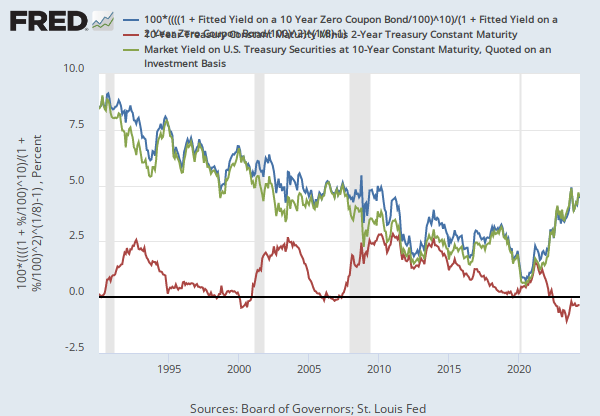
Series is calculated as the spread between 10-Year Treasury Constant Maturity (BC_10YEAR) and 2-Year Treasury Constant Maturity (BC_2YEAR). Both underlying series are published at the U.S. Treasury Department.
Suggested Citation:
Federal Reserve Bank of St. Louis, 10-Year Treasury Constant Maturity Minus 2-Year Treasury Constant Maturity [T10Y2Y], retrieved from FRED, Federal Reserve Bank of St. Louis; https://fred.stlouisfed.org/series/T10Y2Y, .
Source: U.S. Bureau of Economic Analysis
Release: Personal Income and Outlays
Units:
Frequency:
Notes:
BEA Account Code: A034RC
A Guide to the National Income and Product Accounts of the United States (NIPA) - (http://www.bea.gov/national/pdf/nipaguid.pdf)
Suggested Citation:
U.S. Bureau of Economic Analysis, Compensation of Employees, Received: Wage and Salary Disbursements [A576RC1], retrieved from FRED, Federal Reserve Bank of St. Louis; https://fred.stlouisfed.org/series/A576RC1, .
Release Tables
Employment Situation
Personal Income and Outlays
Related Data and Content
Data Suggestions Based On Your Search









Content Suggestions







Other Formats
Average Hourly Earnings of Production and Nonsupervisory Employees, Total Private
Monthly, Not Seasonally Adjusted10-Year Treasury Constant Maturity Minus 2-Year Treasury Constant Maturity
Monthly, Not Seasonally AdjustedRelated Categories
Total Private
Current Employment Statistics (Establishment Survey)
Population, Employment, & Labor Markets
Interest Rate Spreads
Interest Rates
Money, Banking, & Finance
Personal Income & Outlays
National Income & Product Accounts
National Accounts
Releases
More
Series from Employment Situation
More
Series from Interest Rate Spreads
More
Series from Personal Income and Outlays
Tags
Nonsupervisory
Headline Figure
Current Employment Statistics Survey (Establishment Survey)
Average
Hours
Earnings
Wages
Production
Private
Employment
Seasonally Adjusted
Bureau of Labor Statistics
Monthly
Nation
Public Domain: Citation Requested
United States of America
2-Year
Yield Curve
Spread
10-Year
Maturity
Treasury
Interest Rate
Interest
Daily
St. Louis Fed
Rate
Copyrighted: Citation Required
Not Seasonally Adjusted
Disbursements
Salaries
National Income and Product Accounts
Bureau of Economic Analysis