Notes
Source: Chauvet, Marcelle
Source: Piger, Jeremy Max
Release: U.S. Recession Probabilities
Units:
Frequency:
Notes:
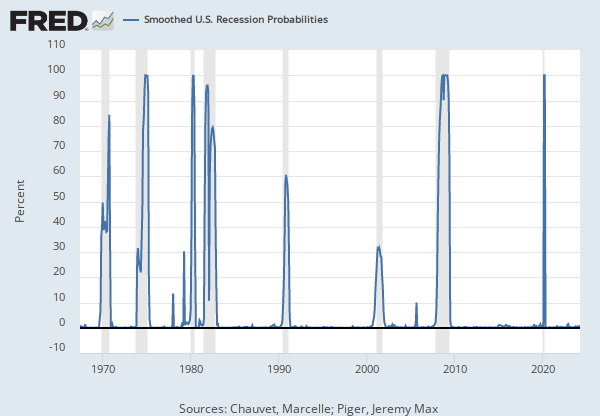
Smoothed recession probabilities for the United States are obtained from a dynamic-factor markov-switching model applied to four monthly coincident variables: non-farm payroll employment, the index of industrial production, real personal income excluding transfer payments, and real manufacturing and trade sales. This model was originally developed in Chauvet, M., "An Economic Characterization of Business Cycle Dynamics with Factor Structure and Regime Switching," International Economic Review, 1998, 39, 969-996.
For additional details, including an analysis of the performance of this model for dating business cycles in real time, see:
Chauvet, M. and J. Piger, "A Comparison of the Real-Time Performance of Business Cycle Dating Methods," Journal of Business and Economic Statistics, 2008, 26, 42-49.
For additional details as to why this data revises, see FAQ 3.
Suggested Citation:
Chauvet, Marcelle and Piger, Jeremy Max, Smoothed U.S. Recession Probabilities [RECPROUSM156N], retrieved from FRED, Federal Reserve Bank of St. Louis; https://fred.stlouisfed.org/series/RECPROUSM156N, .
Source: Federal Reserve Bank of Chicago
Release: Chicago Fed National Activity Index
Units:
Frequency:
Notes:
A zero value for the index indicates that the national economy is expanding at its historical trend rate of growth; negative values indicate below-average growth; and positive values indicate above-average growth.
For further information, please visit the Federal Reserve Bank of Chicago's web site:
http://www.chicagofed.org/webpages/research/data/cfnai/current_data.cfm
Suggested Citation:
Federal Reserve Bank of Chicago, Chicago Fed National Activity Index: Three Month Moving Average [CFNAIMA3], retrieved from FRED, Federal Reserve Bank of St. Louis; https://fred.stlouisfed.org/series/CFNAIMA3, .
Source: Federal Reserve Bank of Philadelphia
Release: State Leading Indexes
Units:
Frequency:
Notes:
The leading index for each state predicts the six-month growth rate of the state's coincident index. In addition to the coincident index, the models include other variables that lead the economy: state-level housing permits (1 to 4 units), state initial unemployment insurance claims, delivery times from the Institute for Supply Management (ISM) manufacturing survey, and the interest rate spread between the 10-year Treasury bond and the 3-month Treasury bill.
Suggested Citation:
Federal Reserve Bank of Philadelphia, Leading Index for the United States [USSLIND], retrieved from FRED, Federal Reserve Bank of St. Louis; https://fred.stlouisfed.org/series/USSLIND, .
Source: Federal Reserve Bank of St. Louis
Release: Interest Rate Spreads
Units:
Frequency:
Notes:
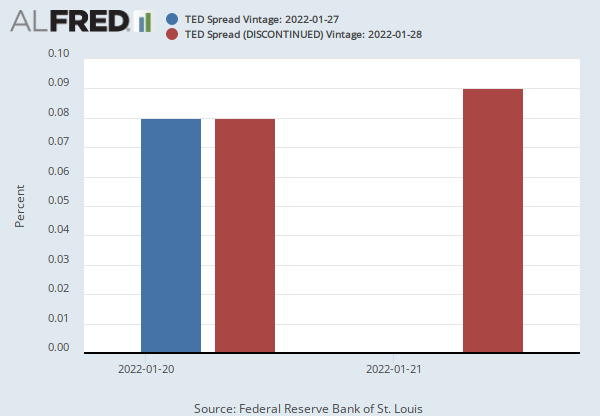
Series is calculated as the spread between 3-Month LIBOR based on US dollars (USD3MTD156N) and 3-Month Treasury Bill (DTB3).
Starting with the update on June 21, 2019, the Treasury bond data used in calculating interest rate spreads is obtained directly from the U.S. Treasury Department.
The 3-Month LIBOR based on US Dollars has been removed from FRED as of January 31, 2022, so this calculated series has been discontinued and will no longer be updated. Users interested in calculating a similar credit risk can use the Secured Overnight Financing Rate (SOFR), which has been identified as the rate that represents best practice for use in certain new U.S. Dollar derivatives and other financial contracts. For more details, see the article Transition from LIBOR from the Alternative Reference Rates Committee (AARC).
Suggested Citation:
Federal Reserve Bank of St. Louis, TED Spread (DISCONTINUED) [TEDRATE], retrieved from FRED, Federal Reserve Bank of St. Louis; https://fred.stlouisfed.org/series/TEDRATE, .
Release Tables
State Leading Indexes
Related Data and Content
Data Suggestions Based On Your Search








Content Suggestions




Related Categories
Recession Probabilities
Academic Data
Financial Activity Measures
Financial Indicators
Money, Banking, & Finance
Business Cycle Expansions & Contractions
Production & Business Activity
Interest Rate Spreads
Interest Rates
Releases
More
Series from U.S. Recession Probabilities
More
Series from Chicago Fed National Activity Index
More
Series from State Leading Indexes
More
Series from Interest Rate Spreads
Tags
Chauvet, Marcelle
Marcelle M. Chauvet and Jeremy Piger
Recession Indicators
Academic Data
Monthly
Nation
Public Domain: Citation Requested
United States of America
Not Seasonally Adjusted
Chicago Fed National Activity Index
Moving Average
Chicago Fed
3-Month
Average
Indexes
Copyrighted: Citation Required
Leading Index
Philadelphia Fed
Headline Figure
Seasonally Adjusted
London Interbank Offered Rate
Yield Curve
Spread
Bills
Treasury
Interest Rate
Interest
Daily
Discontinued
St. Louis Fed
Rate